On Latir Creek in New Mexico we fished 8.5 foot 3 weight rods. On the Cimarron, I stuck with the 3 weight and Kris switched to a 4 weight. On both streams we fished 7.5 foot leaders with a 5x tippet. I wet waded the Latir, Kris wore waders. We both wore waders and boots on the Cimarron.
Wading staffs are always helpful.
In Colorado, we used 9 foot 5 weights, which have just a bit more punch. There weren’t any overhanging trees, and the stream and the fish were larger. Leaders were 9 foot 5x.
I dug out a 30-year-old vest to take to New Mexico because I thought I’d be carrying lots of stuff. I’m not sure why I ever quit using it in the first place. It holds lots of stuff.
Where we stayed
The first day we drove from Houston to Tucumcari, which has a great selection of Route 66 motels from the 50s and 60s. We stayed at the Roadrunner Lodge because they advertised as pet-friendly, and they were. It’s a great place to stay with dogs. In Taos we stayed at an AirBNB, and it was outstanding. It had a kitchen and we cooked a lot of green chile sauce.
Where we ate
During the past year, I seem to have migrated to spicier food. Maybe it’s age and declining taste buds, maybe it’s Covid boredom, but a trip to New Mexico seemed timely. I vowed that on this trip I would learn to like green chile sauce–in New Mexico you’re supposed to choose green sauce or red, and in the past I always chose red, under (the mistaken) impression that green was hotter. Here’s what I ate:
Green chile sauce cheese enchiladas at the Pow Wow in Tucumcari.
Green chile sauce huevos rancheros at Kix on 66 in Tucumcari.
Green chile cheeseburger at Santa Fe Bites in Santa Fe.
Green chile sauce chile relleno at Rancho de Chimayo in Chimayo.
Green chile cheeseburger at the Abiquiu Inn in Abiquiu.
Green chile sauce chile relleno at La Cueva in Taos.
Green Chile cheeseburger at the Blake’s Lottaburger in Tucumcari. On the way out of town. Just in case.
Plus I had ordered a copy of the Rancho de Chimayo cookbook, and we made two batches of green chile sauce at our AirBnB, one vegan and one con carne. I made green chile cheeseburgers one night and enchiladas another, plus huevos rancheros a couple of mornings. Kris made posole with green chile sauce one night.
I love green chile sauce. The Rancho de Chimayo cookbook has both a vegan and con carne recipe. Both are great. Here’s the Ranco de Chimayo vegan recipe, more or less:
4 C vegetable broth
2 C chopped roasted mild to medium New Mexican green chile. I bought a tub of frozen, and didn’t bother thawing.
2 chopped tomatoes. Or a can of chopped tomatoes would work.
1 T minced onion
1 t garlic salt
2 T cornstarch dissolved in 2 T water
Combine everything but the cornstarch in a large saucepan and bring to a boil for 15 minutes. Add the cornstarch slurry. Reduce to a simmer and cook for about 15 minutes more.
It goes with everything, though I didn’t try any green chile sauce donuts. The con carne sauce basically adds a quarter pound of browned ground beef to the vegan recipe.
Donuts.
Rebel Donut in Albuquerque is decidedly on the “I-learned-my-skills-in-Portland” ledger of the donut world. My son explained that the Blue Sky donut with the blue rock candy is an homage to Breaking Bad, which was filmed in Albuquerque, so civic pride! The strawberry/chocolate donut is high on my list of not-to-be-missed donuts. It’s a great place.
I asked at the counter if they’d fill my thermos with coffee, and it kind of shook them. I asked if they’d sell me the number of large coffees it would take to fill my thermos, and they smiled. They filled my thermos and charged me for three large coffees. I think there were actually four. Friendly folk.
Where we didn’t go.
There are so many things I’ve seen in New Mexico, and so many I haven’t. I hope I get to go again.
We didn’t go south to fish for Gila trout, one of the smallest and most fragile of North American trout populations. Probably best to leave them alone. Still . . .
In Taos, we didn’t visit the Taos Pueblo. I wanted to. I haven’t been since I was a child. The reservation is closed because of Covid. We also didn’t re-visit the Millicent Rogers Museum, or stop at Georgia O’Keefe’s home in Abiquiu. Next time.
Books
I listened to most of the mystery novels by Tony Hillerman, and his daughter Anne Hilleman. I’d read the Tony Hillerman novels before, years ago, and they hold up well.
Hampton Sides’ biography of Kit Carson, Blood and Thunder, is outstanding. All the problems and glories of westward expansion are focused in Kit Carson’s life, and he really was extraordinary.
I re-read Death Comes for the Archbishop. There’s even a vignette about green chile sauce. And Kit Carson.
Playlist
Our Colorado playlist consisted of Rocky Mountain High. Like I said, there wasn’t a lot of preparation for our trip to Colorado.
Our New Mexico playlist was also pretty short. The Shins are from Albuquerque, and I included Michael Martin Murphy because, even if he’s from Dallas, he’s connected in my mind to Red River. The folksinger Anna Egge grew up in a commune near Taos, presumably populated by the kind of near-nuff Buddhists who open their hook gaps. I downloaded a bunch of what I would call Norteño music off of a New Mexico playlist. There’s supposed to be a difference between New Mexico Hispano Norteño and Tejano Norteño, but I’m not that subtle.
We tried to listen to Aaron Copeland’s Billy the Kid, but frankly IMusic sucks and it kept playing the Gun Battle over and over and over.
Around Tucumcari–I really liked Tucumcari–we started listening to (Get Your Kicks on) Route 66. There must be 37 covers, including versions by The Rolling Stones, Chuck Berry, Manhattan Transfer, and Nat King Cole. Then we started listing to versions of Willin‘. Just to be clear, the lyrics to Willin’, which goes from Tucson to Tucumcari, are not “just give me wheat, rice, and wine.” Kris was right, even if she did laugh at me 38 years ago.
I don’t care. “Wheat, rice, and wine” is altogether better than “weed, whites and wine.” That lyric doesn’t even include the Oxford comma.
Guitar
I took the Kohno, and played transcriptions of lute music by John Dowland. I got a new sticker for my guitar case.
We took waders, boots with studs, and wading staffs, and we used them. Kris fished with her 10’6″ Orvis H3 3 weight that Trout Unlimited sent her for her intelligence, beauty, and patience. I fished a 9-foot Winston Pure 5 weight that I got from Trout Unlimited because they felt sorry for me.
On the third day, trying to tight-line nymph with a medium-length leader and only a foot or so of fly line out of the rod tip, I couldn’t control the short casts of the leader. Some of it was unfamiliarity, but whatever it was, my casts were mostly big looping air balls with minds of their own.
Dom recommended that I pick up the line earlier, before the leader passed me on it’s way downstream. With the increased line tension I could get a better back-cast, and that helped, but I’ve wondered since if one of the longer, lighter rods used for Euro-nymphing–like the Orvis rod Kris was using– wouldn’t have made those casts easier? That if an advantage of the long, light rods is that the greater leverage and limber tip section make short casts of light lines easier? I don’t know. Maybe I’ll be curious enough to try it and reach a conclusion, or maybe not.
We fished Dom’s flies and Dom’s leaders, or Jim’s flies using pretty standard trout leaders. I don’t think we fished anything smaller than a 5x tippet, which is good since anything lighter than 5x tippet has to be manufactured by captive fairies in Celtic sweatshops. It must have been ok. We caught some fish.
Penns Creek
Other than being a pretty great place to fish, Penns Creek holds an oddly significant place in American history. In 1755, a group of Lenape massacred 14 Irish and German settlers on Penns Creek, and took another 11 captive. While William Penn lived, the Lenape and Penn’s Quaker-controlled government had good relations–maybe the longest-lasting good relations between Europeans and Native Americans in the British colonies–but after his death the English pushed the Lenape out of their historic territory into territory controlled by the Iroquois, and then the Iroquois joined the pushing. The Lenape struck back at Penns Creek.
The Penns Creak Massacre kicked off the Western Pennsylvania colonist/Indian conflicts of the French and Indian War, and as a direct result of the massacre, Pennsylvania assemblyman Benjamin Franklin led the effort to fund a common defense. Military funding was something that the Quaker-controlled Assembly had previously refused to do, and still because of their religious convictions didn’t want to do. Franklin won. In response, the remaining Quaker assemblymen resigned from government. It represented the end of Pennsylvania Quaker dominance, a broader divorce of religion and government, and a spasm of self-governance that arguably spurred Franklin toward the Revolution. That’s a pretty heavy load for a little crick.
Moccasins, Probably Lenape, history unknown, purchased 1908, National Museum of the American Indian.
The colonist/Indian conflicts in Western Pennsylvania were particularly violent. The Indians, encouraged by the French, fought a bloody no-holds-barred war against settler families. The English, encouraged by the English, offered bounties of $150 for Lenape men’s scalps and $130 for women’s. In the end, after the French surrendered, the Lenape were pushed out of Pennsylvania further into Ohio. Ultimately the largest groups of the Lenape–now known as the Delaware–settled in Oklahoma, with tribal governments in Bartlesville and Anadarko.
Irony of ironies, when I was 10 I shook Roy Rogers’ hand in Anadarko.
Knife sheath, possibly Lenape, 1780-1820, National Museum of the American Indian
Gettysburg
The Battle of Gettysburg, together with the concurrent fall of Vicksburg, Mississippi, was the end of the Confederacy, even if they wouldn’t admit it for another two years. Gettysburg was Lee’s greatest military blunder, other than rebelling in the first place. We called too late to get Segway tours of the battlefield, which sounded pretty fun, but we did find a horse-drawn wagon tour, which was probably better since it was too cold and windy to go zipping around on Segways. There were about twelve of us huddled in the wagon, not counting the horses, and it was a wee bit awkward being the only Southerners. I’m not sure that it helped that I was the only person who could answer the Guide’s question about which president besides Lincoln was born in Kentucky? It was Jefferson Davis, who hardly seems to count as a president, but I knew the answer so I couldn’t keep my mouth shut.
Because we were going to Gettysburg, I was reading Ty Seidule’s Robert E. Lee and Me: A Southerner’s Reckoning with the Myth of the Lost Cause. Along with the rest of his army career, General Seidule is the former head of the West Point history department. He rightly touts his Southern, military, and historical bona fides. I don’t have any military bona fides, and barely any historical, but I certainly have Southern: five of my great-great grandfathers fought in the War, four for the Confederacy, one for the Union, but even the Yankee was a Southerner, having migrated from Eastern Tennessee to Missouri. During Gettysburg all of my great-greats would have been somewhere in the West, not Gettysburg, but still, notwithstanding family ties, it’s Gettysburg that captures attention. There’s a lot more romance in Pickett’s Charge than in siege starvation at Vicksburg.
I suspect that many of us white Southern boys of a certain age are reckoning with our Confederate legacy. It’s hard to tell four of your ancestors that morally they sucked, even if the conversation is only in your own head. My great-greats were mostly privates, but I don’t really doubt that they knew they were fighting for the preservation of slavery. They may have made treasonous choices for indefensible reasons, but like as not they weren’t unaware of the reasons the War was fought.
I suspect too that General Seidule’s book has a limited audience–old Southern white guys with a moral conundrum; their early reverence for the South smacking up against their delayed realization that the Confederacy doesn’t deserve reverence–but it’s an audience who will be comforted by General Seidule’s authority and certainty and urgency. I appreciated it anyway.
As an odd aside, I re-read the Gettysburg Address before we went to the battlefield. In Pennsylvania it finally registered that Lincoln was only memorializing the Union dead. Only the Union dead were buried in the new national cemetery. The Southern dead were left on the field and then buried in mass graves, and Lincoln’s words didn’t extend so far. It was a startling realization, that unlike what came after the end of Reconstruction the memorialization of the War didn’t always include the South, and that Lincoln’s consecration said nothing ennobling about the Southern dead. That’s tough stuff for a Southern boy.
In Philadelphia we ate. Yeah, yeah, we saw the Museum of Art, and the Barnes Foundation collection, we walked around the preserved Colonial part of town and looked at the Liberty Bell through a window. It was all fabulous, but mostly we ate. Then we ate some more. Then we ate.
Of course I consulted my friend Tom, font of all trustworthy food suggestions. “Tom,” I asked, “Pittsburgh? Philadelphia?”
Tom didn’t know anything about Pittsburgh. About Philadelphia he was certain:
DO go to Zahav, Michael Solmonov’s paean to Israeli/Middle Eastern food. Great food. Great service. Great cocktails. And contrary to everything I say, it’s ok to order the set menu here – for two. Lots of appetizers, salads, entrees, and dessert.
Getting a reservation to Zahav is a bit like going fly fishing. It takes preparation, memory, some luck, and a credit card. Still, it’s worth it. It is an unflinching barrage of food, fabulous food, the kind of food that wears you down and leaves you drained and unhappy that you can’t eat it all, and thrilled that you ate what you ate.
There is also the Reading Terminal Market, where we ate roast beef and roast pork sandwiches at Tommy DiNic’s, then went back the next day to eat Philly cheese steaks at Carmen’s. Since it’s the only Philly cheese steak I’ve had, I can attest that it is, as far as I know, the best in Philadelphia.
We failed to get the Amish donuts at Reading Terminal Market on Saturday because I didn’t know the owners were Amish and I didn’t want to stand in line, and then they were closed on Sunday. It’s a lot of God to ask us to give up donuts for the Sabbath, so instead of the Amish donuts we went to Federal Donuts and Fried Chicken. I’m sure the fried chicken is excellent, but I really regretted missing my chance at the Amish donuts. Our daughter says they’re outstanding.
There was a very good market in Lancaster, the Central Market, which had lots of Amish goods but I recall no donuts. After visiting the Lancaster Market we ate lots of pickles. It’s a great place to buy pickles, plus after Philadelphia we needed some kind of a purge.
As for Pittsburgh, there were vendor stalls all over the Strip District, but as a market it was not so good as Reading Terminal Market, and while Pittsburgh’s Carnegie Museum of Art is very fine, it’s not so good as the Philadelphia Museum of Art. I screwed up and we didn’t see the Pirates at PNC Park, which is unforgivable because the park is beautiful and I like the Pirates. The Pirates are far more likable than the Phillies.
The Pittsburgh airport is remarkably inconvenient. It’s hard to figure out where near the airport to stay, and Uber rides from downtown to the airport are ridiculously expensive. We did eat the famous local sandwich at Primanti Brothers, which for some reason is stuffed with French fries, and on Saturday night ate at a good Italian place, Picolo Forno.
The French-fry stuffed sandwich is not so good as the Philly cheese steak.
George Catlin, Ambush for Flamingoes, c. 1856-57, Carnegie Museum of Art, Pittsburgh, Pennsylvania.
The Feathered Hook
We stayed at some good places, and a lousy airport Holiday Inn Express in Pittsburgh–it was advertised as an airport motel but it was seven miles from the airport and its airport shuttle was shut down for Covid–but best of all we stayed at the Feathered Hook in Coburn, which is a fly shop on Penns Creek with an attached bed and breakfast. This is not a romantic bed and breakfast decorated with period gew-gaws and serving artisanal breakfasts. This is a place for anglers to sleep when they fish Penns Creek. It’s decorated with fly fishing gew-gaws and second-hand furniture that might be antique someday but more likely will be discarded as junk, and there is a bit of a college frat house vibe about the place, that is if the college frats were 60-year-old fly fishermen. Kris was the only woman there, so if it is considered a romantic getaway it’s romance for a decidedly niche clientele.
Breakfast at the Feathered Hook is bacon and sausage and eggs and toast; three eggs, however you want them (though probably not poached, and certainly without any hollandaise). I guess that could be considered artisanal among the same niche that goes to The Feathered Hook for romance.
Coburn itself consists of The Feathered Hook, a main street with a few dozen raggedy clapboard houses, a bridge over Penns Creek, some vacation homes, and four Trump 2024 signs. The fly shop at The Feathered Hook is very good, and they have a fine selection of handmade bamboo fly rods. I have no reason to own a handmade bamboo rod; there’s no fishing I commonly do where I could enjoy a handmade bamboo fly rod, and they’re expensive–even for fly rods–so of course I’ve long wanted one. They’re pretty. If The Feathered Hook had put prices on the rods, I probably would have bought one, but I didn’t want to ask because then I would have been committed and Kris would have been aghast. I would probably find as many uses for an English riding saddle.
I’ve long wanted an English riding saddle.
We stayed at the Feathered Hook two nights, and the first night we drank whiskey in the kitchen with the Antietam Fly Anglers of Maryland. There was a very funny story about one of the members, a doctor, who had organized a trip to Argentina, and then a couple of days before the trip he collapsed and had to have immediate heart surgery. His friends, some of whom were at the kitchen table–as I recall it is a fine formica and chrome table that perfectly matches the decor, but memory is tricky and it may have been deal–went on to Argentina to fish for golden dorado without him. Ok, that’s actually not a very funny story. Maybe it was a funnier story because of the whiskey.
Anyway, the next day the members of the Antietam Fly Anglers were gone and were replaced by members of Long Island Trout Unlimited. They were good to drink whiskey with too, and I think that maybe Kris told them the heart bypass story, though in her version I bought a handmade bamboo rod for an extravagant outlay before I collapsed after she brained me. I can’t remember if in her version she went fishing for golden dorado without me.
Playlist
The Pennsylvania playlist was particularly fine, especially the jazz. Art Blakey, Keith Jarrett, Melody Gardot, Stanley Clarke, Tommy and Jimmy Dorsey, Billy Eckstine, Joe Venuti, Joe Pass, and Stan Getz are all from Pennsylvania. Three of the great jazz pianists, Errol Garner, Billy Strayhorn, and Ahmad Jamal, all attended Westinghouse High School in Pittsburgh. I could listen to that music forever.
I hadn’t listened to Jim Croce in years, or Todd Rundgren or Labelle or the O’Jays, and I’m a fan of them all. Henry Mancini grew up in Pennsylvania and was the composer of the soundtracks to the movies of my childhood, and you know what? It’s terrible music, almost unlistenable. The two best songs, Peter Gunn and Breakfast at Tiffany’s, just can’t do enough to make me forget the Theme from Hatari! or Love Story or Dear Heart. If Mancini had been all we had to listen to, I couldn’t have left Pennsylvania fast enough.
Did I mention that Joe Pass was from Pennsylvania? And also Joe Pass?
Hans Bernhard, Joe Pass and Ella Fitzgerald, 1974, licensed under Creative Commons attribution.
Taylor Swift is from Pennsylvania, and Pink and Christina Aguilera and Joan Jett and Ethel Waters. Chubby Checker, Frankie Avalon. Fabian, and the Stylistics are from Pennsylvania. There’s also a pretty good classical orchestra in Philadelphia, and the Curtis Institute, and lots of new young bands. It is, all in all, a pretty great state for driving around listening to music.
Here’s a recording of the Guarneri Quartet with Emmanuel Axe playing the single best piano quintet ever written about trout, and brown trout specifically. All but one of the Guarneri Quartet studied at Philadelphia’s Curtis Institute.
Guitar
I took the Kohno, and played a good bit, though I don’t remember playing anything in particular; some Bach, some Villa-Lobos, some Sanz. I almost certainly worked some on a guitar transcription of Pavane for a Dead Princess. I always work some on a guitar transcription of Pavane for a Dead Princess, and never remember any of it beyond the first couple of pages. Too bad there are five pages. Ravel, by the way, was not from Pennsylvania, but I bet he would have liked it.
We had ’em, two of ’em each, plus the 10 days’ grace period. No side effects, though I’m certain that Hillary Clinton is telling me it’s time for another trip to Arkansas.
Besides mind control (of which I’m all in favor–not having to make decisions seems like a real boon), my friend Limey tells me that the CDC has determined that with rare exceptions the Pfizer and Moderna vaccines prevent virus infections, and don’t just lessen the symptoms. I need to check to see where Limey got his information, but part of me wants not to check and believe what’s most favorable to my world-view. I guess I’m having a fake news moment.
Apparently everybody in Arkansas and East Texas has already had the vaccine, because there wasn’t much social distancing or mask wearing. In a gas station, the cashier pulled down her mask so that I could hear her answer my question. I’m pretty sure I’d have heard her anyway, but I guess she figured I needed to read her lips. In a cafe, another cashier told the couple waiting for a table at the register that I was brave so they didn’t need to move. I told her I wasn’t brave at all. Actually, I think I’m brave enough, but I’m not stupid. I am both a baseball fan and a fisherman, so my outlook starts from superstitious, and as a lawyer I’m always belt and suspenders. Why test fate?
We wouldn’t have gone into restaurants without the vaccine, which leads me to
Where We Ate
It’s just as well that fine dining is a consideration but not a requirement, because there isn’t a lot of fine dining in Arkansas. There is some, in Bentonville and Little Rock, but Arkansas doesn’t really rival Paris, France. On the whole it’s a cheap-food-and-lots-of-it kind of cuisine. There’s nothing wrong with that, but as often as not it’s not something one wants to remember.
Kris and I both like to cook, and even before the pandemic we cooked at home most days. Restaurants are rare, so maybe I think more about them than I should. What good things make me remember a restaurant? I can remember some places vividly, a fish place in the Keys where the fish was great and the couples next to us argued about Donald Trump, a dinner at Three Brothers Serbian in Milwaukee with our friends Tom and Sal, a weekend of ethnic eating in Chicago suggested by Tom, a Basque place in Reno (again suggested by Tom) where we sat at a communal table. . . As often as not I remember places because they are great food, sure, but I think as much because they tell me something about the place. I hated Voodoo Donuts in Portland, bad service, bad food, too many gimmicks, but it did tell me something about Portland. That’s not, though, memory created by good things.
On our January pre-Arkansas fishing excursion, we ate at the Hive in Bentonville. The Hive is generic American imaginative–the kind of place you can now find in almost any urban area From Sea to Shining Sea, with pretty similar menus. It was just fine, had a good wine list, and could have been anywhere, from the Wine Country to Connecticut.
So for this Arkansas trip I tried to figure out where Arkansans thought was essential Arkansas eating. A lot of the places were further west than us, a lot involved fried catfish (which I like), and none were in Heber Springs where we stayed. We had been to Heber Springs before, and pretty much knew what was there. I wouldn’t let the food keep me away from Heber Springs, but I wouldn’t go back for it.
On the way to Heber Springs, we drove out of our way to the Bulldog Restaurant in Bald Knob, because (1) who doesn’t want to visit Bald Knob, and (2) they were supposed to have excellent strawberry shortcake. It has excellent strawberry shortcake because Central Arkansas is, apparently, a strawberry-growing region, and there were no strawberries yet, so no strawberry shortcake. We had a good burger and fries, thought it looked like the people at the next table ordered smarter than us. They always do.
On the way home, we ate breakfast at Cheryl’s Diner in Cabot for their chocolate gravy. Apparently chocolate gravy on biscuits is a breakfast thing in Arkansas. If you can imagine a slightly creamier version of chocolate pudding slathered onto a biscuit, you have chocolate biscuits. I like biscuits. I like cream gravy. I have now had chocolate gravy on biscuits. It was certainly memorable. I would go back for Cheryl’s cream gravy on biscuits.
We skipped a last meal in Arkansas and made it to Jefferson, Texas, to Riverport Barbecue, which is on the Texas Monthly top-50 list. It was 3 in the afternoon, and they were out of just about everything. Except for me and one teenager, no one wore a mask. That teenager was a rebel, and so was I.
We did eat at a great place in Shreveport, Strawn’s Eat Shop, recommended by my high school classmate Cindy (who lives in Shreveport). Great strawberry and coconut icebox pie, and chicken fried steak as part of it’s meat and three lunch special. Larry McMurtry once wrote that only a rank degenerate would drive across Texas without eating a chicken fried steak. We weren’t in Texas, but still. Avoiding rank degeneracy should always be a goal, though some degeneracy probably doesn’t hurt. Cindy texted that Strawn’s would be a good place for a reality TV show: The Waitresses of Strawn’s Eat Shop. Thanks Cindy. You’re right, both about the waitresses and Strawn’s Eat Shop.
The Drive
What’s it like driving up I-40 through Arkansas? It’s like this:
Gear
We took trout stuff; a 9-foot 6 weight for streamers, a 10-foot 4 weight and a 10-foot 3 weight, and a couple of 9-foot 5 weights (because you have to have a five-weight when you fish for trout, even if you never use it). All had reels with floating lines. We fished them all except my Winston 5 weight.
There is a story with the 4 weight, a Thomas & Thomas Avantt that four years ago I’d bought on sale. This year Kris gave me a Thomas & Thomas 10-foot 3 weight for my birthday.
Here’s the thing about all that weight stuff: with fly fishing, it’s usually the weight of the line that lets you cast the fly, so you match a 3 weight rod to a 3 weight line. You can overline, you can match a 3 weight rod with a 4 weight line, or underline–I’ll let you figure that out yourself–but all of that is nerdy fiddling. Weights and lines are pretty much standardized (if a bit esoteric).
Anyway, I thought I’d taken the new 3 weight, but had accidentally taken the 4 weight. Do I need both these rods that do pretty much the same thing? What a silly question, of course I do. The thing was, I thought I’d taken the 3 weight until I got home. I put a 3 weight line on the 4 weight, and never noticed anything wrong. We had so much weight on the rigs, both with heavy weighted flies and split shot, and all the casts were so short, it made no difference. Not to me anyway.
All the weighted flies and split shot were to get the flies down in the river as quick as possible and then keep them there. And also to smack me in the back of the head if I tried to get fancy with my casting.
Flies
I’m a firm believer that if I’m fishing with a guide, I should use the flies that the guide brings to the river. It’s funny though, I always look at what should fish in a place, and usually try to tie a few things to fish there. This time I tied some big streamers, Barr’s meat whistles, and fished them for a bit. I foul hooked–snagged–one rainbow in the gill plate, but nothing else. I decided streamer fishing was a lot of work for low reward and stuck to the guide’s stuff. I’ll use the excuse on the streamers that my shoulder’s been hurting.
Drew started us out with mop flies (and I could go into a long digression on mop flies, but won’t), but then switched me to a marabou jig fly, and that worked better. He really liked the jig flies, and bought them pre-tied from Little Rock. He claimed that you could catch anything with a jig fly, and frankly I thought they looked like the perfect fly for crappie and white bass.
Thirty years ago in Arkansas, scud flies were all the rage. Scud flies are an underwater fly that is supposed to look like a shrimp-related crustacean called, of all things, a scud. I don’t think it has anything to do with the missile. Think roly-polies, doodle bugs, but in water. I have never been able to imagine the fly, though from time to time I’ve tried to tie them. Drew said that a study from ASU (translation, Arkansas State University) had determined that scuds were Arkansas trouts’ primary food, and that Arkansans still heavily fished scud flies because Arkansas trout still ate them. He put one on a dropper on Kris’s rig. I thought Oh boy, I’ll see a scud fly, and then I forgot to take a look. I guess I was busy watching my orange bobber.
The second day we fished shallower, and Drew had us fish hare’s ear nymphs, which are about as traditional a fly as nymphs can be. His flies were sparse, and tied on tiny jig hooks.
When we came back I tied more Barr’s meat whistles–I wanted to go ahead and use up my cache of streamer jig hooks, and yesterday I fished a purple one at Damon’s. I caught my largest bass in a while, and I watched it crash across a sandy flat to hit the fly. The meat whistle’s usually thought of as a trout streamer, but as often as not, fish are fish. Next time I’ll try a marabou jig fly.
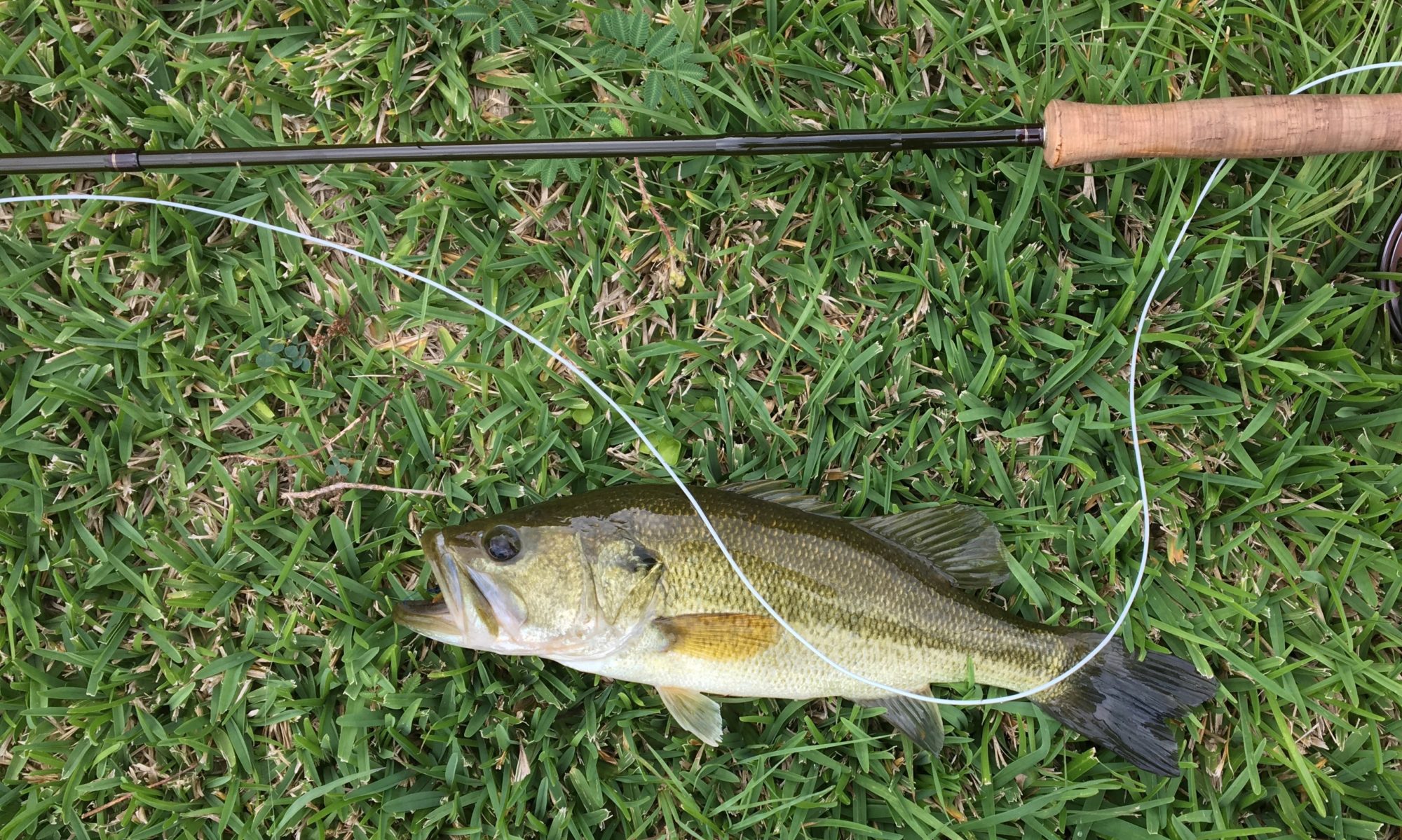
Terrible picture, I know. But it was a big fish, and I wanted to keep it in the water. The purple smudge in the vicinity of its mouth is a purple Barr’s meat whistle.
We drove last night from Sapphire, North Carolina, to Houston. We didn’t exactly drive straight through. Around 2 in the morning we stopped in Louisiana at a rest stop on I-10 just west of the Mississippi border and I slept for an hour. I had planned to stop for the night at a motel somewhere in Georgia, but Kris had other ideas and there you have it. I dozed while Kris drove through South Carolina and Georgia, and then it was after midnight and we just kept driving, trading back and forth, through Alabama and Mississippi and Louisiana into Texas. It was 941 miles in about 15 hours.
We planned this trip as a car trip because we were just paranoid enough not to get on a plane, but not paranoid enough not to go, and we’d always planned to make the return trip in one long leg. Going home we were going to leave this morning around 4 am and drive straight through, but instead left last night. I hope our hosts will forgive the abrupt change in plans.
Going out was different, slower. We went north through East Texas, into Louisiana at Shreveport, in the heart of Northern Baptist Louisiana, through a bit of Delta Arkansas into Delta Mississippi. We had plugged the Robert Johnson Crossroads marker in Clarksdale, Mississippi, into the GPS because, well Satan, but neither Satan nor Robert Johnson were there, and I’m no better guitarist than before we left. It’s funny though, growing up in High Plains cotton country prepares you for the Delta. You know flat land, and you recognize cotton in the field. The Delta looked a lot like home.
Rowan Oak.
We went on to Oxford to visit Rowan Oak, Faulkner’s house near the University of Mississippi, and then camped nearby at an unremarkable state park. Rowan Oak was closed because of the virus. At the campground, I was drenched with sweat by the time I set up the tent; camping in Mississippi in July may not have been our best idea, but in the evening we drank Four Roses in memory of Faulkner and the Four Roses gave me sufficient courage to try to explain the ukulele to Kris. Kris has wanted to learn the ukulele.
“It’s the top four strings of the guitar a sixth up from the nut, so it’s D-G-B-E only it’s G-C-E-A . . .”
“Show me a chord.”
“This is wait, wait, it’s a 6th up from G, so this is E.”
“I can’t see your fingers, let me see your fingers.”
“Here, right here, this is, wait, a 6th up from G, so E.”
“Show me another chord.”
“This would be, wait, let me translate, it’s up from C so it would be A, or it could also be D-minor . And this is either B or B-flat, is it B-flat a 6th up from D or is it B? “
I thought I was being particularly lucid, but I think Kris got away from the lesson without knowing a single thing about the ukulele. That’s a good thing, since it should have been a 4th up, not a 6th.
***
To get to Shiloh National Battlefield we drove through Northern Mississippi and Southwestern Tennessee, and we started driving past Trump signs, Trump flags, Trump bumper stickers. I am surprised there weren’t Trump cut-outs, or even President Trump himself, waving at us from the side of the road. It struck me that if I lived in the area and was Biden prone, I’d be leary of putting a Biden sticker on my car. It just wouldn’t seem a safe thing to do.
Whatever our discontent with one another now, that locale of the first high-casualty battle of our largest discontent is not an easy place to get to. Because it’s not easy to get to, it’s pretty much as it was in 1862. I don’t know why I feel this need to visit our battlefields, but I continue to do so. Reverence and awe is what I feel when I’m there, for young men whose deaths and bravery were a long time ago, and sadness.
Me and William Faulkner.
***
I like to travel in the South. There is always great stuff to see, and many friendly and often peculiar people, and great food. And this trip there was still great stuff to see, but we weren’t stopping to eat anyplace, not even for donuts.
It may have been my imagination but there seemed to be an overlay of hostility about, of all the stupid stuff, masks. East of Nashville we lost an hour, which we hadn’t expected. Kris wanted to stop at a McDonalds because she thought it would be clean and we could get some iced tea and use their bathrooms: corporate America she thought could manage the virus, even if we collectively couldn’t. There was a sign on the door requiring masks, but inside it seemed to be a point of honor for customers to defy the sign. The staff, stressed with the burden of protecting themselves and America, were angry and yelling at each other, and openly hostile to the customers, who, arrogantly standing maskless, deserved their hostility. We stayed, which we shouldn’t have done, then tossed the food into the trash on the way out the door.
If I die because of the coronavirus, I will blame that McDonald’s.
***
Asheville may be one of the South’s better food cities. We had a barbecue pork sandwich at Little Pigs Bar-B-Q, which was very good and which we ordered to go from the parking lot, but you can’t like anything about traveling through a good city with good restaurants and not stopping at any of them because, well, coronavirus. When I picked up our sandwiches the customers inside wore masks, mostly.
***
Kris has a new minivan. Kris loves minivans, and she traded in her ancient Chrysler Town and Country on a new Chrysler Pacifica, which may well be the smartest collection of car compromises ever. It is even a good-looking car, if you can get past its mini-vanness. I hated to drive the Town and Country because it was like driving a bowl of jello; I love the Pacifica, but don’t tell Kris.
We piled so much stuff into that car.
tent
folding chairs
folding table
cots
sleeping bags
kitchen junk
food
a case of wine
some more food
stove
a five gallon water jug
fly fishing gear, including waders and boots
more food
a Yeti cooler
another Yeti cooler
still more food
a guitar
a yukulele
clothes, including whites to play croquet in North Carolina, because you can’t play croquet in anything but whites
Some more fly fishing gear
And it was all in a constant state of disarray. It was an experiment, to see after all these years, if we could still drive someplace and camp. We did it. We camped for one night. We can do it again.
***
Driving through Mississippi last night at 2 in the morning I told Kris that we were only 10 miles from the Tatonut Donut Shop in Ocean Springs. She said let’s go there and park on the street until they open in the morning. When we checked the internet they weren’t open on Monday. We kept driving. Those are very good donuts though, perhaps the best I’ve ever had. We would have broken up the trip for Tatonut donuts.
***
The Mississippi Delta is Mississippi cotton country, and still today 60% of the population is African American because Delta cotton production was industrial agriculture that depended on cheap labor. That’s where the enslaved were brought. It is also the home of the Blues. It is now one of our poorest regions because in place of cheap labor cotton production has mechanized.
Structurally the blues are usually a 12 bar phrase, repeated again and again with variations. The Blues can be extraordinary sophisticated, think Bessie’s Blues by John Coltrane, or raw and driving, like Cross Road Blues by Robert Johnson. One of the things that makes the blues different from other music is that it is cyclic, there is no chorus, no bridge, the phrase goes that 12 bars, or maybe 16 bars, and then it does it again and then it does it again and then it does it again. Folk music is cyclic as well, and one suspects that there is interplay (or at least a common human bond) between, say, Barbary Allen and Crossroads Blues.
In Clarksdale where we went to see the Crossroads Marker everyone, even people walking randomly down the street, seemed to be wearing masks. It gave me great hope for the drive. One hope, dashed.
***
Downtown Oxford, Mississippi, is charming, with cute shops, restaurants, boutique hotels, and a lovely courthouse with a Confederate soldier out front. There is a current controversy of course about the Confederate soldier, that he should be removed, but forgetting all else it is a charming vignette. It is hard though to forget he’s a Confederate sentinel for the courthouse. He will someday go I suspect, and I suppose I shouldn’t regret it, but I do, a little, but only because the statue is very pretty, and it makes me consider the War.
Current estimates are that there were about 750,000 young men, North and South, who died in the Civil War. If you include Americans both North and South among the dead, it remains our costliest war. We can only speculate at why most of those young men were fighting, but I suspect some of it was that young men fight when called by old men, or maybe, as Shelby Foote told about the answer of a random Confederate private, “because you’re down here.”
If the War was inevitable, both because of slavery and the fragility of the Union some 70 years in, then there had to be Confederate soldiers as well as Union, and the Confederates were as flawed and tragic as Hamlet, or Lear, or best of all, Othello. We may not be able to forgive them, any more than we can forgive Othello the death of Desdemona, but we can recognize their flaw and our collective tragedy. Honestly, I’d like to see that statue stay, rededicated to the dead of both sides, with an addition of a memorial to the cost of the failed Reconstruction and slavery. It would give us a better picture of our history. I suspect that ultimately it won’t stay though, and that’s ok as well.
***
I had a call last night with a young friend, a young African American woman. It started as business but we talked and I told her about driving through the majority-black Delta where everyone wore masks, even walking down the street, and then into East Tennessee, where it seemed a point of honor for the young white men in the McDonald’s to defy mask orders because the Second Amendment and tattoos would protect them. I told her that driving home the night before we had stopped at a convenience store/gas station on the edge of some city, Montgomery I think, and while I filled up the car I watched a series of young black men enter the store to buy cigarettes or beer or whatever.
“They were all wearing masks, right?” She thought that would be the denouement, that the young white men in East Tennessee arrogantly disobeyed the mask signs that the young black men in Alabama obeyed.
“Nope.”
“I thought you were going to tell me they were wearing masks.”
“Nope.” Having been one myself, I think that young men are sometimes just uniformly stupid.