Pyramid Lake Ladders

Pyramid Lake Needles, seabamirum, Creative Commons license.

Since in a couple of weeks we’re fishing for Lahontan Cutthroats at Pyramid Lake with Casey Gipson, I’ve been debating whether to buy ladders for the trip. I know that we could use Casey’s, but like a lot of fly fishers I’m a gear head, and I think I could find all sorts of applications for a ladder even if we never fished Pyramid again. It just seems like a good use of our money.

Ted Williams Signature fishing ladder, Sears Catalogue at 212, Fall 1967, Swanson, Dick, photographer, National Archives, https://catalog.archives.gov/id/549962. White pelican fly-overs are a problem at Pyramid Lake.

Of course all the major manufacturers make ladders, and Kris and I have spent a lot of time at our local fly shops trying to decide which ladders are right for us. We are really good at agreeing on the big stuff, but the devil is in the details. For instance, Kris likes Orvis rods and so do I, but I generally like Winston for freshwater or G. Loomis for salt a little better. Kris likes lightweight reels, but I prefer Tibor because they’re bombproof or Hardy English-made reels because they’re classy. She likes Simms waders, I like Patagonia. Anyway, if you’ve used any of the ladders in the market, I’d appreciate your thoughts. Following are the ones we’ve looked at.

Tenkara Ladders demonstrated by Japanese anglers, Popular Mechanics at 519, April 1907.

While I’m at it, does anyone have any advice on carrying a ladder on a plane? Do they fit in the overhead? I’m disappointed that only the Loomis Asquith comes with a ladder case. Maybe I’ll wait until we get to Reno and buy from Reno Flyshop. They have a lot of good information online.

Fishpond

RodMob, Angler fishing for Lahontan Cutthroat Trout, Pyramid Lake, Nevada, 2014, https://www.flickr.com/photos/rodmob/12607378375/sizes/o/, Creative Commons attribution with limitations. https://creativecommons.org/licenses/by-sa/2.0/

The guy in the picture above is the kind of angler who gives fly fishing its reputation for effete commercial excess, decked out as he is from head to toe in the newest Simms River Camo–who knew that camo would be a thing for fly fishing? In my opinion he’s all style, no substance, but I can’t argue with his choice of ladder. Fishpond makes a range of high-tech carbon fiber ladders that are not only functional, but you can’t argue with their good looks. There’s also a ton of available attachable accessories, including rod holders, bottle holders, floatant clips, net clips, shoulder straps, beer can holders, tippet holders, fly patches, bottle openers, ladder tethers, solar panels, and lip balm. $625 as shown (without accessories).

Thomas & Thomas

Dr. Thamizhipparithi Maari, Ladder Shop, Wikimedia Commons.

I’ve got a couple of Thomas & Thomas graphite rods, a 10′ 4 wt Avantt and an old saltwater 8 wt, and my friend Mark Marmon is on their pro staff. They’re better known on the East Coast than in the West, but they’ve really made a name for themselves with their traditional bamboo ladders. I’ve never climbed bamboo, but the aesthetics and craftsmanship are the highest I’ve seen. I’d love to own one of these. $3,750.

Winston

Ladder Stile, Wikimedia Commons.

Nothing gives rise to thoughts of Western trout fishing like Winston rods, and I’ve used them happily for years. They’re beautiful, and the Winston feel is special. I like casting Winston, and I’m guessing that I’d happily climb their ladders. I particularly like the engraved nickel silver ladder feet with the burl wood spacers. Beautiful. $875.

Temple Fork Outfitters

Wikimedia Commons.

By manufacturing its ladders in South Korea, the TFO ladders are exceptionally well made and functional at an excellent price point. They’re good-climbing ladders too, and if you’re not hung up on American manufacture, price gives them a rung up on the competition. $399.99.

Abel

Edward Muybridge, Animal locomotion: an electro-photographic investigation of consecutive phases of animal movements. 1872-1885, plate 110

There’s always something kind of sexy about Abel aesthetics, and you can’t argue with Abel function. If you want to climb up and down a ladder, Abel lets you do it with style and confidence. Abel is expensive though, and if you get a custom anodized ladder like the one in the picture, prices start to get into bamboo territory. The ladder shown is milled from aircraft grade aluminum with a wood-pattern custom anodized finish, with matching pliers, nippers, and zinger available. $2555. Also available in Montana Brown, Native Tarpon, and Rasta Fade custom finishes, or standard solid or custom satin colors.

Orvis

Marcel Duchamp, Nude Descending a Staircase No. 2, 1912, Philadelphia Museum of Art,

I was in the Orvis Houston store when a customer said that he had purchased one of every size of Helios 3D rod made, from size four to 12, plus the Helios Tenkara rod. I think Kris would be happy with that, and I love to cast her rods. I’m sure the Helios 3C ladders are excellent, both for climbing and descending, and I’m sure that no ladder is more accurate. I kinda like the modern look of the Helios 3 ladder too, though I know it’s been controversial. $950.

G. Loomis Asquith

Niwaki Tripod Ladder, https://www.niwaki.com/store/tripod-ladders/

I don’t like the feel of the lighter weight Loomis Asquiths, but I really like the heavier rods, 7 weight and above. Because they are shipped to Japan for attachment of Shimano’s proprietary Spiral X rails, the price of Asquith ladders is a good bit higher than other comparable ladders. Still, they work so well it may be worth it. I don’t think the aesthetics are particularly good, and the little flecks of color remind me of bowling balls and bass boats, but they sure perform. I’m certain this is the last ladder I would ever buy, and that it’s a way better ladder than I am a climber. $1100.

As a side note, Asquith rods are named after the top step on stepladders, which is properly referred to as the ladder’s asquith.

From Die Gartenlaube (1873), Wikimedia Commons. Note that the angler is wearing a Fishpond Eddy Hat and Fishpond Flint Hills Vest. His guide is handing him the Fishpond Donner Pass Umbrella.

Lahontan Cutthroat Trout (Oncorhynchus clarkii henshawi)

Lake Tahoe Trout, New York Forest, Fish and Game Commission, Seventh Report of the Forest, Fish and Game Commission of the State of New York, 1901, Albany, N.Y, J.B. Lyon Company.

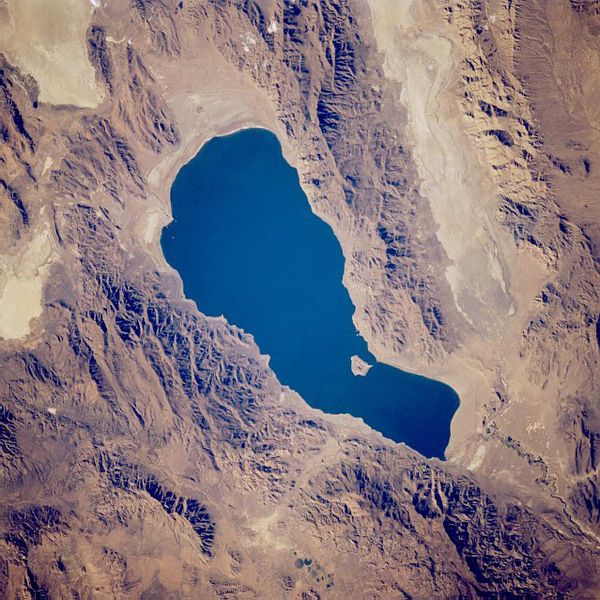
The Lahontan cutthroat trout is the state fish of Nevada, and it’s what we’ll fish for in Pyramid Lake and the Truckee River. You’d think that the name Lahontan was Native American: The Lahontan Sioux, the Lahontan Paiute, the Lahontan Comanche. Where the Lahontan cutthroat are located, west northwest Nevada, there was once, roughly 15,000 years ago, a Pleistocene lake covering much of the Great Basin: northwestern Nevada, southern Oregon, and northeastern California, and there are remnants of that lake, Pyramid Lake, Walker Lake, Lake Tahoe. Pyramid Lake was the deepest part of Lake Lahontan, with the lowest point 900 feet below the surface. Lake Lahontan was the historic range of the Lahontan cutthroat.

Lake Lahontan, © 2004 Matthew Trump, under GNU Free Documentation License.

But back to the name Lahontan. The trout (and the ancient lake) were named after Louis Armand, Baron de Lahontan, who was neither Sioux nor Paiute nor Comanche. Lahontan was a 17th century French explorer in Canada, Wisconsin, and Minnesota. He never made it to Nevada. The name was chosen in the 1860s by a U.S. Geological Survey geologist, Clarence King, who admired Lahontan, or at least liked the name.

The Lahontan cutthroat was originally named the salmon trout because of its size, but unlike Lahontan that was a lousy name and didn’t stick. The Truckee River was originally named by John C. Frémont as the Salmon Trout River, but that didn’t stick either. Like I said, salmon trout as a name is lousy.

In the United States, Nevada seems always to be a one-trick pony, though that trick has changed over time. The current trick is tourism. The previous trick was mining precious metals, silver and gold, mostly silver. The original inhabitants, the four principal tribes, the Shoshone, Washoe, Northern Paiute, and Southern Paiute, plus the far west settlements of the Anasazi (or Puebloan as they now prefer to be called), got on well enough. They supplemented subsistence agriculture, beans, squash, and corn, with hunting and gathering. Ok, they ate desert lizards, but they also ate Lahontan cutthroats. They didn’t rely on silver or gambling. And they didn’t need Elton John, though maybe they would have liked him better than I do.

Jordan, David Star, Tahoe Trout, Salmo Henshawi, Fishes, 1907, New York, N.Y., Henry Holt and Company, University of Washington Freshwater and Marine Image Bank.

The Lahontan cutthroat was almost extinct by the 1940s, and the tie between mining and its extinction seems obvious. In 1860, the population of Nevada was 6,857. By 1870, after ten years of boom driven by silver and gold, the population was 42,941. It was during this period that Mark Twain went to Nevada with its new territorial secretary, Orion Clemens.

Over the next 40 years the market for precious metals went up and down, mines played out and new booms played out, mining towns like Belmont, Nelson, Unionville, Silver City, and Gold Point came and went. A United States mint was built in Carson City and then went away. Monetary policy favored silver as a base for U.S. currency, and then didn’t. Nevada was crucified on that cross of gold. In 1900, the population of Nevada was still 42,335. There had been some growth and some decline during the interim, but it didn’t stick.

O’Sullivan, Timothy, Miner working inside the Comstock Mine, 1867, Virginia City, Nevada, National Archive.

Nevada had snuck into statehood during the Civil War–“Battle Born” appears on the state flag. It was a sure Republican vote for the 13th Amendment ending slavery. But Nevada’s mining population wasn’t very stable and the state didn’t exactly lend itself to other kinds of economic development, desert lizards not being an exportable dietary commodity. I’m sure they’re fine, and I’m sure they’ll be appearing on the menu of some New American restaurant in Brooklyn soon, but meantime by 1900 Nevada residents were stuck in a 20-year economic depression. At one point the population was so small that removal of statehood was seriously considered. How can a state with 20,000 eligible voters have two senators and a congressman?

O’Sullivan, Timothy H., The Pyramid and Domes, Pyramid Lake, Nv., 1867, from Geological Exploration of the Fortieth Parallel, U.S. Army Corps of Engineers, Clarence King, geologist in charge. Library of Congress, from Wikimedia Commons.

Between 1904 and 1913 the U.S. Bureau of Reclamation constructed Lake Tahoe Dam and Derby Dam as part of a series of dams to divert waters from Lake Tahoe to agriculture land as part of it’s Newlands Project. The Lake Tahoe Dam controls flow from Lake Tahoe, the Derby Dam diverts water from the Truckee River drainage into Lake Lahontan and the Carson River watershed. That water irrigates something over 50,000 acres, which is a lot to an Easterner, but really not so much. It was the first project of the newly created U.S, Reclamation Service. New lands for old!

One can just see the engineer’s and politician’s minds a-spinning: silver is pretty much done, the senators from Nevada won’t leave me alone, and the state otherwise can’t support much settlement. We’ll transform the region into the Garden of Eden! With farming! Not that farming ever appeared to be all that much fun to me, though I’m thankful somebody does it.

U.S. Bureau of Reclamation, Carson River Diversion Dam.

The result was that Lake Winnemucca Lake, a sister-lake to Lake Pyramid, lost all inflow and dried up. Lake Pyramid lost 80 feet of lake elevation. Lahontan cutthroat trout, already decimated by a commercial fishery supplying California and the mining boom with salmon trout, no longer had sufficient flows or water quality in the Truckee for the native fish to move upriver to spawn–they are their own kind of mildly anadromous migratory fish. By 1943, the Pyramid Lake population was extinct. On the other side of the Lake Tahoe Dam, in Lake Tahoe, predation by introduced lake trout and hybridization with rainbows wiped out the Lahontan cutthroat by the 1930s.

There is an amazing story of the discovery of pure-strain Lahontan cutthroats in the 1970s high in the Sierras (of course it would be a better Nevada story if they were living with a striper in Vegas). They were recovered, hatchery-raised, and reintroduced to Pyramid Lake and the Truckee. By 2013, Pyramid Lake anglers standing on ladders were once again catching 20-pound Lahontans. These can be big fish, and the record fish, 41 pounds, was caught in Pyramid Lake in 1901. Reading about the Pyramid Lake fishery by those who care about it, there is an almost religious conviction that soon a 30-pounder will be caught.

The Cui-ui, a lake sucker important to the diet of the Northern Paiute, was also decimated in the 20th Century and has also recovered (also supported by hatcheries), but it’s not much of a fishing target, so it’s not news unless you’re the Northern Paiute. Pyramid Lake, by the way, is managed by the Pyramid Lake Paiute, and the return of both the Cui ui and the Lahontan cutthroat is thanks in big part to tribal management. One doubts that if they’d had anything to say about it they would have allowed the irrigation diversion in the first place. One suspects what makes the Garden of Eden is always relative.

Snyder, John Otterbein, Cui-ui, Fishes of the Lahontan System of Nevada and Northeastern California, Bulletin of the United States Bureau of Fisheries, v. 35, 1915-1918, Washington, D.C,, Government Printing Office.

Nevada

In April we’re going to Reno. I’ve read Roughing It, and years and years ago I read The Godfather and saw the movies. I watched a lot of Bonanza as a child, and once, coming back to Houston from somewhere, we had a layover in the Vegas airport. Kris played the slots and I didn’t. I know most of the words to Folsom Prison Blues, and could probably still play it on the guitar. In college I read Fear and Loathing in Las Vegas. I don’t think that’s the reason I went to law school, but who knows? Everybody needs a lawyer.

We’re leaving Thursday April 11, and coming back on the next Sunday, fishing Friday and Saturday. We’re fishing one day on Pyramid Lake and one day on the Truckee River. Our guide, Casey Gipson, says that April is a great time to fish near Reno. The average high for April is 64°, the average low is 35°, so it’s probably a great time because nobody fishes when the temperatures are near-arctic. I get hypothermia just thinking about 64°. The good news is that Reno is not only west of the 98th meridian, it’s in the rain shadow of the Sierra Nevada for a stunning 7.48 inches of rain per year. Putting that into my own peculiar perspective, my hometown (which was also west of the 98th and certainly dry), averages 28 inches per year. Houston averages about 50.

Reno averages two days of rain in April, and if you were a betting man and wanted to lay down money in Reno, betting that it will rain April 12 and 13 would be pretty safe.

Google Maps

I’ve considered flying into Las Vegas and then driving to Reno. Flying into Reno we’re missing Las Vegas. Everybody knows Las Vegas. Sin city! Wayne Newton! What happens in Vegas! There is gambling and booze and ladies who dance naked and Elton John** at the Stardust or the Carousel or some such! I don’t know, the naked ladies sound sort of interesting, but it’s a 440-mile drive northwest up the border to Reno. While that’s appealing, we’d have to go a day early to see anything of Vegas, and I don’t really like Elton John. I bet we could rent a Cadillac convertible for the drive though.

Great Basin Ranges of Southern Nevada and Adjacent California, Bulletin of the Geological Society of America, 1890, Smithsonian Libraries, from Wikimedia Commons.

Reno is located a bit more than halfway up the Nevada border, on the cusp of the Great Basin, just east of the Sierra Nevada Mountains, at 4,400 feet above sea level. Boundary Peak, at 13,147 feet, is the highest point in Nevada and is a few hours south of Reno. The lowest point, where the Southern border meets the Colorado River, is 481 feet. The elevation at Las Vegas is 2,030 feet. Overall Nevada is our highest state, with an average elevation of 5,500 feet. I thought sure our highest state would be Colorado. Nevada, notwithstanding legalizing everything but mafia murder (which is only tolerated), refused to legalize marijuana in 2002 and didn’t vote for legalization until 2016.

This elevation stuff is important, not because we’ll be going up and down but because it’s what characterizes much of North America from eastern California to Colorado, and from southern Idaho into the highlands of northern Mexico: it’s the Basin and Range Province. This is of the highest interest to geologists and John McPhee and maybe not so much to many of the rest of us, but it is at least a bit interesting.

A big area of the Western United States is an alternating series of mountain ranges interspersed by relatively low elevation plains or basins, running more or less parallel like geologic corduroy. When you start reading about it, you get all sorts of geologic jargon that dances in front of your eyes, tectonic plates and crusts and endorheic watersheds, like an Easter sermon in Latin, but the general drift of it is this: There was some stretching of the earth’s crust. The stretching caused some issues. Some crust was lifted up in the glory of the Lord while some collapsed into perdition and sin! Hallelujah!

Maybe corduroy makes more sense. Here’s a description from the U.S. Geological Survey (the internal links are theirs):

Within the Basin and Range Province, the Earth’s crust (and upper mantle) has been stretched up to 100% of its original width. The entire region has been subjected to extension that thinned and cracked the crust as it was pulled apart, creating large faults. Along these roughly north-south-trending faults mountains were uplifted and valleys down-dropped, producing the distinctive alternating pattern of linear mountain ranges and valleys of the Basin and Range province.

See what I mean? Maybe it’s ancient Greek, not Latin. How do they figure the crust was stretched, and what was it stretched from? I think I’ll go back to corduroy.

Landscape of Basin and Range Province, Central Nevada, NASA, from Wikimedia Commons.

On the western side of Nevada and the eastern side of California (where the watershed divides was supposed to define the border) is the Sierra Nevada. If you’re facing north and reading from left to right that’s the first range. If you drove the thousand or so miles from Denver to Sacramento you could take great comfort in knowing that not only were you covering a good bit of ground, you’re also covering a goodly number of radical uplifts and down-drops, all lined up in a row. Ok, a squiggly kind of a row.

Map from Denver, Colorado to Sacramento, California
Google Maps.

The United States colonized in a weird way. When Mexico generously gifted us most of the Southwest after the Mexican American War, colonization leap-frogged. We settled the East and the South to about the 100th meridian, then we settled California and Oregon. We pretty much skipped what came between: The Great American Desert. The big exception was the Mormons in Utah, who also tried to settle Colorado and Nevada. In the 1840s there was also exploration in Arizona by fur trading companies and government explorers like John C. Frémont. All of them generally failed to find a path through Nevada to California, even when they looked. The Nevada expeditions attempted to find a river course to follow through the Sierras, but they couldn’t. This may sound heretical to fly fishers, but No Rivers Run Through It.

What confused them was a trick of geology. The Great Basin, which covers most of Nevada, covers the same area as much of the Basin and Range Province, but the Great Basin isn’t describing the same thing. Instead it is an endorheic watershed: The water–whatever water comes from 9.63 inches annual rainfall statewide–comes flowing out of the hills and into the valleys and then likely as not peters out in the desert. This is a dry place, and there’s no spare water to share with California. The Truckee runs from Lake Tahoe to Pyramid Lake and that’s it. The Great Basin is the third largest endorheic watershed in the world, after the Chad Basin in Africa and the Caspian Sea at the cusp of Europe and Asia. Endorheic basins don’t have to be dry, ergo the Caspian, but the western desert basin pretty much defines dry. It includes the Great Salt Lake, Bonneville Salt Flats, Death Valley, Lake Tahoe, and Pyramid Lake. The Great Basin is a place water goes to not go any further.

C.E. Lewis, Col. John C. Frémont, Library of Congress.

John C. Frémont, noted explorer, Presidential candidate, Governor of Arizona, and civil war general of dubious accomplishment, discovered Pyramid Lake and the Salmon Trout River and named them. He named Pyramid Lake for the rock formation that looks about as much like a pyramid as any other mildly pointed lump of rock, but there you are. He named the Salmon Trout River for the large trout, but then later the name got changed to honor the Paiute chief, Truckee, for his aid to white folk. I’m not sure what the Paiutes got out of that bargain, other than more white folk, but Pyramid Lake is owned and managed by the Pyramid Lake Paiute. Apparently one of Chief Truckee’s worst confrontations was with the Donner Party, which burnt a Paiute food store. I suppose the Donner party figured that anybody could survive a winter with limited food supplies if they just put their mind to it.

File:Pyramid Lake sat.jpg
Nasa sattelite photo, Pyramid Lake, 2006, Wikimedia Commons. The lake is about 29.8 miles long and 8.7 miles wide.

**Kris notes that she likes Elton John, and that there is no reason for me to denigrate him. All I can say is that after Madman Across the Water, Elton John was a great personal disappointment to me.

Mississippi Packing List

Redfish, Shearwater Pottery.

Gear

For a long weekend fishing Ocean Springs, we took a Loomis Asquith 7 wt with a Tibor Back Country Reel (which are now discontinued–why did they do that?), an Orvis HD3 9 wt with an Orvis Mirage reel, and an Orvis H2 flex tip with a Tibor Riptide reel. All the lines were floating. We fished both the 9 weight and the 10 weight quite a bit, and I caught the black drum on the 10 weight. That was probably for the best. We never touched the 7. I love that 7, but guides generally don’t. We fished with Richard Schmidt.

Over time I keep adding random bits and pieces to my leaders. Richard shortened them because he said it was hard for him to track flies on long leaders, and the fish weren’t leader shy. The leaders were probably about eight feet after he’d finished. They all ended with 16 pound tippet. Or 20. Something more than 6X.

What we didn’t take was bug nets. I’m covered with welts from gnat bites. The good folk from Magnolia Fly Fishers swear by Gnaughty Gnat from Marina Cottage Soap Company as a gnat deterrent. There should be signs on the state border. There’s a version of Gnaughty Gnat with an spf 50 sunblock. I ordered some. If I could go back in time I’d order some then.

Flies

Not gnats. We used Richard’s, and it was purple Clousers or Clouser derivatives all the time. Dark skies, dark flies. They were big flies, maybe a #2 on the 9 and a 1/0 on the 10. Not muskie big, but two to three inches long for the largest.

I’ve never fished purple flies before. Live and learn.

Where We Stayed

We stayed at Front Beach Cottages, which I found online in an article in Coastal Living. We were in the Key West Cabin, and there’s irony in that. It was a lovely little place, within walking distance of the cute shops and restaurants, and even closer to the Walter Anderson Museum. It’s a good place.

Talk

Everybody in Mississippi is up for a conversation, so bring your A-game. In a cute shop (Ocean Springs is chock-a-block with cute shops) I had a long conversation with the proprietor about what it was like to be gay in Mississippi, living in Houston, and living in San Francisco. At dinner the people at the table next to us struck up a conversation that went on and on, and after they left their replacements never missed a beat. I can’t even remember what we talked about, but this is not only a world class fishery it’s a world class place for conversations with strangers.

Shearwater Pottery

Shearwater Pottery is in a kind of raggedy compound in Ocean Springs. It was founded by Walter Anderson’s oldest brother, Peter, and all three brothers, Walter, Peter, and James, made their living out of the pottery. It’s now run by descendants, and according to locals some of them still tend towards the eccentric. Richard said a descendent did magnificent tattoos, so if you’re in the market it’s a consideration. Some of the pottery is incredibly beautiful, and I guess because of the influence of Sophie Newcomb Memorial College there is a lot of innovative and interesting decorative and functional pottery made in Mississippi. The Museum of Mississippi History/Mississippi Civil Rights Museum store in Jackson has a great selection of potters from around the state, including Shearwater.

Shearwater Pottery.

Books

I listened to a bunch of stuff, and read some. There is so much great literature out of Mississippi, it’s baffling. Here’s my booklist.

  • Faulkner, The Hamlet. I read The Hamlet 40 years ago and it’s amazing how much of it I remembered, especially the Texan with the spotted horses and Eula Varner. She’s the world’s most literary pinup girl. We listened to it driving back and forth from the Guadalupe River and to Ocean Springs. It’s Faulkner at his happiest, which for other writers is their most grim.
  • Faulkner, Absalom, Absalom!, I probably read this 40 years ago too, but I didn’t remember anything if I did. Faulkner originally wrote this as a children’s book, with illustrations, but then he drank a bottle of Four Roses or ten and things got muddled. Not really about the children’s book, but there probably was some Four Roses. It’s usually compared to James Joyce’s Ulysses, without the humor, and the plot is announced early so you always know what’s coming, but when Henry Sutpen finally kills Charles Bon to stop him from marrying Judith Sutpen it is still stunning, Maybe the most stunning murder ever written, even though you knew from chapter one that it was coming, and the reason: not that Charles is Judith’s half-brother but because he has black blood. It’s perfect Faulkner, perfect.
  • Shelby Foote, The Civil War: A Narrative: Volume 1. I know the Civil War reasonably well, and I thought I could listen to this. I had to re-listen to the same stuff so often that I’d probably recommend buying the book. Where Foote shines is in his anecdotes about the big personages: Lincoln and Davis, Lee and Jackson and the string of Union Generals. He doesn’t have much to say about the small folk, and his descriptions of battles were usually where my mind would wonder. I missed the entire Seven Days Campaign and had to go back to re-listen.
  • Mark Twain, Life on the Mississippi. I’d read it before, so I listened this time. Twain’s observations are so acute you have to trust them, even when he’s at his most outlandish.
  • Jesmyn Ward, Salvage the Bones. Ward has now won two National Book Awards, and her first was for this. She’s on every list, but I was dubious. I invested in a listen and it was stunningly good. Can an old Texas white guy identify with a pregnant black 15-year-old whose brother has a fighting pit bull and whose father is an alcoholic? I reckon. It’s riveting, and the description of Katrina is as gripping as Faulkner’s murder of Henry Bon. She claims Faulkner as one of her influences, and I think he’d be proud.
  • Thomas Merton, Lectures on William Faulkner. Merton did a series of lectures at the Abbey of Gethsemani on Faulkner and some other stuff shortly before his death in 1968. His description of Easter in The Sound and the Fury made me wish that we didn’t drive cars to church. These are great to listen to, and each lecture is about 15 minutes long. I didn’t re-read The Bear (though I had intended to), but I got Merton’s description which may have been better.
  • Eudora Welty, Why I Live at the PO. I read more stories by Welty than just the one, but it was that one that every Mississippian seems to mention. I read it, but after a few drinks in our little cabin in Ocean Springs we played a YouTube recording of Ms. Welty reading the story. It’s worth doing both, and Kris suspects every Mississippian mentions the story because listening to Ms. Welty was the high point of 10th grade English. The talkative store owner said his sister’s cat was named Stella-Rondo, which I vow to appropriate if I ever own another cat.
  • Mark Childress, One Mississippi. I read this when it was published, and started listening to it but never quite finished. Parts of it ring true, parts don’t, but what Childress does catch is the 1970s. That’s pretty much exactly how I remember it.
  • Greg Iles, Natchez Burning. This is the first of a trilogy, and it’s a pretty engaging road trip listen. By volume two it’s just a bit too outlandish, even for Mississippi. I think Kris listened to all three. I got bored.
  • Westley F. Busbee, Jr., Mississippi: A History. It’s a college textbook so it’s pretty dry, and only got to the Civil War. I’d like to read through Jim Crow and the Civil Rights movement, and maybe I’ll get there when we go back for Kris’s fish.
  • Elijah Ward, The Blues: A Very Short History. This is a personal beef of mine: If you’re going to produce an audio book about music, why not do it right and include snippets of the music you’re writing about? It seems like the best of all possible media. The book has a particularly good chapter on Jimmie Rodgers.
  • Richard Grant, Dispatches from Pluto. I love books like this, and it was apparently a New York Times bestseller when it was published. It’s a memoir of an English literati who moves to the Mississippi Delta with his then girlfriend, now wife. Grant is a careful and sympathetic observer, and he likes pretty much everybody and makes them likable, notwithstanding flaws. I’m guessing he’s a lot like Mississippi, but I wish he’d mentioned the gnats.

Donuts

Tatonut Donuts in Ocean Springs is the best. The donuts aren’t elaborate, but they’re still warm and if you eat in the shop you can get coffee in a real ceramic mug. Every donut shop should do this. We had a second breakfast at Phoenecia Gourmet, and that was pretty good too. On the road trip we also hit both a bakery and a donut shop in Lafayette, Louisiana, which may have more real bakeries per capita than anyplace in the world short of Paris. And I’ve yet to run across a donut shop in Paris.

The dozen oysters we ate at Charred in Ocean Springs before dinner were uniform and plump, as good of Gulf oysters as I’ve eaten, and Richard explained that they were farmed. At Vestige where we actually ate dinner the other diners were memorably talkative. Mary Mahoney’s Old French House in Biloxi feels like it’s 30 years past its prime, but the Chimneys in Gulfport is outstanding. That was the best sauced tripletail I’ve ever eaten.

Tripletail, The Chimneys, Gulfport.

Where We Didn’t Go

We still haven’t been to Oxford, and we haven’t been to a juke joint in the Delta. We haven’t caught a sunfish or a bass or a catfish in freshwater, and of course Kris didn’t catch a fish. Did I mention I caught a big fish? Let me show you a picture.

Music

There is so much great music out of Mississippi. Here’s a list of who was on our playlist, and I’ll only talk separately about stuff that was particularly interesting to me. Albert King, Mississippi John Hurt, Elvis Presley, Mississippi Fred McDowell, B.B. King, Robert Johnson, Faith Hill, North Mississippi All-Stars, Cedric Burnside, Jimmie Rodgers, Muddy Waters, Howlin’ Wolf, Cream. It could have had a dozen more.

  • Johnny Cash & June Carter, Jackson. This was very popular when it was released in 1967. Kris had never heard it. She’s a lot younger than me.
  • Cedric Burnside. This was a surprise. When you listen to Burnside you hear bands like the White Stripes and the Black Keys. He should be as well known.
  • Faith Hill, “This Kiss“. I originally downloaded a bunch of Faith Hill, then I got rid of everything but “This Kiss.” It’s an infectious song, but listening to Hill made me think less of country music than of a Broadway musical without the complexity of a Broadway musical plot. I couldn’t take it. She did record the theme song to Lilo and Stitch, which is one of the strangest movies ever.
  • North Mississippi All-Stars. This is a current band, and a band I’d go out of my way to see.
  • Jimmie Rodgers. I think I’d always confused Jimmie Rodgers with Governor Jimmie Davis from Louisiana, who may or may not have co-written “You Are My Sunshine“. I had never listened to Rodgers, who’s considered one of the foundations of country music, but is just as important as a white guy singing the blues. On “Blue Yodel No. 9” Louis Armstrong on trumpet and Lil Hardin Armstrong on piano accompany Rodgers on the blues and where the heck did that come from? With yodeling? Elijah Ward says that Howlin’ Wolf said that he howled because he couldn’t yodel like Rodgers, which if true may be the single wittiest thing anyone has ever said.
Jimmie Rodgers, source unknown.

Movies

O Brother Where Art Thou. There’s a cover of Jimmie Rodgers’ “I’m in the Jailhouse Now.”

Mississippi Burning. Mississippi had more than its share of Civil Rights Movement confrontation and violence. Richard Grant tells a story about pulling up to the collapsing store in Money, Mississippi, where the Emmett Till tragedy started. The tag line is basically that the folk of Money were exhausted: the murder of Emmett Till was the only thing they were known for. I suspect a lot of Mississippi, black and white, feels that way and wants to move on. I thought Mississippi Burning was no worse than it should be, but I suspect moving past that story line is the real story about modern Mississippi.

Guitar.

I took the Kohno, and sat in front of our cabin and played Bach. Another guest asked if I was hired or a guest which was flattering, but I should have told her I worked for tips.

Walter Anderson, Part of a Wall, Ocean Springs Community Center Mural, 1951.