Alabama Packing List

What We Took.

Rods

On the Tallapoosa we didn’t expect big fish. We threw a lot of stuff in the car, helter skelter, but we intended to fish with five weight rods, and that’s all we set up for the float. Kris had her Helios D3, and I had the new Winston Pure that Trout Unlimited had sent me for my high school graduation.

So far I’ve caught largemouth, bluegill, longear, redeye, Alabama bass, and a really big catfish on the Pure. It’s an excellent trout rod I’m sure, and someday I plan to catch a trout with it. With the rod Trout Unlimited also sent a Cheeky Reel, which must be the single gaudiest unobtrusive reel ever made. It’s an electric blue and green. It’s also disk drag, smooth and silent, and I don’t fish much with five weight disk drags, smooth and silent. After I put it on the rod I never really noticed the reel was there. Like I said, at once gaudy and unobtrusive.

I have lots of five weight reels, so I loaded the new reel with something different for streamers and poppers, a Scientific Anglers half-weight heavy MPX line. I don’t know what MPX stands for, but I’m used to big weight forward lines for redfish and bass and I liked the MPX. It’s probably the worst possible combination with the Pure, mixing a medium slow rod with a half-weight heavy line to make it faster, but there you are. The combination worked fine for Alabama, where neither the bass nor the legislature is big on subtlety.

I do have one beef with the Winston rod. It has a hook keeper, a rather large, sharpish hook keeper which when combined with the cigar grip and my choked up hand position rubbed my index finger raw. Does anyone actually use hook keepers? Why are they still put on rods? I guess I’ve got lots of rods with hook keepers and cigar grips, but that combination on the Pure really rubbed me the wrong way. All afternoon. And it’s an ugly hook keeper too, and ugliness isn’t part of the whole Winston thing.

Flies

My leaders were a highly technical design: Three or four feet of 20 pound fluorocarbon joined to three or four feet of 16 pound fluorocarbon by a blood knot. They worked fine.

A month or so before we went to Kansas Alabama I lost most of my bass and sunfish flies, four fly boxes worth. They were returned by a Good Samaritan, but not before I’d frantically tied a bunch of new flies, including (at the suggestion of a Kansan I’d been emailing) some Barr’s slumpbusters. Other than the disreputable baseball tie-in, I really like that fly, and fished it about a third of our river time in Alabama. I also tied some BBBs, woolly buggers, and clousers, and used none of them. I tied everything but the BBBs on size 8 streamer hooks, so they should be fine as well for our New York/Vermont/New Hampshire trout swing at the end of June. Of course the whole point of that trip is to learn something about dry flies, so I shouldn’t use them. I really shouldn’t.

The rest of the time we fished poppers. Craig didn’t bother calling them anything but Boogles, which is exactly right. I know there are people out there who tie their own poppers, but I never could get them painted in a way that made me happy, so I am happy to use Boogles. Craig fished with an intermediate size, neither as large nor as small as the ones I usually use. I’m going to have to buy some intermediate Boogles. East Alabama Fly Fishing has an excellent discussion on popper colors, and when to use them. It’s the kind of cool stuff that Craig and the guide service owner, Drew Morgan, are thinking about.

New Shoes

I’m a biting bug magnet. This spring alone I’ve suffered from infestations of gnats, mosquitoes, and fire ants. There’s nothing quite like a couple of hundred fire ants together with your feet in a pair of Keen sandals.

I figure that I’m not likely to pay more attention, so I bought a pair of cornflower blue Converse high tops for our trip to Kansas Alabama. Paired with running socks and some supplemental arch support for the aged they’re pretty comfortable. There’s reasonable traction, and I don’t have to worry about fire ants between my toes. Plus the cornflower blue matches my eyes when I stick my foot in my mouth.

The laces will catch a fly, so it’s another reason to debarb hooks.

I think Kris prefers snake boots, and the Chuck Taylors probably don’t provide much snake protection.

Restaurants, Barbecue

Coming into Alabama, the lady at the visitor center sent us to a Dick Russell’s for barbecue. It wasn’t really so much a barbecue place as a plate-and-three place, with an incredibly good two instead of three and pretty mediocre barbecue as the meat. I had turnip greens and black-eyed peas, and I’d go back for them. They also didn’t have white sauce barbecue, which southern Alabama is known for: Mayonnaise, vinegar, brown sugar, mustard, horseradish, salt and pepper. It sounds awful for pork or beef, but is supposed to be great on chicken.

In Montgomery everyone I talked to told us to eat at Central, which was around the corner on the same block as our hotel. It was the kind of elegant modern American place which seems to be everywhere and because of which the world is better off, and on a Saturday night it was crowded. One of the servers suggested Cahawba for biscuits the next morning for their breakfast biscuit sandwiches. The cheese in the eggs was a bit much, but the biscuits were excellent. I’ve never baked a decent biscuit, though from time to time I try. Because of my own failures I admire the craft of a good biscuit.

Back in Mobile heading home we ate breakfast at Time to Eat, which had the only Amnesty International and Human Rights Campaign stickers on doors in Alabama, and a smoking room. We accidentally ate in the smoking room. It had good grits, and the view of the locals coming in to smoke and drink coffee was pretty memorable.

In Louisiana we tried to get po’ boys in Lafayette, one of the great po’boy towns, but everyplace was closed for Memorial Day.

Where We Didn’t Go

We didn’t see Birmingham, home of both the AA Birmingham Barons and the former Negro League Birmingham Black Barons, for whom Willie Mays, Satchel Paige, and, of all people, Charlie Pride played. Pride and another player were apparently traded to the Barons in 1956 by the Louisville Clippers for a team bus. Everyone seems to like Birmingham, and it was once, along with Memphis and Atlanta, the industrial heart of the South.

The Northern part of the state is supposed to have gorgeous waterfalls. Our guide Craig Godwin said it was the prettiest part of the state.

We didn’t try enough barbecue, and we didn’t catch a redfish on the coast. The same server who suggested Cahawba for biscuits suggested the F. Scott and Zelda Fitzgerald Museum, Montgomery having been Zelda’s home. It didn’t open until noon on Sunday, so we didn’t make it.

Playlist

I didn’t know that Charlie Pride played for the Birmingham Black Barons, or he would have been included.

  • Alabama Shakes. This is one of those bands I follow because of their appearance on Austin City Limits. There’s just nothing not to like, except that I guess they may not exist any more.
  • Emmylou Harris. I probably have more Emmylou Harris music than anything else. For someone who doesn’t write many songs, she’s consistently had the best taste in music, and has a liberating way of making other people’s songs her own. I actually needed to cut 50 or so songs so I could hear something else, but I just never got around to it. She was a military brat, and didn’t spend much time in Alabama after she was born there, but being born there was enough of an excuse to listen to Emmylou. And of course there was “Boulder to Birmingham.”
  • John Prine, “Angel From Montgomery.” I had versions by Susan Tedeschi and Bonnie Raitt, but oddly I first knew the song from a high school John Denver record. It was a good version.
Handy’s Memphis Orchestra, 1918.
  • Paul Simon, “Loves Me Like a Rock,” “Kodachrome.” First I ever heard of Muscle Shoals, sometime circa 1973.
  • Arthur Conley, “Sweet Soul Music.” Muscle Shoals.
  • Wilson Pickett, “Land of 1000 Dances,” “Hey Jude,” “Mustang Sally.” Muscle Shoals.
  • Bob Seger & the Silver Bullet Band, “Old Time Rock & Roll.” Muscle Shoals.
  • James & Bobby Purify, “I’m Your Puppet.” Muscle Shoals.
  • Clarence Carter, “Snatching it Back.” Muscle Shoals.
  • Jimmy Cliff, “Sitting in Limbo.” Muscle Shoals.
  • Etta James. James, from California, had a long and strange career, and she recorded a lot of fine rhythm & blues, but none finer than what she recorded in 1967 in Muscle Shoals. “Tell Mama,” “I’d Rather Go Blind.”
  • Aretha Franklin, “Do Right Woman, Do Right Man,” “I Never Loved a Man.” Muscle Shoals.
  • The Staple Singers, “I’ll Take You There.” Muscle Shoals.
  • Percy Sledge, “When a Man Loves a Woman.” Just try not to sing along. Muscle Shoals.
  • The Rolling Stones, “Brown Sugar,” “Wild Horses.” Muscle Shoals.
  • Ma Rainey, “Bo-Weevil Blues,” “Ma Rainey’s Black Bottom,” “See See Rider.” Rainey made some of the first important blues recordings, and the available versions are pretty poor quality. She said she was born in Georgia, but scholars think she was born in Alabama five years before the year she admitted to. Charlie Pride did the same thing in minor league baseball, and this is now known in baseball circles as Dominican Aging Syndrome.
Ma Rainey, 1917.
  • Hank Williams. What a lot of great songs in a too short life. There’s a Williams museum In Montgomery, but it closed before we got to it.
  • Erskine Hawkins, “Tuxedo Junction.” I had versions by Hawkins, Glen Miller, Duke Ellington, and Manhattan Transfer. Tuxedo Junction was a blues bar in Birmingham. One of the great happy songs.
  • W.C. Handy. Ma Rainey is the mother of the blues, and Handy is the father. I had the Louis Armstrong plays W.C. Handy recording. If I’d known “Loveless Love” was by Handy I would have included the Billie Holiday version. I probably should have included Holiday’s “Strange Fruit” as well, in honor of the National Memorial for Peace and Justice, but it’s a tough song to contemplate, as is the National Memorial for Peace and Justice. One was enough.
  • Alabama, “Dixieland Delight,” “Song of the South.” I liked these more than I thought I would.

On principal I did not download “Sweet Home Alabama.” I meant to download a selection by St. Paul and the Broken Bones, but never got around to it. If you’ve never watched the Muscle Shoals documentary, Muscle Shoals, do. Muscle Shoals is some of the best of Alabama because, well, it’s some of the best of all of us.

Guitar.

I took the Kohno since we were driving, but then worried about the heat of the day when it had to live in the car while we went down the river. I worked on the Allemande movement of the first Bach Cello suite, the Duarte transcription that I always associate with Segovia. I’ve been told that Duarte was kind of a jerk, but it’s a good transcription, and the Allemande is actually my favorite movement. I can’t remember it for anything.

Alabama

For each destination state I’ve written at least one blog entry before the trip, but we went to Alabama on the spur of the moment so it didn’t get done. Usually they were evidence of my preconceived notions, and sometimes they were out-and-out wrong. For Alabama I started to skip it because it’s supposed to be a precursor not a post-cursor. I can’t quite bring myself to waste a perfectly good postcard though, so I’ll tell some stories from our trip.

Alabama doesn’t quite match Mississippi for music and literature. There is the one book, lots of people’s favorite book, To Kill a Mockingbird, and Fannie Flagg is enjoyable, but neither Ms. Flagg nor Harper Lee are Faulkner or Eudora Welty or Jermyn Ward. There’s some important blues like W.C. Handy and Ma Rainey, and there’s Hank Williams and Emmylou Harris, but it’s not the almost endless list of musicians from Mississippi. There’s Muscle Shoals though. That’s pretty good. And don’t tell Kris but I’ve had a crush on Emmylou Harris since I was 17.

Willie Mays, Hank Aaron, Willie McCovey, and Satchel Paige were all from Alabama. Maybe they played on the same high school travel team.

And there’s “Sweet Home Alabama.” Ok, that’s harsh, Lynyrd Skynyrd wasn’t even an Alabama band, but the song is embraced by the state, there’s even a sweet home proclaiming sign when you cross the border from Louisiana, but the song’s resentment and outrage never seemed like quite the thing to me. It’s a catchy tune, but dang it’s pissy.

*

It’s fitting that we did Alabama and Mississippi in the same year. Mississippi and most of Alabama were ceded to the United States by Spain in 1798. Mississippi was admitted as a state in 1817, and Alabama was admitted two years later in 1819. In the 1820 census, the Alabama population was 127,901. and some of my second and third great-grandparents lived in Alabama in the 1820s.

Alabama and Mississippi are a weird counterpoint to two other matching states, New Hampshire and Vermont, so going to the four in the same year has a weird resonance. The pairs of states are different, sure, but get rid of the state line and we could easily be back to 48 states without much change in the national character. They really are matched sets. There’s a lot more difference between, say Northern California and Southern California, or West Texas and East Texas, than between Alabama and Mississippi, or Vermont and New Hampshire.

Alabama has 4,887,871 residents, so it’s almost 2 million people larger than Mississippi. It’s also richer than Mississippi, but not by much. Mississippi now ranks ahead of West Virginia at 49th in median wealth per household, with $43,529, Alabama 45th, with $48,123. Alabama and Mississippi are also essentially white and black, with Alabama 68.5% white and 26.2% black, and Mississippi 63.5% white and 35.6% black.

Alabama Presidential Election Results 2016.svg
Alabama Presidential Election Results 2016, Wikipedia, US gov – derivative work: Ali Zifan.

In 2016, Alabama voted 62.08% for President Trump, and 34.36% for Hillary Clinton. Like most states, there is a rural/urban split, with Montgomery and Birmingham voting for Clinton, but like Mississippi there is a black majority in the rural historic cotton counties, the rich-soil agriculture region that belts the south-central counties of the state. In Mississippi it’s the Delta along the Mississippi River. In Alabama it’s the Black Belt. Where 150 years ago the majority of residents were slaves, 150 years later the majority of the residents are black.

*

I have never been a particularly devout alumnus of the University of Texas. I don’t belong to Texas Exes or go to football games or answer the phone when the fundraising calls come in from Austin, but still, from time to time I check the football scores, and if I ever drive cross-country I’m going to stick the largest longhorn I can find on my rear window out of a strange mix of perversity and pride. Kris went to Rice, so her experience doesn’t really embrace the goofy. Hook ’em.

On the way out of town Sunday morning downtown Montgomery was deserted except for one family, African American, standing on a corner looking mildly lost Two were wearing burnt orange tee shirts and one of the tee shirts was clearly decorated with a white longhorn. I was overcome, rolled down the car window, flashed the hook ‘em horns hand sign and screamed hook ‘em! They were startled for a second, long enough for it to dawn on me just how stupid I was being, and how a black family in Alabama might not expect friendly gestures yelled from passing cars by white guys, but then all four of them flashed the hook ‘em horns sign and yelled hook ‘em! I was feeling pretty satisfied.

Except that Kris was beating on me, not just any mild sort of beating either. She was pounding on my shoulder just as hard as she could.

“Why did you yell fuck ‘em at those people!”

*

Earlier in May the Alabama legislature approved legislation that effectively banned abortion in the state. Alabama was followed by Missouri and Georgia. I think Louisisana’s legislation is on the governor’s desk.

I get it. Abortion is a difficult issue, and it should be. In Roe v. Wade the Supreme Court didn’t conclude that these questions are no-brainers, and that the litigants were wasting their time. I’ve been mulling the issues raised in my undergraduate Philosophy 101: Moral Philosophy: Abortion class for 40-odd years. It is an extraordinarily subtle and morally ambiguous question, which I admit I weigh out for the most part on the side of women’s rights, but there was a particularly gleeful screw-you totalitarian current to the Alabama vote that seemed to have more to do with political positioning than a thoughtful moral stance.

By happenstance after the trip a Republican congressman who I particularly like visited our office. He was not optimistic for his party for 2020, though he, a Republican in one of the most Democratic districts in the country, named a litany of party failures. He noted that 30% of the 2020 voters would be millennials, and that their first concern is climate change. Ok, climate change and college debt. He talked about the failure of both parties to adopt a sensible immigration policy, and how if legislation wasn’t adopted before the fall it wouldn’t get done because the parties needed it as an electioneering punching bag.

He said that in 2018 his party had lost 20% of its educated suburban women voters. He asked if we could think of what the party had done to recover that vote. “Georgia and Alabama,” I said. I forgot Missouri and Kentucky and Louisiana. It wasn’t only a mean-spirited choice by the states, it was a choice that given the 2018 election and what’s coming for the Republican Party in 2020 was incredibly naive.

*

Notwithstanding what goes on in the capitol building, Montgomery is a pleasant place to visit. We did lots of stuff in our short stay: ate at a recommended restaurant, Central, saw part of a Montgomery Biscuits baseball game and even better went shopping in the Biscuits’ store, the Basket, and instead of donuts had excellent Sunday morning biscuits, the baked good not the ballplayers, at Cahawba. We also visited The National Memorial for Peace and Justice, the national African-American lynching monument. It’s reminiscent of the Vietnam monument in Washington, and is incredibly effective.

It’s the African American lynching monument, but it’s probably worth noting that not all lynching victims were black. In the period from 1882 to 1968 there were more than 1200 white victims, and more than 3400 black. Most African American lynchings were in the South. There were 347 recorded lynchings in Alabama: 299 African American and 48 white victims. Mississippi lynched 589 African Americans. Texas lynched 352 African Americans (and 141 whites, though that number is likely to include Mexican Americans). The monument signage says that African American lynchings included levels of torture and brutality that were generally not part of white lynchings, though I suspect South Texas Mexican Americans might raise issue with that. Black lynchings in the South were in part, maybe in big part, to control political authority, and in part to enforce the codes of racial etiquette that were thought to be required for a moral society. Irony is so ironic.

*

The University of Alabama is in Tuscaloosa, 80 miles north and east of Selma. We didn’t make it to Tuscaloosa, but we did drive from Montgomery to Selma on Sunday morning. Selma could be a graceful Southern town, with pretty churches and handsome early houses, but it’s not. Driving around it looks beat up and ragged, with a lot of public housing and a lot of boarded businesses.

When we got home I talked to a young friend, a graduate of the University of Alabama, who said Tuscaloosa would look just like Selma if it weren’t for the University and the Mercedes plant. Would you put your Mercedes plant in Selma? Sometimes it seems the sites of such extraordinary racial conflict never really recover, and whatever the notions are 50 years later the places are still battlegrounds. I felt sorry for Selma, black and white, but I wouldn’t put my Mercedes plant there.

*

Floating the Tallapoosa on the long Memorial Day weekend there were other users, though it was never crowded. Where roads, not much more than tracks really, came down to the river through the hardwoods there were bank encampments of families and friends. They could be pretty elaborate, with multiple tents and pop-up shelters and dogs and children and pickups and boats and every kind of cooking gear imaginable, and, one suspects, plenty of beer. All of it seemed a bit slovenly, but a fun way to fill the weekend. Backwoods is a derogatory term for Alabama whites, like cracker in Florida and Georgia, or hillbilly in Arkansas, or redneck for anywhere in the South, and we were clearly in the backwoods. Our guide Craig made jokes but said they were his people, and I reckon they were some of my people too, though like I said none of my ancestors have lived in Alabama since before the War. Cousins.

There was an assortment of guys drinking beer and bait fishing where we took out of the river, a big guy came over to tell us all about himself. While Craig was loading the raft he talked, and he talked, and he talked. He told us about the tuna he caught while he was in the merchant marine, and his grandmother’s Irish potato salad, and where in those hills there was gold that could still be found. Craig thought he might have already drunk a bit of beer, but there was also a bit of the Boo Radley about him. Craig said that every time he came off the river there was always some weirdness. There was some weirdness, though the potato salad sounded pretty good. He ate it on Saltines, just like boudin.

*

It had been way too long since my last Moon Pie, and in Alabama they were two for a dollar. You can get two Moon Pies and an R.C. Cola for two bucks. Inflation.

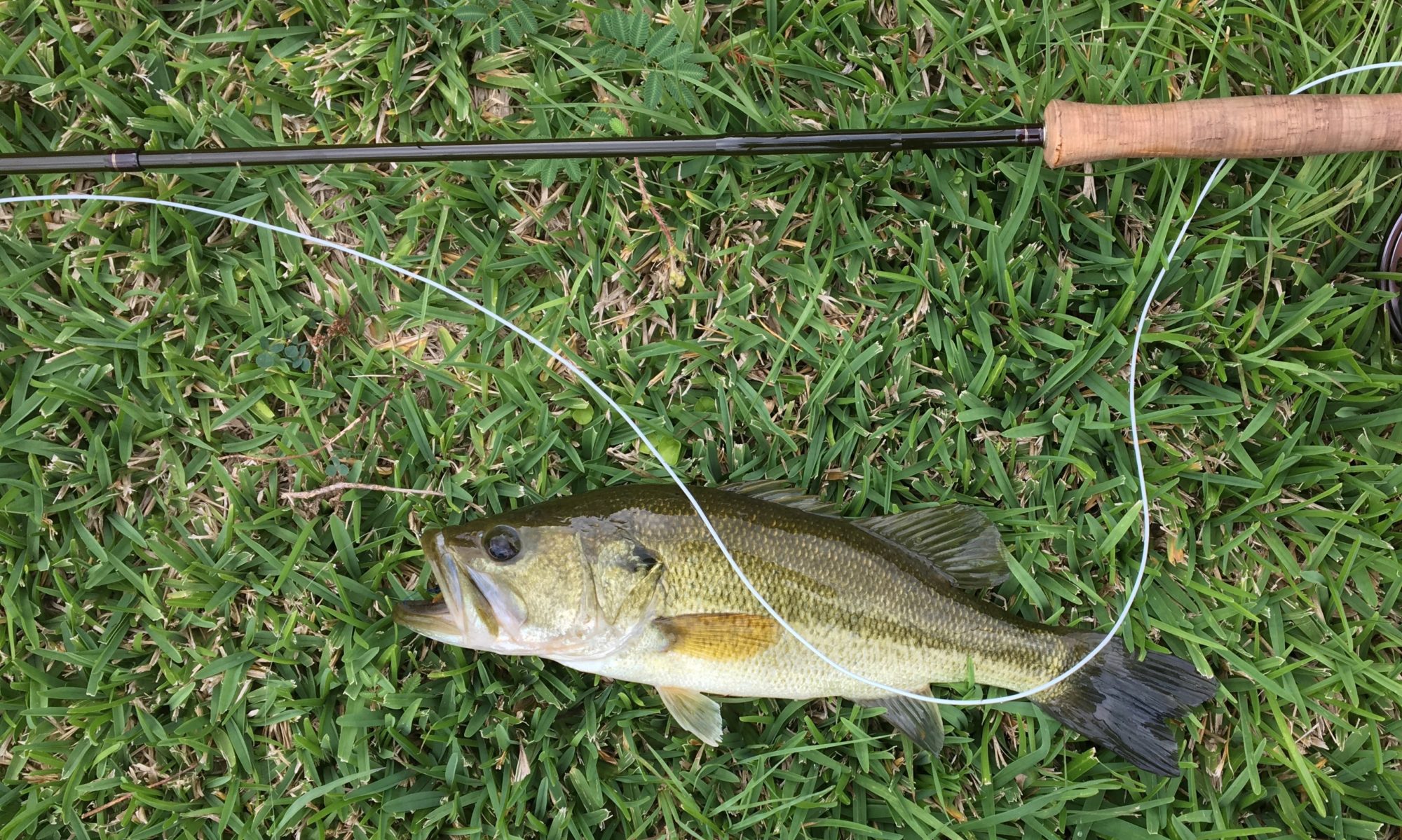
Alabama Bass, Spotted Bass, Redeye Bass, Tallapoosa River, Alabama, May 26, 2019

We postponed Kansas because of wind and lightning. Wind and lightning aren’t abnormal for Kansas in the spring, but it was lots of wind and lots of lightning. The New York Times said there were more than 300 reported tornadoes in the Midwest over the last 30 days. Of course whenever I read now of weather that’s a bit more than it should be I wonder if it’s climate change, and whether I should be buying land in soon-to-be-tropical Minnesota instead of going fishing. Being reasonably short-sighted I went fishing.

We fished mid-state, halfway between Birmingham and Montgomery. I picked mid-state in part because I found a guide, East Alabama Fly Fishing. The obvious play for us was the Gulf, from Gulf Shores or Mobile, but we’d already fished for redfish in Mississippi and Louisiana, so we drove four hours further and fished for bass and sunfish. Of course I would have liked to fish for redfish in Alabama, but we only had three days. Choices must be chosen.

So bass. How many species of bass are there? Nine, though it’s not the most settled thing in the world. Fish species identification has a way of being uncertain, even for the best known game species. The nine that are currently agreed on? Largemouth, smallmouth, Guadalupe bass from Texas, Florida bass, Alabama bass, shoal bass from Georgia, Suwannee bass from Georgia and Florida, spotted bass, and redeye. Our guide, Craig Godwin, said we would fish for spotted and redeye on the Tallapoosa.

There’s a problem with that, and it’s a complicated problem. spotted bass, also called Kentucky bass, and Alabama bass, also called spotted bass, are almost indistinguishable. When I thought about it later I had no clue whether we’d been fishing for Kentucky bass or Alabama bass. There’s an easy test. All you have to do is count the pored scales on the lateral line. Alabama bass usually–note the usually–have 71 or more scales with holes. Kentucky bass typically have 70 or fewer. If you use a magnifying glass and don’t lose count you can be pretty certain of your fish. Usually. Since we didn’t have a magnifying glass, and since we haven’t yet been to Kentucky and will likely never go back to Alabama, I’m claiming victory and declaring our spotted bass in the Tallapoosa River as Alabama bass.

Since I’d caught a largemouth just last week, and a smallmouth last year on the Shenandoah, I’m only five species away from a Bassmaster BASS Slam! I may make something of myself yet.

Back to the river, I had never heard of the Tallapoosa. I’ve heard of a lot of rivers, but before we left for Alabama if you’d asked me to name a single Alabama River, I couldn’t have named one. I knew there was a bridge in Selma, but I had no clue what river ran under it. It’s the Alabama, by the way, formed where the Tallapoosa and the Coosa meet near Montgomery.

We met Craig at the put-in at Horseshoe Bend National Military Park, considerably north of where the Coosa and the Tallapoosa meet. Our raft float to the Jaybird Creek boat launch was five and a half miles and a bit more than five hours. It’s a big river by my lights, not Mississippi big, but except around island channels where it narrows it’s at least a football field from bank to bank, and where the river falls it’s a limestone boulder garden. And there’s plenty enough fall. There are Class II and and even Class IV rapids on the river, though thank goodness no class IV where we fished.

It’s a tailwater, with four separate power dams. We were below the H.L. Harris Dam and above Lake Martin and Martin Dam. Craig said that the level of the river was driven by power generation at H.L. Harris, and that the river elevation could vary greatly. Maybe I’m wrong, but it doesn’t seem that the dams have changed the fish in the river. These are native fish, the fish that were there before we were.

It’s a clean river too, though no river I’ve ever fished was clean enough that I could see bass in current. Ponds, sure, if a pond is clear I can see fish, but these aren’t stillwater bass. Spotted Alabama and redeye bass hunt in the current and we fished the pockets back of rocks and the lines where the speeds of the river changed, and as close to the banks as we could manage to cast.

They were clean, beautiful fish, perfect for the river. First things first. Redeyes do not have red eyes. Some we caught had a red spot on the gill plate, and that may be where the name comes from, but frankly we saw more red in the eyes of spotted bass. They also aren’t big, and the redeyes we caught in the river seemed to be in the neighborhood of a pound. But the dark green and black backs paired with the turquoise lower jaw and belly was so colorful, they’re an unforgettable fish. They also have on the edges of their fins the slightest tinge of white, a hint, a tell, a joy to discover.

The Alabama bass are larger, and frankly I’d have confused them with largemouth if I hadn’t known better. The colors, even the lateral markings, often aren’t that different. The most obvious difference is the jaw. The jaw on a largemouth extends back behind the eye, the spotted bass’s jaw is in front of the eye. Plus there’s the whole current thing. Largemouth don’t live long and prosper in current.

We both fished five weights with floating lines, and most of the float we fished poppers. It was funny popper fishing though. We cast the popper, let it drift like a dry fly, and now and again gave it a twitch. Do you know how to fish a popper on a pond? There are lots of ways I suppose, but my best luck is to cast the popper, let it sit until the ripples die, then give it a nudge. Then let the ripples die and give it another nudge. I guess this was similar but in the absence of pond ripples the popper drifted. It was like fishing dry flies on a drift, except for the now and then pop.

Sometimes the sunfish would hit it, but the poppers we were using were just a bit much for sunfish. Look, I have to admit it, and I had to admit it to Craig, give me a choice of any fish in the world to catch I’d probably catch a sunfish. I loved them as a child, and I love them now. I love to see their colors and to try to parse out the species. I love their ferocity. We were catching bass, yeah, and there’s no nobler calling, tarpon or trout-be-damned. But this year I’ve caught a paucity of sunfish. Late in the day I switched to a Barr’s slumpbuster I’d tied up for Kansas, because I knew I would catch sunfish. I caught sunfish. Craig said these were longears, and I’ll go with that.

Just a note on fishing with Craig. I’ve fished with a lot of guides. I’ve fished with well-known guides and I’ve fished with extraordinarily skillful guides. I’ve fished with guides who were too young to be guiding and guides who were fun to fish with precisely because they were old enough to have seen all they could possibly see, older even than me. I never fished with a guide who took as much joy from the place or from me catching a fish.

Late in the day a fish on Kris’s line went under a rock and couldn’t be brought up. Craig went in after it. That’s service, or maybe you just can’t keep an Alabama boy from noodling.

That’s Southern humor, and I can get away with it. Don’t you try it at home.

Wind

The Wizard of Oz, 1939, Metro-Goldwyn-Mayer.

We’ve postponed Kansas. It’s the problem with spring on the Plains: weather. Growing up on the Plains you assume everybody has tornado cellars and tornado sirens and knows the name of the weather man on the local news channel, because no other threat is as real. L. Frank Baum got that part right, though I think he may have made up the part about Oz.

Kris found a wind map of the US on Tuesday that showed the continent east of the Rockies as a massive wind vortex, with the center at Wichita, Kansas. The forecast for the weekend isn’t better, it’s more wind with thunderstorms, and fighting wind and lightning isn’t a winning proposition, with or without a fly rod.

So we’ll go to Alabama instead.