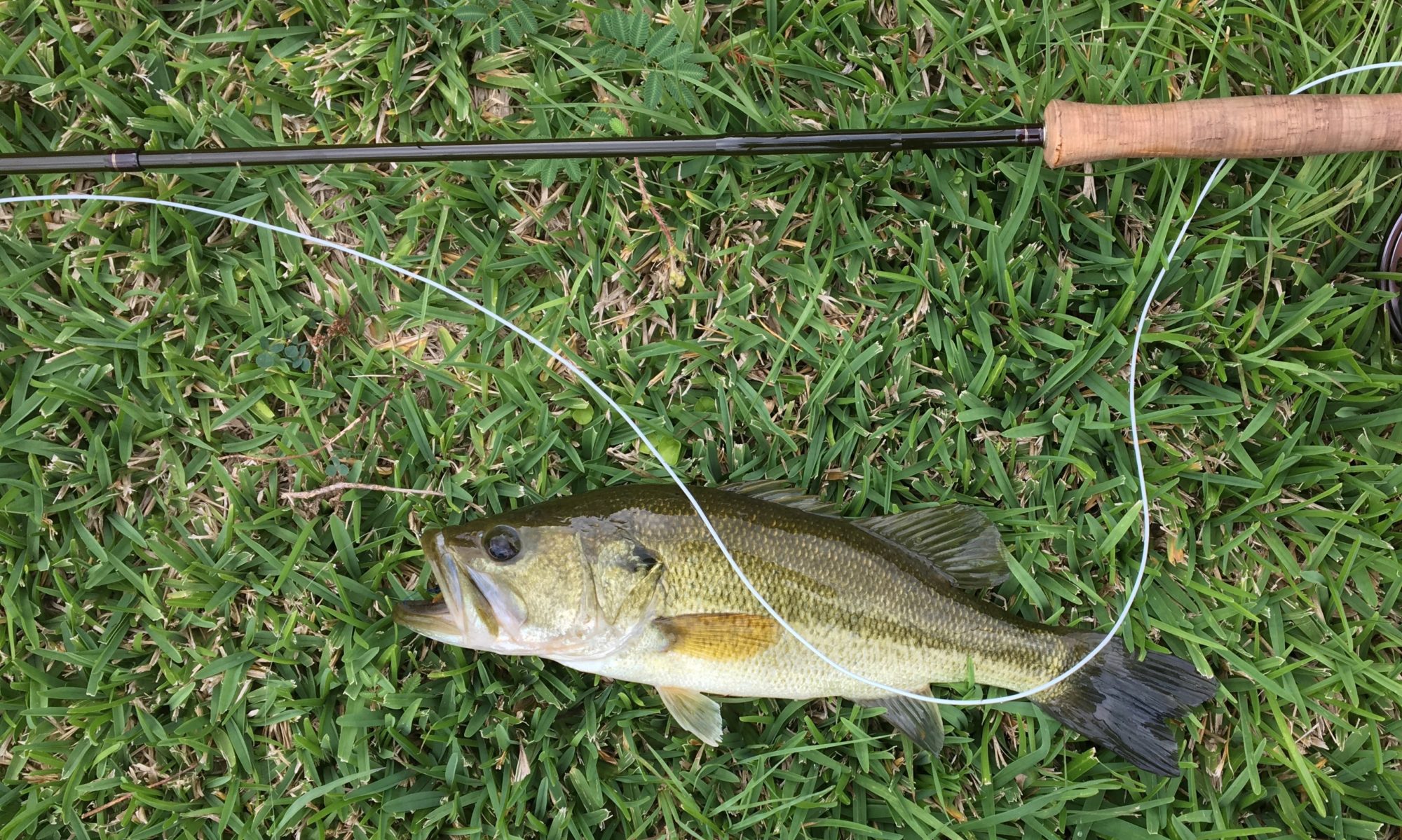
The largest trout I’ve caught was in Arkansas, in the Ozarks on the Little Red River in the northwest part of the state, on a root-beer colored streamer called a meat whistle. Whoever named that fly wasn’t subtle, but neither is the fly.
I caught that trout three years ago, and I considered including it in our list and skipping another trip to Arkansas. For some reason that seemed wrong–if I included Arkansas where would it end? North Carolina 20 years back? That trip to Wyoming 30 years’ ago? So a month ago we booked a weekend trip back to the Little Red on April 4. Then came Coronavirus.
The Little Red is a tributary to the more-famous White River, and like the White it’s known for its trout. It once held the world all-tackle record for brown trout, over 40 pounds. Since the 1980s, the browns are always wild, never stocked. It’s a pretty river, to my eye prettier than the White, and we fished it from a flat-bottomed, jet-motored sled-boat Nothing says Arkansas like a flat-bottomed, jet-motored sled-boat.
Parts of the Little Red are lined with vacation homes, but its banks are heavily wooded and the houses don’t intrude except when your fly gets hung on a dock. There’s always something for flies to get hung on. The Little Red and the White are tailwaters, and while trout aren’t native to Arkansas, water is discharged from the dams at 40-50 degrees, cold enough to dissuade the native black bass and catfish. Trout thrive.
My great-grandfather, Henry Louis Thomas, was born July 17, 1850, in Ozan, Arkansas, two counties northwest of the corner where Texas and Arkansas meet. His father, William Louis Thomas, was born I-don’t-know-where and died in Ozan in 1849. He was 38. Because of problems with a stepfather, as boys Henry and his older brother, James Jasper, left Arkansas on a donkey and came to Bowie County near Texarkana. It seems pretty desperate, but I suspect these were pretty desperate people.
All William Louis left behind was a marriage license, a denied dram shop license application, and two sons. I doubt that my great grandfather Henry could read, or at least that he could read much, and wonder what it must have been like for Amanda Adeline to be widowed and poor and pregnant in Arkansas in 1850. She was born in 1834, two years before statehood, in Argenta, Arkansas, now North Little Rock. She was 16 when Henry was born. She died in 1864 in Bois d’Arc. She was 30.
Bois d’Arc, by the way, is pronounced bow dark.
When I was a boy, my grandmother’s house was a few blocks south, the Texas side, of State Line Boulevard in Texarkana. The Texas side was dry, meaning that alcohol sales were banned. The Arkansas side was wet, evidencing a wildness that I suspected was typical of the other side of the street. The federal post office sits on the line, part in Texas, part in Arkansas. Near the post office is a peculiarly elaborate Confederate memorial dedicated in part to the women of the Confederacy, or at least the white women of the Confederacy.
“O great Confederate mothers, we would paint your names on monuments, that men may read them as the years go by and tribute pay to you, who bore and nurtured hero-sons and gave them solace on that darkest day, when they came home, with broken swords and guns!”
I don’t think there’s a corresponding monument for Southern women who weren’t Confederate mothers.
I doubt my family history is uncommon. I expect that lots of early immigrants to Texas came through Arkansas: white, black, or brown they could only have come through Arkansas, Louisiana, Mexico, or the Gulf. Maybe there were a rare few souls from New Mexico. My family history is probably only nuanced by the time some of my ancestors actually stayed in Arkansas.
Henry Schenck Tanner, Arkansas, A New Universal Atlas Containing Maps of the various Empires, Kingdoms, States and Republics Of The World, 1836.
Since Thursday I’m home, self-isolating. A colleague in Dallas may have the virus, and there is a feeling of inevitability about the spread of Covid-19. Fifteen days ago I went to a breakfast for the Harris County Community College system with about 500 others, and after the breakfast I stood in the foyer for an hour discussing local politics with a friend, the wife of a Harris County commissioner, and greeted passers-by. That evening I stood with our mayor in a crowded room for a reception for Cory Booker, and then left for a dinner at a Chinese restaurant with about half of the Harris County state representatives–the purpose was to advertise the plight of Asian Town restaurants. At all those events we were still shaking hands, hugging, standing closer than six feet.
Now of course our mayor has ordered all Houston dining room service closed, and I’m at home. Everything’s canceled. Everything’s ground to a halt.
I haven’t canceled our trip to Arkansas yet, and haven’t discussed canceling with Kris. I should go ahead and cancel, I’m pretty sure we won’t be going, but part of me wants to stock the van with groceries and sleeping bags and drive, to see deserted highways, to make Henry’s trip on that donkey in reverse. We wouldn’t have to interact with anyone except the fishing guide, and that would be outdoors. We could sleep in the van in WalMart parking lots, right? There are WalMarts in Arkansas, right? It would be a small rebellion against our current paralysis. At some point life must go on, or maybe not.
I need to spend a day outside. And I’ve only been home since Thursday.
I didn’t catch a steelhead on the Olympic Peninsula. I caught fish. I foul-hooked a couple of whitefish, landed two or three small rainbow—I remember a par and a smolt—and caught one nice 18” rainbow. I also caught a Dolly Varden. I didn’t know that Dolly Varden are named after a Charles Dickens character from the novel Barnaby Rudge, 1841. Dolly Varden are a pretty fish, with bright silver and pastel yellow jewels along their back and sides. Naming a pretty fish after a pretty Dickens’ character is such a 19th century sort of thing, you gotta like it. There was also a style of women’s dresses called Dolly Varden, which I suspect was named after the Dickens’ character and not the fish. The dress doesn’t much resemble the fish.
William Powell Frith, Dolly Varden, 1842, oil on canvass, The Victoria and Albert Museum. This is not the fish.
Kris had worse luck than me. She foul-hooked a whitefish, and her waders leaked. She was cold and wet and miserable the first day. It looks like a manufacturer’s defect, so back to Patagonia they go.
We fished with Ryan Steen of The Evening Hatch, and stayed at The Evening Hatch’s lodge on Lake Quinault. We don’t stay at a lot of lodges, but they are fun, and when we have, in Argentina and Belize, it’s been pretty luxurious, for us pretty glamorous. The Evening Hatch lodge wasn’t exactly luxurious, but it was very nice and the food was great and the coffee was excellent. It was less like a glamorous destination than when as a kid we visited my aunts’ house in Texarkana. The food was great at my aunts’ house too, though both aunts being Church of Christ there was nothing to drink but ice tea. Jeff and Jan Cotrell ran the lodge, and filled in well for relatives. If they weren’t younger than us they’d have made a great uncle and aunt. If we’d just played a bunch of dominoes it would have been my childhood all over again.
I caught the Dolly Varden on the Quinault River, above Lake Quinault. We floated from early to late, I’d guess six or seven miles, alternating between wading and swinging streamers with Spey rods, and nymphing with artificial salmon eggs, either plastic beads or yarn. The eggs were seven or eight feet under a bobber, and the point was to let the egg drift deep while we rafted downriver. We were fishing 9 foot 8 weights, with the bead drifting below a swivel and lead pencil weight crimped to the leader. Some folk would say that’s not fly fishing at all, but it takes some care to throw that monstrous rig without damaging your guide or yourself. I mostly managed.
Dolly Varden trout, Salvelinus malma malma, adult female, The Fishes of Alaska, 1906, Bulletin of the Bureau of Fisheries, Vol. XXVI, P. 360, Plate XL. Wikimedia Commons.
On the single hand rods we fished floating lines with a 30 lb nylon mono butt to 20 lb mono and finally to 15 lb tippet. When the bobber bobbed Ryan yelled SET! SET! SET!, and if I wasn’t watching the scenery I usually did. The set was sidearm, upstream, not a straight up trout set and not a strip set. The idea was to pull the bead out of the mouth and pull the hook trailing the bead into the mouth. The rig is supposed to result in fewer foul or deep hook sets for trout and steelhead, though because of their small mouths the poor white fish that went after the eggs were always foul-hooked, outside the mouth and in its skin. Maybe that’s why Western anglers don’t really like whitefish. It’s all that foul-hooking guilt.
In the river we drifted the egg along the seams and in the softer water just beyond the seams, and we caught a lot of trees, both drifting and casting. Poor Ryan lost a fortune in plastic beads and octopus hooks.
The Olympic Peninsula is a beautiful place, and the rain forest reminded me oddly of New York City back in the 80s, where if you stood still too long you’d get graffitied. Instead of spray paint the rain forest covers everything with moss. It’s lush, with each nook and cranny covered with something green and growing: ferns, moss, the largest red cedar in the world, the largest Sitka spruce in the world, the largest . . . Oh hell, I don’t know. Just about the largest every kind of tree except mesquite and mangrove, and they were probably there too until somebody logged them.
This is northern spotted owl country, which from its photos is a lovely little owl that doesn’t really deserve its notoriety, but it’s not an easy place for people to live either. There’s tension between the wildness of the place and its human inhabitants. Ryan tells good stories about the area, insightful stories, about backwoods North Carolinians who moved there a century before for logging, and who still live in isolated backwoods pockets; about Theodore Roosevelt creating the national park to save the elk wintering ground for hunters and how he incidentally saved the rivers for salmon and steelhead; about tribal netting of salmon and steelhead; about boom and bust logging and the minimal old growth forests preserved for the spotted owl.
It can’t be an easy place to live, either for the remaining tribal nations or the loggers, the commercial fishers, or the small business owners. The population is estimated to be a bit more than 100,000, or about 28 people per square mile, which is 15 more people per square mile than my hometown county in Texas, but still . . . It feels more remote, especially on the west side, and especially in the midst of all that isolating forest. Plus in West Texas we had oil and cotton and wheat and cattle, they’ve got trees and fish and tourism, tourism and fish and trees, and balancing wild places with making a living can’t be easy. It’s probably better now. At least for loggers and millworkers forest land is probably better managed, but it will never be perfect, and there’s always spotted owls to blame.
The flip side of all that fecundity is the rivers. The rivers aren’t rich with all the good things trout love, insects, baitfish, crawfish, there are few of them. The rainfall scours the rivers too often, much of the flow is glacial melt or spring water or rainfall, without a lot of organic stuff taking hold, and there’s not the richness in the water that grows concentrations of trout. There is some stuff, but the wealth in the rivers on the Olympic Peninsula is its access to saltwater. It’s salmon in the fall and steelhead in the winter that make the rivers great fishing, but it’s ultimately access to the Pacific, to baitfish and glass shrimp, that make the coastal rivers a destination fishery.
Kris didn’t have all the bad luck. I failed a cast—this is an important life lesson. You have to end the snap of the snap-T with the rod tip in or near the water or the weighted fly will slam into your rod tip and snap it. Notwithstanding its name, that’s not what the snap-T is all about, it’s not the snap-tip. It was operator error, but operator error that Beulah the rod maker will repair with a small contribution from the operator. Thank heavens for no-fault rod warranties.
The second day fishing we didn’t swing flies. I don’t know if it was because Ryan wanted to cover more water (we covered a lot of water), or because he was worried about Kris’s wader leak and wanted her to stay dry and warm (relatively warm anyway—we are, after all, from Houston), or maybe because he was sick of watching us flail around with Spey rods and wanted to watch us flail around with single handed rods (I don’t blame him, variety is the spice and all that). We were on a different river, the Clearwater, above where it joins the Queets. Fishing with Ryan was a bit like taking a river tour, only the sights to see were usually just the other side of that seam, closer to the bank, alongside that rock, and this is shallow. Every now and again he’d yell SET!
The Quinault ran through a broader bed with more channels and, as I recall, more riffles and rapids than the Clearwater. There was more rock in the river and on the banks, and more room between the river and the trees. The Clearwater ran in more of a channel, through heavier forest.
On the Clearwater I came as close as we got to a steelhead. There was a set, a thrash, a feel that this 8 weight may be too small for this fish, a streak of silver at the surface . . . It was enough to know that this is a big fish, to wonder if I could handle this big of a fish, and then it was gone. Just that moment, it lasted no more than that, but then again that’s the kind of lost fish that lasts a lifetime.
We had two days of sun while on the river, and it was amusing that Ryan had no sunscreen in his kit. “The next ten days,” he told us, “it’s rain.” Of course for all I know he was just telling us a tall tale. It may never rain on the Olympic Peninsula, and may always be sunny. I do know there are steelhead though. For a few seconds I hooked a steelhead.
Kansas is a pretty conservative state, more conservative than most. Kansas hasn’t had a Democratic senator since 1938, when George McGill, elected in 1930 to fill an unexpired term, lost his second bid for reelection. There was one other Kansas Democrat elected in the last century, in 1913. He lost in 1919. Maybe he won as a peace-time Democrat, that sort of thing happened before World War I, and it’s interesting that at some point we switched from electing senators in odd years to even. It clearly wasn’t a change that helped Kansas Democrats.
The current governor is a Democrat, and that happens in Kansas from time to time, not like all the time but every now and again, so maybe Kansas is less conservative than one might think. But over the last eight years Kansas was uncharacteristically prominent in the national news for a peculiarly conservative administration. Another governor, Sam Brownback, made Kansas the nation’s petrie dish for supply side economics. Brownback resigned the governorship to become President Trump’s United States Ambassador at Large for International Religious Freedom, and by the end of his second term when he resigned both Republicans and Democrats couldn’t get him out of Kansas fast enough. Hence there is now a Democrat in office–Brownback blowback.
Gage Skidmore, photographer, Sam Brownback measuring the bluegill he caught in Kansas, CPAC, 2015, Wikipedia.
In 2011 as a newly-elected governor Brownback pushed through radical tax reductions. Being a religious man, he had faith that if Kansas decreased taxation, the resulting economic stimulus would increase tax revenues. Common sense supports Brownback’s notions, at least somewhat: If you tax too much, say 100%, people won’t pay or won’t work and no taxes get collected. The generally accepted notion though isn’t that reduced taxation will always result in economic stimulus, but that there is an optimum level of taxation, a level at which necessary economic drivers like schools and roads and health care aren’t crippled, but the supporting taxes don’t themselves hold back the economy. In the Kansas Experiment, Brownback slashed rates of taxation in 2012 to lower tax revenues by $231 million. Brownback was certain that the reduced taxation would stimulate a slow Kansas economy, and promised more future cuts.
It didn’t exactly work. The Kansas economy continued to lag, and by 2017 the Kansas legislature had slashed expenditures on roads, schools, bridges, and other necessary stuff. The legislature, both Republican and Democrat, rolled back the tax rollbacks, and then overrode Brownback’s veto.
The Laffer Curve, a Historical Reenactment. Much of our fiscal policy over the last 40 years is derived from this napkin.
The notion that lower tax rates result in higher tax revenues isn’t new, and was the theoretical support for a number of U.S. tax cuts, even pre-Reaganomics, even by Democrats. Maybe its most famous association (other than with President Reagan) is with the economist Arthur Laffer, who in 1974 as a White House staffer sketched the Laffer curve onto a napkin for Dick Cheney and Donald Rumsfeld. Winner winner chicken dinner! I hope it was a paper napkin. I’d hate for a conservative administration to waste cloth napkins. On the other hand, maybe if it’s still around it could be like the Shroud of Turin, and we could charge admission.
Before that, in 1924, Secretary of the Treasury Andrew Mellon, he of Mellon Bank and one of our then-richest folk, wrote “It seems difficult for some to understand that high rates of taxation do not necessarily mean large revenue to the government, and that more revenue may often be obtained by lower rates.” At that time the marginal tax rate was 73%, and since as one of the .01% Mellon lived at the margins, maybe he had a better understanding of the result than most. The marginal rate was ultimately reduced to 24%, but then it was increased in 1932 at the outset of the New Deal to 62%. By 1951 following World War II, the highest marginal rate was 91%.
Trinity Court Studio, Andrew W. Mellon, 1921.
Tax optimization theory is not inherently conservative, but it does go hand-in-hand with a bulwark of conservative economics, Supply-Side Economics, dba trickle-down theory, dba voodoo economics. Supply-Siders believe that the economy is driven by production, by those willing and able to invest capital into producing more, and that the only way the economy grows is if production grows. Production only grows if the triumvirate of minimal regulation, stable monetary policy, and–here’s where tax reduction comes to play–low taxes spur producers to invest in production. It can’t, for instance, spur producers to go fly fishing in New Zealand instead of investing in production, because that’s not the sort of thing producers do. Consumption, the theory goes, will follow production, one supposes in part because of increased funds available to workers and in part because of the availability of goods. If you build it, they will come. Just look what happened to Iowa!
The direct counterpoint to Supply-Side Economics is Keynesian Demand-Side Economics. Give a consumer a dollar, and he’ll spend it on consumption, which in turn will spur production. I’m sure that there are Supply-Siders with complex calculations that prove Supply-Side is the very thing, and Demand-Siders with their own set of complex calculations that prove that Demand-Side is the very thing, and that I would make head-nor-tales of neither set of calculations. As a demonstration model though Kansas isn’t a very convincing proof for the Supply-Side. Maybe it failed because the state reduced tax rates for both the highest payers and the lowest? Maybe they should have increased taxation on the lowest to spur production? Maybe, but end of the day the Kansas economy started stagnant, and six years later was apparently still stagnant, and the state government was a mess. I hope Ambassador Brownback fares better with religious freedom, ‘cause if he doesn’t we’re all going to end up under Sharia law.
I’ve been thinking about Kansas a good bit, mostly because fishing Kansas is kind of intimidating to me. There are no fly fishing guides. There are no fly fishing guidebooks. It’s not a destination fishery and it’s a bit short on the fly fishing resources that destination fisheries usually have. I figure the cause must be a combination of high taxation and excessive regulation.
Kansas flat with tarpon, a preenactment
Just consider: fly-fishers like mountains, and Kansas is one of our flattest states. If mountain producers would just produce some mountains in Kansas, then fly fishers would flock there. If, for instance, mountain producers dug out the eastern portion of the state, and dumped the spoil in the west, Kansas could have both a mountain range and an inland sea: just add salt. Fly fishers would flock to both the mountains and the sea, as would bonefish, permit, tarpon, and trout. Clearly, the only reason that hasn’t happened is because of Kansas laws that discourage mountain and inland sea production, and the current high taxation on Kansas mountain and seaside property. If you produced a mountain in Kansas with a few good trout streams, I reckon just about everybody–not just fly fishers–would come to see it.
Did you know that if you took any song written about Mexico, and changed it to Idaho, the meter still worked? That’s why Canadians sing “South of the border/Down Idaho way.“
What We Took
We took gear for trout. We took a 3-weight rod, a 4-weight rod, and two 5-weights, and we never took the 4-weight out of the luggage. I liked the flimsy 3-weight just fine until it got windy, but it got windy a lot so I finally gave it up for the 5-weight. Both rods I took were Winstons, a new Pure 5-weight that Trout Unlimited sent me because I won their annual spelling bee, and a Boron IIIX that I picked up at a Gordy & Son’s remainder sale because Winston came out with the Pure. Kris took her Helios 3D 5 weight. I fished it for just a bit. I’m used to big booming saltwater rods. I’m not used to big booming trout rods. That rod is a big booming trout rod.
We took floating lines and some 5x and 6x leaders I’d tied. We didn’t use the 6x, and I think the guides laughed at me for owning 6x tippet. We took some reels, a couple of Abels, a Ross, a Hardy, but I caught exactly one fish on the reel, and then I was reeling in my line for a pause in fishing when for some unfathomable reason a fish hit the skating fly.
We took waders and boots for Silver Creek, but didn’t take them on the Middle Fork. The guides strongly discouraged waders in the boats, something about getting thrown out, waders filling with water, and drowning. All things being equal I’d just as soon not.
Our gear was limited by the weight we could take on the bush plane, 30 pounds apiece, and I was already taking 11 pounds of guitar and case. I paired down and then paired down again. Instead of taking all ten foam hoppers that I’d tied, I only took five. Really. I’m stupid.
We took a bottle of Four Roses bourbon in honor of William Faulkner’s birthday, and poured the contents into a plastic water bottle to save weight. Happy birthday William!
I gave myself a new guitar case for my birthday, a Visesnut, maybe the best guitar case made (though they make a carbon fiber model for about $800 more). For years I’ve traveled with a cheap 3/4 size classical that I would stow in the overhead bin. Coming through Chicago Midway on Labor Day I talked to a guy who always checked his guitar with his luggage, and when I asked Kris if I should get a better case and check my guitars she immediately said yes please. Apparently with a guitar case on a plane I’m a nuisance.
We took too many clothes, but that’s probably because we had great weather. I discovered that I really liked wearing a fishing shirt on the water, the kind with lots of pockets, because, well, pockets. When I just wore a knit pullover I wanted pockets.
I bought a new pair of shoes for the trip, Simms Riprap wet wading shoe. They worked great, except that I didn’t wear socks until the final day on the water. I should have worn socks. They’re better with socks.
What We Lost. Where We Didn’t Go.
Kris destroyed her IPhone on Silver Creek by dunking it. I destroyed my Nikon Coolpix W300 waterproof camera on Silver Creek by ignoring the warnings about cleaning the seals and then dunking it. If you ignore the warnings it’s not waterproof. I had to take pictures the rest of the trip with my GoPro, which was better for stills than I thought it would be. Kris had to use my phone. She takes most of the photos I post, and is better at it than I am.
We didn’t go to McCall or Couer d’Alene, both of which my parents loved 60 years ago. I’m sure they haven’t changed. We didn’t fish the Henry’s Fork.
What We Ate.
On the way out of Boise we stopped by the Basque Block and bought a baguette and cheese, which got us to Ketchum. Ketchum is a strange mix of college town sans college and affluent resort, but I enjoyed the Pioneer Saloon, where I had a long conversation with an older south Idaho rancher and his daughter about barrel racing, how I could never break 20 seconds as a kid, and why I don’t much like horses. Some of us just aren’t really horse whisperers.
The guides kept us fed on the river, breakfast, lunch, and dinner. In order of dinner entrees: fried chicken, pork chops, fajitas, salmon, steak. It was always excellent, though Idahoans could use some advice on how to serve tortillas. I got two deserts on my birthday, though one may have been for William Faulkner.
Books
I’ve already written about Housekeeping by Marilynne Robinson, which stands alone as a peculiarly great book about Idaho. Hemingway famously died there, but he didn’t really write anything important in Idaho except maybe A Moveable Feast, and that’s about Paris. But did you know that Hemingway’s buddy Ezra Pound was born in Hailey, Idaho?
Ezra Pound is at the heart of American literature, he really is. I like some of his poems very much, and there is still no writing more beautiful to me than Pound’s The River Merchant’s Wife: A Letter.
At fourteen I married My Lord you. I never laughed, being bashful. Lowering my head, I looked at the wall. Called to, a thousand times, I never looked back.
At fifteen I stopped scowling, I desired my dust to be mingled with yours Forever and forever, and forever. Why should I climb the look out?
Ezra Pound circa 1913, doing his best Bob Dylan, from the Paris Review.
That said, I suspect I wouldn’t have much liked Pound in the flesh. Since college, whenever I’ve thought of Idaho, I’ve wondered how Pound could have been bred and born in Hailey? I finally looked it up. Turns out he was born there because his broke father took a political appointment in Hailey’s general land office. He was born and then a month later Mom left one of the most beautiful places on earth for New York City because she wouldn’t raise her son in such a God-forsaken wilderness. Dad soon followed. It explains a lot.
Baseball
When we left Ketchum and civilization, the Astros had clinched the American League West. When we got back to Salmon they had clinched home field advantage over the Yankees and the Dodgers. It was a good way to return to WiFi. That whole Ukraine thing happened with the President too.
Birds
Kris birds, seriously birds, as in she’s permanently attached to a pair of binoculars and a birding guide, and she spent as much time in Idaho looking at her copy of Peterson’s New Birder’s Guide as I spent playing the guitar. There are birds, eagles and ospreys, that fish for a living, and we saw ospreys but we never saw an eagle. She was thrilled with the osprey skull found at a campsite.
There is a small bird on the river, called an ouzel by the guides but the American dipper by the guidebooks. It lives in the rocks by the river and is a delight and joy. They’re the only aquatic songbird in America, and one dusk when we heard a bird song I said to Kris that sounds like a mockingbird. Of course I always tell Kris every pretty bird song is a mockingbird, even when in Idaho where there are no mockingbirds, but for once I was sort of right; it was an ouzel. The New Birder’s Guide said its strong sweet tones sound like a mockingbird. And they do.
After Kris got tired of my collection of Josh Ritter (which is surprisingly extensive, and his Wolves is a great favorite), she found a bunch of songs with Idaho in the name or the lyrics and an internet comment that said there are a lot of songs with Idaho in the name or the lyrics, none of which have much to do with Idaho. Like I said, you can substitute Idaho for Mexico anytime you want, and it looks like lots of songwriters do.
Victor Wooten, a well-known jazz bassist and the bassist for Bella Fleck and the Flecktones, was born in Idaho. His parents were military, and he apparently stayed about as long as Ezra Pound.
b-52s, Private Idaho. I could do without ever hearing this song again.
Riders in the Sky, Idaho (Where I’m From). Ranger Doug is a great Western Swing guitarist, and Too Slim is responsible for the Paul is Dead Hoax.
Bryan Lanning, Idaho. It is stunning that there are so many songs called Idaho. This may be the only pop anthem called Idaho.
IDAHO, To Be the One. And this may be the only band called Idaho. I’d change my name, just because it’s so hard to google.
Gregory Alan Isakov. Idaho.
Gorillaz, Idaho. Bon Iver meets Harry Nilsson, and I’m not sure it works,.
BoDeans, Idaho. I’m just a BoDeans kinda guy. They’re from Wisconsin.
Jeffrey Foucault, Idaho. I liked this. Foucault is also from Wisconsin, and this song would have worked if sung about Mexico.
Y La Bamba. Idaho’s Genius. A Spanish lament out of Portland that mentions Idaho. I should have had these people on our Portland playlist.
Hot Buttered Rum, Idaho Pines. Bluegrass. Tennessee mountain music about Idaho.
Caitlin Canty, Idaho. Clean voices, clean guitars. Good Nashville.
Down Like Silver, Idaho. This is also Caitlin Canty, with Peter Bradley Adams. She must have a thing for Idaho.
Ron Pope, Twin Falls Idaho. Road song. More ok Nashville, but it’s kind of the problem with songs about Idaho: they don’t have to be about Idaho. It’s convenient. It’s exotic. It’s a place to yearn for in a sadly yearning sort of way.
Rick Pickren, Here We Have Idaho. This is the state song. It’s kind of a polka song.
Jeremy McComb, Bury Me in Idaho. McComb was born in Idaho. McComb sounds like he’s from Nashville. What is it with Nashville and Idaho?
Old Bear Mountain, Idaho. More Idaho Bluegrass.
Ronee Blakly, Idaho Home. This was from Robert Altman’s Nashivlle. Inauthentic old-time Nashville meets Idaho, and Blakly is still authentically great.
Clare Burson, Take Good Care. I don’t know what this song has to do with Idaho.
Cori Connors, Idaho Wind. I don’t know what this song has to do with Idaho.
Rosalie Sorrels, Way Out In Idaho. Sorrels was part of the 50s-60s folk movement, and recorded a number of Idaho timber and mining songs. They’re very earnest.
Tony Rees, John Renbourn and Stefan Grossman, 1978, Norwich Folk Festival.
John Renbourn, Idaho Potato. For guitarists of a certain type and age, Renbourn is a hero. This is classic Renbourn. If I were picking out a road trip playlist, this would be my Idaho song.
Drew Barefoot, Idaho. Instrumental that would fit just fine on an Ennio Morricone Spaghetti Western soundtrack.
David Robert King, Bad Thing. This guy listened to too much Tom Waits as a child. This is off his album “Idaho.”
The Eisenhauers, Idaho. Every time this came on I had to pick up the phone to see who sounded so great. They’re Canadian. I think they thought they were writing about Mexico.
Amy Annelle, Idaho. Annelle is from Austin, and has a troubled medical history and a lovely voice. Apparently writing about Idaho in Austin isn’t quite the thing that it is in Nashville. She’s the only Austin musician on the list.
All those songs called “Idaho?” You may not believe it but every one is a different song. If I ever write a song I think I’ll call it Idaho, and it will never mention Idaho once.
Reckless Kelly is from Idaho. I think of them as an Austin band. My fail.
One song named Idaho stood out: Idaho by Afroman. “Idaho, Idaho, Idaho baby/potatoes ain’t the only thing they grow.” Then the song gets obscene. Really really party rap obscene. Don’t listen to this with your children. Don’t listen to this if you’re squeamish. I’m squeamish, but it was funny to listen to once or twice.