Sunfish, Tarpon, and Donuts

Friday we fished the San Marcos River with Chris Adams of Go Outside Expeditions.  We’d fished on the San Marcos with Chris before, and there are few things as pleasant as repeating a river with a guide you like. Chris had a new raft, which was great, and his wife made cookies which were also great,  and we fished from 7:30 or so until almost 5, with Kris the client spending a good two hours trying to re-think Chris the guide’s business plan.  Meantime I added to my sunfish collection.

There was a nice redbreast, the most notable feature of which is that weird long opercle flap–the ear.  I also caught a long-ear, which is more boldly named but which runs a poor second to the redbreast in the long-ears competition.

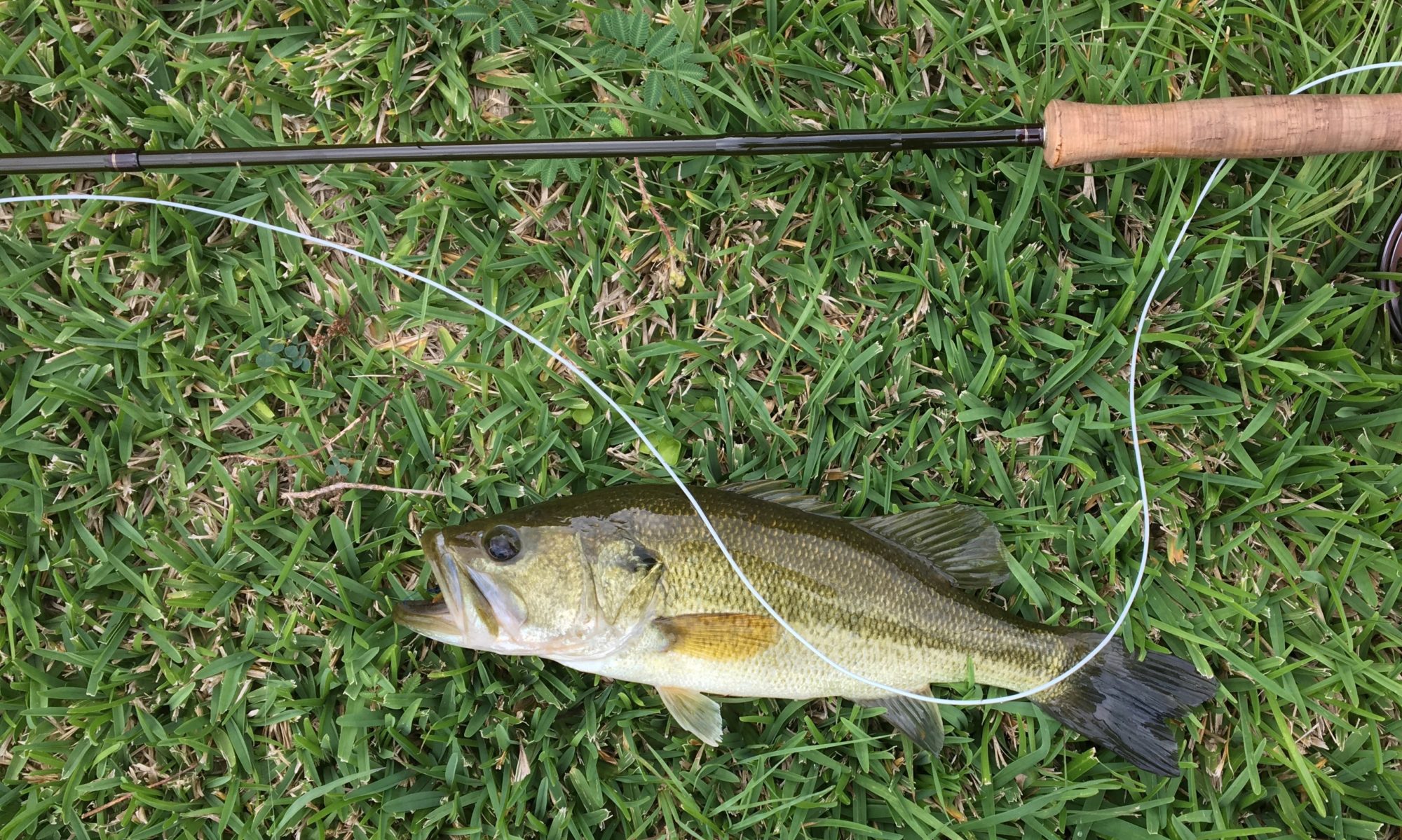
Kris caught the pretty Guadalupe-largemouth hybrid in the top picture and a warmouth and some largemouths and some other stuff.  I got a nice river largemouth.

Mostly we were fishing poppers and streamers with 6 weights, and we switched flies a lot during the part of the day when things were slow.

I noticed that the river fish aren’t as dark as the pond fish I usually catch.  They seem almost translucent, less brightly colored, and better matched to the shades of the river than the fish in weedier ponds. As long as it’s not time to spawn the fish match the place.

* * *

We go to Tampa at the end of the week to fish with Court Douthit, and I’ve had a lot of conversations in Houston about Tampa. It seems that everyone but me visits Tampa or came from Tampa, and a lot of the people I talked to have fished Tampa Bay for tarpon.

In the elevator a colleague told me that she went to St Petersburg for a deposition, and thatshe had to cross the Howard Frankland Bridge. Halfway across with no other traffic she had a memorable anxiety attack. Duly warned.

At Gordy & Sons, I was buying a big game sinking line and got into a conversation with an employee and another customer. The customer said he’d fished Tampa a lot, that the bait fishermen gather to catch tarpon on their way into the bay at the Howard Frankland Bridge, and that the boat bloom was not to be missed. “You should get your guide to take you there just to see it.” The same thing happens up and down the west coast of Florida, famously at Boca Grande for abundance of tarpon and Homosassa for the size of the tarpon. The customer told me that the boats were so crowded that the guides carried knives, big knives, to slash tangled lines. I could picture guides in center consoles slashing away with sabers.

Last Thursday a client showed me his picture of a 70-pound tarpon caught in Tampa the weekend before.  We were in a medium-sized banquet room, about the size of a basketball court, and he said that in a space the size of that room there would be 100 boats. He said they were fishing 60 feet deep with crab, and that the guides were so used to the press that a path opened for his boat to follow the tarpon’s run.

I’ve been reading Marjory Stoneman Douglas’s River of Grass, and because of the conversations and the reading it finally struck me that I was missing something important.  Douglas is a lyrical writer. She describes the Rock, the limestone spine that gives Florida shape and substance, the concave shape of which creates the Everglades, and which plays out as the Keys in its final submersion. It struck me that because it shapes Florida the rock also shapes the tarpon migration up the western coast. Like I said, Douglas is pretty lyrical, and maybe I let too much rub off.

The tarpon migration, not the limestone migration, follows the Gulf Coast from the Keys as far as New Orleans. For marine biologists the number of tarpon that migrate and why they migrate, including their inshore excursions, is one of the grand mysteries. It’s probably all the usual fishy reasons: Sex and food and protection. They spawn offshore so inshore would only be a staging point for spawning, but there’s certainly food inshore.  Maybe they come in because from larvae they’re hardwired to move offshore to inshore, inshore to offshore. It’s some kind of vestigial biological instinct that plays no real purpose. Maybe.

In the 1880s anglers figured out that tarpon migrate and could be caught with light tackle at the openings of the bays, so the anglers began show up in numbers to match the tarpon. Maybe we’re as hard-wired to follow game migrations, whether woolly mammoths or salmon or tarpon, as tarpon larvae are to move inshore. Maybe the angler migration is as much a vestigial instinct as the tarpon migration.

Postcard, Tarpon Inn, Port Aransas, Texas, 1911-1924, The University of Houston Digital Library, from Wikipedia

It also struck me that I hadn’t connected Marjory Stoneman Douglas with  Marjory Stoneman Douglas High School, where the mass shooting occurred on Valentines.  She doesn’t deserve that connection, but no one does.

* * *

Bakeries, which in my worldview includes donut shops, are necessary to fishing, and on our way to fish with Chris from where we were staying in San Antonio we stopped at Mi Tierra’s panaderia for breakfast.  Of course what we really wanted was to have the huevos rancheros at Mi Tierra: there’s no better bacon or coffee or wait staff anywhere, but we were running late. It was doubly disappointing.  There was no pan dulce that early, only empanadas, and they were only ok.

Earlier this year driving from Houston it struck me that every donut shop on the way to the Guadalupe River seemed to have a Buddhist shrine.

There’s a large Vietnamese population in Houston, and I figured the donut shops must be Vietnamese.  Turns out no.  Cambodian.

At the Foodways Texas symposium in April there was a panel on Cambodian donut shops moderated by Rob Walsh, with David Buehrer, Houston’s hippest coffee guy, filmmaker Keely Steenson (who showed her film on Cambodian donut shops), and Samoeurn Phan, a shop owner. Turns out that most donut shops in Southeast Texas are Cambodian-immigrant owned. These aren’t hip donuts, they’re not cutting-edge donuts, and they’re not authentic kolaches (because every Texas donut shop has to have a kolache which is a sausage roll which is not actually a kolache). They’re working class cheap donuts. Joy Donuts. Snowflake Donuts. LeDonut (where I go for the boudin kolaches, which are also not technically kolaches but which are delicious).

It’s no accident, and it’s all in the business plan. A Cambodian donut entrepreneur builds out the shop then finances its purchase by a Cambodian family, as often as not relatives of the entrepreneur. There’s no bank, because no bank would finance the venture, and it’s a family affair. Mom’s in the front at the counter, dad’s at the back turning out donuts.  It’s a hard way to make a living, but it’s a way to make a living.

Steenson has a film on Cambodian donut shops which was shown at the symposium and which I hope will someday make it to the internet.  Buehrer, the hip coffee guy, had worked at Phan’s donut shop in high school. That, he said, is where he learned about customer service. And kolache. So a hip Anglo coffee entrepreneur learned about an old-fashioned Czech pastry from Cambodian donut entrepreneurs in the Houston suburbs. That’s kind of the way Houston works.


Tarponesque Physiques.

Michaelangelo, detail of the Prophet Jonah (with tarpon) from the Sistine Chapel, 1508-1512.

Tarpon are big girls. They’re big boys too, but the lady tarpon are generally bigger and can reach lengths of more than eight feet and weigh more than 300 pounds. The males are smaller. Females live longer than males, as long as 50 years. Lucky males may make it to 30.  Tarpon obtain sexual maturity at seven to 13 years.  By the time a tarpon reaches 100 pounds it’s 10 to 13 years old.

In their larvae stage tarpon absorb nutrients direct from seawater.  Small juveniles start eating smaller fish, but primarily they’re planktivores and live on  zooplankton. As they grow juveniles eat more fish and add shrimp and crabs to their diet. By maturity they are strictly carnivorous. Sub-adult and adult tarpon eat shrimp, crabs, mid-sized fish like mullet, pinfish, and needlefish, and apparently have a soft-spot for sea horses.  I’ve never fished a sea horse fly, which is probably why I haven’t caught a tarpon.

Tarpon swallow prey whole, which explains the forward placement of the hooks on tarpon flies.  Short takes aren’t a problem.  I’m told that what is a problem is setting the hook Their mouths are hard and strip-strikes are de rigueur. Hooks must be sharp, though whether hooks should be barbed or de-barbed is a controversy. A guide in Belize rejected my tarpon flies because I’d flattened the barbs. Bill Bishop’s High Rollers: Fly Fishing for Giant Tarpon suggests partially flattening barbs, but that seems like neither fish nor fowl. At least the de-barbers have the argument that it’s easier to set the hooks, and it’s easier to pull the hook out of your guide when you makes that special cast.

Bite tippets are needed because tarpon have small densely-packed sharp teeth, villiform teeth, and writers universally criticize the IGFA 12-inch standard for bite tippets. Big tarpon will swallow flies deeper than 12 inches. Twenty-four inches appears to be common practice among anglers, IGFA be damned. There goes my record.

Tarpon have draw bridge jaws and knight-in-armor gill plates. Their silver sides are as straight and thick as walls. They attack prey from below. Look at those eyes. Look at that jaw. That’s no carp, that’s no bottom feeder.

Their scales are as large and bright as half-dollars.

Other than the Indo-Pacific tarpon, the tarpon’s closest relative is the skipjack, wrongly called ladyfish by everyone but Texans. Skipjacks, like eels,  bonefish, and of course tarpon spawn offshore and come inshore as larvae. Like tarpon the skipjack leaps when caught and shreds leaders. They’re just a lot smaller.

Catching skipjacks in saltwater is kinda like catching bluegills in fresh: universally frowned upon by conventional tackle folk but universally loved by fly fishers.

* * *

If I had to pick a fish to hang out in the Mos Eisley Cantina, I’d go with a tarpon. They appear intelligently malevolent, aloof, violent. They look alien.  Maybe Admiral Ackbar’s ancestors evolved from tarpon.

Ok, maybe I’d pick a gar for the Mos Eisley Cantina.  Gar are tarpon’s distant cousins: they share soft rayed fins.

State of New York Forest, Fish, and Game Commission, 1901

Of all the traits of tarpon though, the one that may be the most defining (and another trait shared with gar) is its air-gulping, lung-functioning swim bladder.  On two separate trips I’ve fished rolling tarpon off the South Padre Island jetties, but they were coming up to gulp air for fun, not necessity. Juvenile tarpon mature along mangrove shorelines in stagnant backwaters The absence of oxygen-rich water keeps out most predators. Because juveniles can roll and grab oxygen from air, they can live where other fish can’t.

As an aside, there’s nothing more startling than being on a bayou on a hot summer day, mildly conscious of alligators, and have a four-foot gar pop-up to roll next to your canoe. I don’t think they’re after air. I think they just want to hear me yelp.

* * *

We took the skiff out yesterday.  There’s a tropical disturbance in the Gulf, and it was blowing 20 offshore and picking up fast inshore. It wasn’t bad when we left, but we couldn’t find any water clarity, and the wind made things miserable. We didn’t last long.

Don’t get confused by the photo: our boat’s the one in the front. When we left the Marina we had to pass the cruise liner in the Galveston Channel, and there were Coast Guard cutters running interference.  They waived us further out, to the far side of the channel. It’s the first time I can recall being told what to do by a guy with a mounted machine gun.  I followed instructions.

Today, Father’s Day, we fished a bit for bass at Damon 7 Lakes. The photo doesn’t do the fish justice, though it does a nice job on me.


I caught a textbook bluegill while messing around with a Tenkara rod.  I was listening to Zane Grey’s stories about battles with monster tuna and swordfish and tarpon and stuff, but I couldn’t stretch the bluegill into a five-hour epic struggle of man against fish. Still, the blue on the gill plate complimented my shirt.

West Virginia

In West Virginia we’re staying at Elk Springs Resort & Fly Shop on the Elk River to fish for trout, non-native brown and rainbows most likely.  When I called to book, I asked the reservations lady how far it was from the lodge to Washington D.C. .  She didn’t know.  However far it is, I suspect in some ways it’s further.

Virginia and Maryland share a lot of things, but most of all they share geography. Because of a compromise over the national bank that put the nation’s capitol in the South, they share Washington D.C.. On the east they share the Chesapeake Bay. Coastal Tidelands in each state rise from the Chesapeake and both states turn into a fertile Piedmont region above a fall line.  On the west of both are the Allegheny Mountains, which are part of the Appalachian Mountains.

Interestingly, the Appalachians were named by a Texan, Cabeza de Vaca. Not really, but they were named apparently by de Vaca’s Narvaez expedition.

The Southern Appalachians, the mountains of West Virginia, Kentucky, Tennessee, Virginia, Maryland, and North Carolina, are what I think of culturally as Appalachia, but who knows?  Appalachia may stretch from New York to Georgia. I used to think of the area as isolated, violent, poor, and uneducated, with clan feuds and moonshining. Now I can throw in opioids, meth, and Trump voters.

Some of that stereotyping is fair, too. West Virginia, in the heart of Appalachia, became the bellwether state for articles on why white working class voters were voting for President Trump. And they did in West Virginia, by 67.9 percent to 26.2 percent. My guess is they voted for President Trump because they knew Mrs. Clinton thought them a basket of deplorables.

West Virginia had the highest rate of opioid deaths in the U.S. in 2016, at 43.4 deaths per 100,000. Actually, at 75.4 years, West Virginia has the lowest life expectancy of any state except Mississippi.  The only measured category of death where West Virginia isn’t running with the front of the pack is Alzheimers, one supposes because people don’t live long enough to die of Alzheimers. You want to die by accident? Move to West Virginia. You want to die by suicide or gunshot or meth or black lung? Move to West Virginia. Your chances are usually right up there at the top.

Here’s the oddest thing about West Virginia: it’s 93.6 percent white. If someone told me that a state was 93.6 percent white, I’d assume we were talking about Idaho or Utah. Virginia is 68 percent white, 19 percent black.  Maryland is 58 percent white, 29 percent black. West Virginia is 93.6 percent white. That’s a lot of white folk.

Settlement by whites was pretty thorough, but it didn’t really kick off until the mid-18th century.  The French and Indian War was fought in part over the Ohio Valley, which stretches from Pennsylvania down to Kentucky, with West Virginia at its heart. After the release of claims by the Iroquois and Cherokee (surely absent violence), settlers started in. Ok, they started earlier, but they started in now with England’s blessing.  First were Germans, and lots of Scots via Ulster, the Scotch-Irish.

From early on, West Virginia was different from the rest of Virginia.  It was subsistence living that didn’t support slaves, at least until coal mining.

Louis Hine, 1911

During the Civil War there were two areas in the seceding states that were strongly pro-Union, Western Virginia and Eastern Tennessee.  It was Lincoln’s dream that Eastern Tennessee would separate from the Confederacy, but it never did.  West Virginia did. On Amazon you can still find books about why the separation of West Virginia from Virginia was unlawful and unconstitutional.  Get over it.

Coal was the 18th century’s oil. It was the rural industry that turned us into a modern nation. It was and is a bloody, dangerous, unforgiving industry. Coal gave us some of the most violent labor disputes in the nation’s history: think machine guns mounted on train cars and fired into union strikers. Over 150 years coal gave us Mother Jones, strip mining and mountain-top removal and other ecological destruction, mine deaths, and a purchased West Virginia supreme court. it’s all Hatfields and McCoys, one way or the other. It’s always The Wild and Wonderful Whites of West Virginia, but sometimes at the corporate level.

Hills and hollers. It’s beautiful, a friend said. People use words like hollers when they talk about West Virginia.

When I put together my playlist of songs for West Virginia, it wasn’t very long. There was one person who I greatly admire but didn’t expect, Bill Withers, and there was lots of Mountain Music. And of course there was that John Denver theme: take me home.  It’s the most common theme of West Virginia songs: “My Home Among the Hills,” “West Virginia My Home,” “I Wanna Go Back to West Virginia,” “Green Rolling Hills.”  In our minds we love West Virginia. In our minds West Virginia is the idyllic wildness we yearn for.

I also put Appalachian Spring on the play list, and Mark O’Connor’s brilliant Appalachia Waltz.  O’Connor is from Seattle, and of course Copland was a Jewish kid from Brooklyn.  We all have our notions about Appalachia. Take me home.

***

I did finally get a decent photo of a bluegill, a tiny thing that hit a tiny yellow popper and as is their want hit it hard enough to take in the whole thing.  Lepomis machrochyrus. I originally misidentified the fish because it didn’t look like the pictures of a bluegill on the Texas Parks and Wildlife website, and maybe my fish is something entirely different.  Sunfish are wanton little devils, spawning from May to August, and apparently they hybridize readily among species.  This one has the wrong color fins and the colors generally seem off. It’s just as likely that this fish is the product of some unfortunate parental liaison between two breeds of sunfish.

I caught a nice bass on the same tiny fly,  next to the grass in a pond backwater.


Tenkara-san

Kris gave me a Tenkara Sato outfit from Orvis for Valentines Day.  I gave her more or less the same thing, a Temple Fork Outfitters SH 11’6”. She tried hers on the Guadalupe but didn’t catch anything. I tried mine for the first time Sunday, fishing along the banks at one of Damon’s 7 Lakes for sunfish.  I only had about an hour, and kept meaning to switch to a popper but never did. I didn’t see many sunfish, but I caught one small bluegill and three smallish bass.

It took me a while to set up the rod and line, and my set up was . . . creative. Ignoring the instructions I tied some perfection loops and stuck things together. It was close enough to the picture, with the line that came off the rod dangling off the rod tip and a bit of standard leader attached to that. The booklet informed me that Tenkara was fly fishing, not dapping or cane rod fishing. From what I could tell it was about as much like dapping or cane rod fishing as it was like fly fishing, but I fished with a Damon’s owner’s favorite fly, a BBB. “BBB” stands for something, of which “bitchin” and “bream” are part, but I never have had it straight. They’re pretty easy to tie though, and they catch fish.

For me the 10’ rod had a range of 10-15 feet from the rod tip, plus or minus, but it was easy to cast and reasonably accurate.  Tenkara rods don’t lend themselves to long stillwater retrieves, but in a way they’re perfect for spring bass and bream in shallow water.  Every fish I caught hit while the fly was sinking through the water column, not while it was moving.  Toss, wait, toss again, wait. it’s intimate, visual, almost as good as dapping: all but the sunfish was caught when I set the hook after watching the fish take. If I hadn’t just  blundered down the bank not paying much attention, if I’d used just a modicum of stealth, I probably could have done much better, and caught more fish. Of course if I’d switched to a popper I might have caught more fish.