We took too much stuff. Some of it was necessary; waders, boots, rain gear, clothes, wading staffs; and some of it just made us happy; 5- and 6-weight rods, reels, floating lines, my guitar, running shoes, and boxes of flies; but it all adds up, both in bulk and in pounds. The whole of it makes getting through the airport awkward and fraught. As usual when we fish with freshwater guides, we never touched the flies we brought, and the guides had great rods we could have used. Freshwater guides always favor their own flies, and most of them have good equipment to lend.
Saltwater guides are different. A lot of our saltwater fishing is done in places that are poorer than the US, in Mexico, Belize, the Bahamas, Cuba. The guides have a boat, lunch,1 knowledge of the water, and very good eyes. Anything else, flies, rods, reels, tippet, we have to bring.
There is an excruciating moment on those foreign saltwater trips when the guide opens my fly box and passes judgment. I once had a guide in Belize reject all, every one, todos los dias, of my tarpon flies because I’d crimped the barbs on the hooks. I came home and threw them all away, then I tied dozens more with un-crimped barbs.
One side of one of my three Andros Island fly boxes. I’ve really pared back my luggage after Montana.
We are supposed to go this week with a large group of guys (and Kris) to fish for bonefish at Andros Island in the Bahamas. After Montana I vowed I would never again travel with more than a pair of swim trunks and wading boots. Packing for the Bahamas I’m considerably over budget. Of course I’m also watching the National Hurricane Center (is there anyone left at the National Hurricane Center?) to see whether Hurricane Melissa is going to cancel our trip. It just ravaged Jamaica, a bit south and east of Andros.
But back to Montana, Kris once again didn’t like her ancient Orvis Rocky Mountain 6-weight. She fished instead with the guide’s Orvis Recon 6-weight. Recons I swear are guides’ favorite rods. They’re a bunch cheaper than the top-of-the-line Orvis Helios, but whenever I’ve fished with a guide’s Recon I’ve always been surprised at how much I like them. I know what’s under the Christmas tree for Kris! And to think some girls might not appreciate a new fly rod for Christmas.
Hotelsand Restaurants
I’ve already talked about our learning experience from a week in an RV, and our lifetime experience from two nights at Old Faithful Inn. Other than that we stayed in airport hotels — a Holiday Inn Express and whatnots — charmless and functional. They did what they were supposed to do, which was to get us to and from the airport.
In Bozeman we actually drove past a number of renovated 60s motels, and I really wished we’d stayed at one instead of at the airport. Next time.
While we camped in the RV, breakfast and dinner were in camp, lunch on the river, and all were prepared for us by Justin the camp manager. They were uniformly great. We should eat so well at home.
In Yellowstone you’re captive to the food program of the park concessionaire. No matter how different the setting or how distant one from the other, the lunch menu in the park’s scattered snack bars is always the same. For some reason I kept ordering the vegan black bean burgers, and they contributed greatly to the atmosphere.
Evenings in the park had a broader range of food choices. The best restaurant in the park is supposedly at the Yellowstone Lake Hotel, so of course we never ate there. The dining room in Old Faithful Inn is very pretty, but the food is what I’ve imagined the food on a cruise ship would be, a relatively expensive prime rib-focused buffet with a lot of old folk like me lined up at the trough. It was fine, but it was expensive, and there was pressure to get one’s money’s worth. We had nice conversations with our Romanian waitress, Barbie, about how she and her Romanian boyfriend had made it to Yellowstone to work for the summer.2
We ate at a steak and burger place in Bozeman, Montana Ale Works, and it did have good ale. In Helena we ate at Bella Roma, which is at the edge of a lively pedestrian zone, so we saw a bit of Helena on a Saturday night. The last night in Bozeman we ate at Revelry, and it was great, with great service, a good menu, and an observation-worthy crowd. It seened the opposite of the Yellowstone dining room crowd — young and hip, just like Kris, instead of old and fat, just like me.
We never ate any Montana donuts. I guess we’ll have to go back.
The Montana State Capitol
On the way out of Helena we drove by the Montana State Capitol. From the rotunda surrounding the base of the dome you can see four paintings that sum up Montana history: a trapper, a Plains Indian, a cowboy, and a miner. All they needed to have achieved the completest thing was a portrait of Anaconda Copper and a fishing guide .
Fly Shops
Fly shops in Montana are as common as convenience stores on an interstate. It is a fly-fishing consumer’s dream.
Playlist
There are a lot of songs about Montana, but fewer songs from Montana. Nicolette Larson was born in Helena, but she didn’t really grow up there, and she died too young. Emylou Harris wrote and recorded “Montana Cowgirl,” and also a nice duet of “Montana Skies” with John Denver. The Gypsy Kings recorded a song, “Montana,” but I’m reasonably certain that their “Montana” is Spanish for mountain and has nothing to do with the state. Jimmy Buffett wrote “Livingston Saturday Night” from the wild days when Buffett, Thomas McGuane, Margot Kidder, Jim Harrison, Russell Chatham, Peter Fonda, and Richard Brautigan established Livingston as Key West North.
“I Ride an Old Paint” is the best song about Montana. There’s a New Age pianist, Phillip Aaberg, who’s very pleasant to drive to. Jeffrey Ament of Pearl Jam is from Havre, Montana. Merle Haggard’s “Big City” has something to do with Montana, but I can’t listen to that song because if I do then I can’t stop repeating “so-called social security” over and over in my head.
“The Red-Headed Stranger” is from Blue Rock, Montana. “Long-legged Hanna” is from Butte. “Oh Shenandoah” is our loveliest folk song, and while it doesn’t specifically mention Montana, it does mention the wide Missouri, which gives it credence on the playlist of any state that the Missouri touches.
Guitar
I took my 70s Kohno and added some new stickers to my guitar case. I played a lot, especially in the evenings, and I don’t think I bothered anyone, much. In keeping with my new austerity program, I’m debating whether to take a guitar to the Bahamas. I’ll really miss it if I don’t, but there you are. I will not miss lugging it through the airports.
In the States, saltwater guides usually don’t have lunch, and the old line about guides in the Florida Keys is that you’re expected to take them lunch. On one of my favorite trips for redfish in Ocean Springs, Mississippi, the guide brought two pounds of boiled crawfish. The fishing was a bit sparse, but we spent the day eating crawfish and shucking the shells into the bay. ↩︎
Barbie looked just enough like Scarlett Johansson to make her a fascinating conversationalist regardless of what she was saying, though I wonder if Barbie is a common Romanian name. I suspect she adopted a waitressing name that amused her. ↩︎
It’s a toss-up between a good kolache1 and a good donut, but I’d probably choose the kolache because they’re less common. Pretty good donuts can be found in lots of places, but the best kolache are found only on the edge of the interstate in small towns. In Texas they’re common enough, and in one of the best things you can say about anyplace kolache are common in Nebraska.
Kolache are Czech, re-homed by Czech immigrants to Texas and the Midwest, and are most often compared to Danish. It’s not an apt comparison. Danish probably originated in Austria, are often glazed, and like croissant are made with a laminated dough. Kolache should never be glazed,2 or laminated, and they feature a mildly sweet pillowy yeast dough.
Kolache are about the size of a biscuit. The center depression is filled with either a fruit preserve, sweetened cream cheese, or sweetened poppy seeds. A kolache without any filling would be a tiny bread loaf, not a kolache, and there’s no such thing as a sausage kolache. Except there are sausage kolache, but more on that later.
Many years ago I witnessed a panel discussion by a group of Tex-Czech bakers, who said that traditional kolache were filled with prune preserves, sweetened farm cheese, or poppy seeds. The panel members had all grown up on small Central Texas farms during the Depression, and explained that their mothers baked the big three because prunes were very cheap, everybody–meaning every Czech farm family–had a cow and made their own farm cheese, and that there were always poppies in the farmyard. I guess that in addition to farm cheese all those Czech farm wives made their own opium.
Kolache are filled with all kinds of fruit, not just prunes. I’d probably eat any kolache offered, but if they’re available I usually order one or more of the big three: a farm cheese, poppy seed, or a prune. At the kolache counter in Hruska’s in Ellinger–which sells my favorite kolache and where there’s always a line–the woman behind the counter once beamed when I ordered all three and said that those were the three kinds of kolache that her mother always made. That touch of tradition made both of us happy.
I don’t know the history of Kolache in Nebraska, or even how I knew that Nebraska, like Texas, loves kolache, but we had a campsite reserved for three nights at Smith Falls State Park near Valentine, Nebraska. Since by the first morning we had our Nebraska fish (or more precisely I had my fish and Kris had decided not to fish), the next morning we packed up our campsite a day early and took a 150 mile frolic out of our way to Verdigre, Nebraska, the self-proclaimed Kolach Capitol of the World.3
The dough in Verdigre Bakery’s kolache is a little different from Texas kolache. It’s less puffy, denser, more bite sized. . . Maybe the dough is a bit less sweet. After extensive sampling I couldn’t tell any difference between Texas and Nebraska fillings. The picture above is of poppy seed, so I guess opium is also a farmyard cash crop in Nebraska.
The lady in the Verdigre Bakery said that Texans sometimes stop by for kolache, but that we always asked for sausage kolaches. Kolache with sausage are not actually kolache, but klobasnek (or pigs in a blanket). Calling klobasnek “sausage kolaches” is common usage in Texas, and they’re made with the same dough as kolache. Still, even if it’s common usage, the misuse greatly annoys some Tex-Czechs.4 Kolache lovers from other states are just confused.
From Verdigre we drove another 180 miles out of the way to Omaha, because we had never been to Omaha, and somewhere during the drive to Verdigre we decided that this was our big chance. The College World Series was scheduled to start the next day, and Omaha’s streets were crowded with LSU purple and gold. I didn’t see any Coastal Carolina fans, which was the other team in the Series, and like their fans the Coastal Carolina team didn’t show up much for the World Series. We saw the stadium, and the lively district around the stadium, then drove on to Wichita, Kansas, where we spent the night. During that round-about meandering we crossed into Iowa, so I guess we actually drove through nine states, not just eight. The next day we drove 560 miles home from Wichita, a day earlier than we had planned.
Gear
In Wyoming they told us to bring six weight rods, which is a heavier rod than is normal for trout, but these were big fish in heavy current, so a six weight was a good idea. In South Dakota we used five-weights, which is the most common rod for trout. I tried a three weight spey rod to fish the Niobara River, but that didn’t go too well. I had Winston rods, Kris had a very old 1991 Orvis Rocky Mountain six weight, and she said it was so heavy she could barely lift it.5 I suspect she might have been exaggerating just a bit. She also had an Orvis Helios 3 five weight, and there were no complaints from her about the five weight.
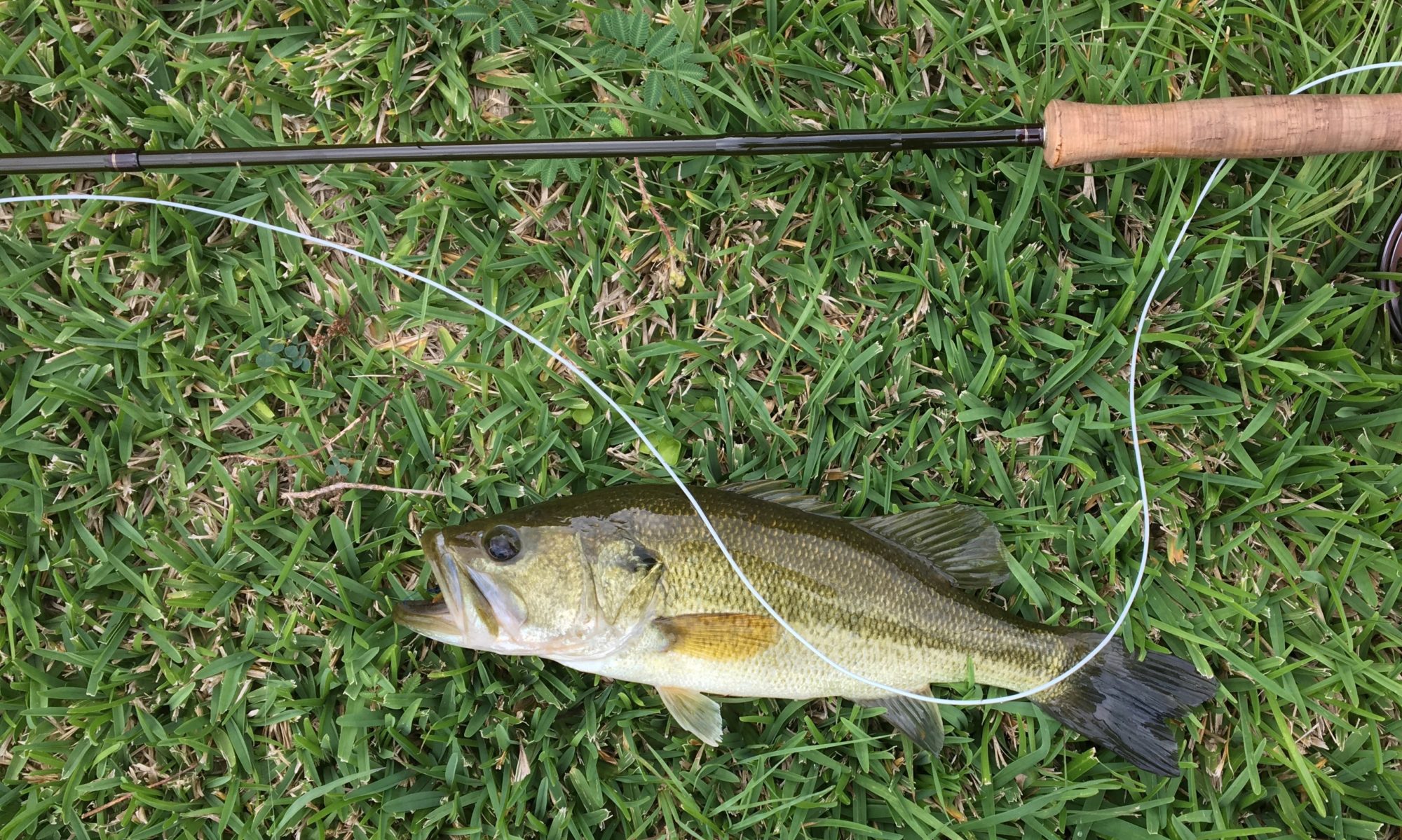
We only used cold water floating lines. In Wyoming and South Dakota we mostly fished with underwater nymphs under indicators. In Nebraska I caught those extraordinary bass on black Pat’s rubber legs fished as streamers.
Our Car
This was a road trip, so a few things about our car.
Pre-trip my car had about 50,000 miles on it. The week before the trip we had scheduled maintenance done, and on the dealer’s recommendation had a brake job and I replaced the battery. I had the tires rotated at Discount Tire. I installed a Victory 4×4 rear window molle panel and upper shelf for storage in the cargo area, and re-mounted the fly rod vault on the roof rack. The upper shelf and the rod vault were useful, the rear window molle panel wasn’t but it looked manly. The fly rod vault holds four assembled fly rods, and rod vaults are apparently required by law in Colorado. They’re certainly common enough.
In addition to the rod vault I bought a Pelican gear box and mounting hardware from REI. I got the smallest box to minimize wind resistance, but it didn’t hold enough stuff. I should have bought the largest size.
In Wisconsin years before our muskie guide had demonstrated the cargo drawers in his truck, and since then I’ve wanted a set for our SUV cargo area. Plenty of companies sell cargo drawers for pickups and SUVs, but they’re expensive, and I thought that I could build my own. It took me about three weeks of intermittent labor, and the result includes the appropriate number of design flaws. I built two 35″ wide drawers from side to side, 30″ deep from front to back. The lower drawer is about 10″ deep and the top 6″.
I loved the top drawer. I could throw in my sunglasses and reels and rod tubes, my fly boxes and maps and camera, and all the other smallish stuff that would otherwise be rattling around loose in the back of my car, but the stuff I put in the bottom drawer would have done better in a duffel. Or a larger roof box.
What’s worse, the two stacked drawers ate up the back of the SUV, and the first time I went to the grocery after installation I realized that except for the back seat I no longer had anyplace to put groceries. When we stacked duffels on the drawers we couldn’t really use the rearview mirror. The drawers will get rebuilt as two shallower drawers, hopefully by our next road trip.
By the time I rebuild the drawers I figure it will have cost me as much as buying pre-made drawers in the first place.
Buc-ee’s
Buc-ee’s is a chain of travel centers, placed strategically along Texas interstates. The first Buc-ee’s was near Houston in Clute (home of The Great Texas Mosquito Festival). I have a love-hate relationship with Buc-ee’s. Once when I fished Matagorda Bay I parked my car for the day in an out-of-the-way corner of Buc-ee’s Wharton parking lot, and management tagged my car with a semi-permanent sticker that told me to never, ever leave my car in a Buc-ee’s lot again. It took an hour of scraping to get the sticker and the residual glue off my car window. It wasn’t very neighborly, and a polite note would have gotten the message across. I also don’t trust their brisket or kolache (though I do give them points for having brisket and kolache), and I hate crowds. Buc-ee’s interstate travel centers are huge and are always crowded, though there are so many urinals in the men’s room that there’s never a line.
On the plus side for Buc-ee’s, there are things you have to respect. There are all those urinals and the bathrooms are immaculate. The gas is cheap. You can buy many strange and amusing things in Buc-ee’s, from barbecue pits to onesies for the grandchild, they don’t allow 18-wheelers, and they’re spaced along the major routes out of Houston just where you need ’em. They pay their employees well above the minimum wage.
Buc-ee’s has now spread beyond Texas, to, among other places, Alabama, South Carolina, Tennessee, and Florida. On this trip we found one north of Denver. Someday Buc-ee’s will be everywhere, and beaver nuggets and mediocre kolache will be available to everyone.
I made my peace with Buc-ee’s on this trip. I forgave them that window sticker and I suffered the crowds. I bought their relatively cheap gas. I even bought some parched corn and a Rice Crispie treat. I did not buy my grandchild a onesie.
Where We Stayed, What We Ate
Out of our 12 nights, we spent only three in hotels. Two of the hotels were unremarkable, a Holiday Inn Express in Amarillo and a Holiday Inn in Wichita, Kansas. The most expensive hotel, The Rally Hotel in downtown Denver, was across the street from Coors Field where we stopped for baseball. Both the hotel and Coors Field were great, though the Rockies not so much. At check-in they gave us free beer, which was friendly even if it was a Coors. Staying next to the stadium was almost worth the cost, and almost worth the drive through downtown Denver at rush hour.
Because Roo the dog was with us, we felt more comfortable leaving her in an AirBnB than in a hotel on the days we spent fishing. We spent four nights in an AirBnB in Wyoming and three in South Dakota, and both were fine. The one in Wyoming had the better view.
We camped two nights in Nebraska, which meant that our car was packed with camping gear. We’ve owned our tent for most of our marriage, more than 40 years, and it has survived a lot of use. This trip though one of the poles broke. We cobbled together a repair, but I wouldn’t trust it in hard weather. The tent may have seen its last road trip.
Because we were camping and staying in AirBnBs, we cooked a lot. At home we almost always cook, and I’d say we’re adventurous, competent cooks, but on this trip there was no adventure. We ate beef for dinner and bacon for breakfast. We ate steaks. We ate burgers. We ate more steaks and then we ate more burgers. We ate eggs and bacon with toast for breakfast.
We spent a lot of time in grocery stores, which is actually a pretty good way to get to know a place. Mack’s Market in Thermopolis, Wyoming, not only sells groceries, but it has its own liquor store inside, and a gun shop. What more does one need?
I think I’ve covered most of the trip’s restaurant stops in the other road trip sections, except for the pizzas we had in Lander and Thermopolis in Wyoming. This really was a junk food extravaganza. We also had donuts in Amarillo, which would make a pretty good country song, and in Fort Collins, Colorado, which would also make a pretty good country song. The donuts were ok, but I wouldn’t have picked them over a good kolache.
Where We Didn’t Go
I would have liked to see more rivers in Wyoming, and in September we are going to fish for a day in Yellowstone at the end of our Montana trip, probably on the Firehole. 6 I’m already thinking about a trip next May through Wyoming and back to the Green River in Utah.
I’d like to explore more of the streams in the Black Hills, but probably never will.
We didn’t stop for an onion burger when we drove through Oklahoma. We didn’t see the giant ball of twine in Kansas. I guess I’ll be remembered as the guy who never saw the giant ball of twine.
Playlist
I made playlists for Nebraska, South Dakota, and Wyoming, but I have to admit we mostly listened to books while we were driving. “Willow, Weep for Me,” by the Nebraska composer Ann Ronnell was on the Nebraska playlist. It has been recorded by everybody, and we had versions by, among others, Billie Holiday, Frank Sinatra, Julie London, Sarah Vaughan, Lew Rawls, Tony Bennett, Barbra Streisand, Chad & Jeremy, and Sam Cooke. Ronnell also wrote “Who’s Afraid of the Big Bad Wolf.”
Disney pigs, likely from Nebraska.
The other well-known song on the Nebraska list was “Nebraska” by Bruce Springsteen, foreshadowing New Jersey, which will likely be our last state. Omaha and Lincoln seem to have pretty lively alternative music scenes. Mannheim Steamroller is from Nebraska. I’m not a fan of Mannheim Steamroller.
Danielle Ate the Sandwich, from Nebraska and Colorado, plays a ukulele and sings. She is wonderful, witty, and fun.
Ooh, I've got soul, I've got soul
But you'd never know, never know
If you were stuck across the table from me
The terrible dinner guest

The Terrible Dinner Guest, Danielle Ate the Sandwich
Danielle Ate the Sandwich.
There are about 100 songs named “Wyoming,” and all of them are pretty good, though the rap song “Wyoming” by Afroman doesn’t live up to his classic, “Idaho.” The country singer Chris Ledoux is the best known musician from Wyoming, and he’s big on melodramatic story-telling, which for me is not quite the thing unless it involves either Laredo, El Paso, or a girl named Rosalita (also foreshadowing New Jersey).
The best song ever written about Wyoming is “Git Along Little Doggies.” This is jumping ahead, but the best song ever written about Montana is “I Ride an Old Paint.”
I never got around to much of a South Dakota list. The only person on my South Dakota list is Shawn Colvin, though I probably should have included “Born to Be Wild” as a nod to Sturgis. I always enjoy Shawn Colvin, though, so I’m ok with sticking to Shawn Colvin.
Guitar
I played the guitar a lot on this trip, probably because we cooked in our adopted homes and there was more free time in the evenings. In Nebraska, at the state park, after the failed attempt at spey casting on the Niobara River, I sat at our campground and played for a couple of hours while Kris went to Valentine to shop for steaks, bacon, and burgers. A woman with a Denver guitar shop tee shirt came over to talk to me about guitars, and invited us to their campfire that evening. It was a nice gesture, but when I went to bed at nine-ish the campfire hadn’t kicked off. I’m sorry. They might have known someplace to fish.
The Czech singular for kolache is properly kolach, and the plural is kolache. The Texas usage of kolache as the singular and kolaches as the plural is not correct, but it makes a lot of sense to English speakers, and probably Spanish speakers as well. At various times I use all of them. Sometimes I suspect I use all of them in the same sentence. I’m betting my usage would make a Czech baker’s head spin. ↩︎
In Schuelenberg, between Houston and San Antonio, there’s an otherwise good bakery that glazes its kolache. It’s unnecessary frippery, and I’ve only stopped for their kolache once. ↩︎
Verdigre is home of an annual Kolach Days Festival. Wikipedia reports that Kolache are also available in other Midwestern states, including Minnesota, South Dakota, and Prague, Oklahoma. Both West, Texas, and Caldwell, Texas, claim to be the Kolache capitol of Texas, and West does have very good kolache. I’ve never had kolache in Caldwell. ↩︎
Sausage kolache are not even Czech, but a Texas variant. The greatest kolache variant of all is from a Cambodian-owned donut shop in St. Charles, Louisiana, where instead of sausage they stuff their koblasnek with rice boudin. Brilliant. There are now boudin kolache at most independent donut shops in Houston. ↩︎
Graphite fly rods are impossibly light, a matter of a couple of pounds and some stray ounces. What’s more, the newer graphite materials in modern rods allow thinner tip ends than rods from 30 years ago, so that when you’re swinging a nine-foot lever a modern rod will feel lighter than a 30 year-old rod of similar weight. The 30-year old rod Kris was fishing was pretty light, but it likely felt heavier than what she was used to. ↩︎
Most of Yellowstone is in Wyoming. This is one of those factoids that always seems unnatural, like Kansas City being in Missouri. ↩︎
It’s 346 miles from Thermopolis, Wyoming, to Rapid City, South Dakota, with detours for the Crazy Horse Monument and Mount Rushmore, and also for cheese enchiladas in Gillette, Wyoming.
The cheese enchiladas were at Los Compadres Mexican Restaurant, and they were perfectly decent Tex-Mex, that glorious bastardization of borderland Texas and Mexico that is a Texan’s comfort and joy and Diana Kennedy’s horror.1 It’s a commonplace that you should never trust Tex-Mex north of Dallas, which is actually too far north for my taste, but I liked the Los Compadres enchiladas, even as far north as Wyoming, and there was a patio where Roo could stand guard while we ate. I even got to practice my Spanish, at least as far as buen día.2
In South Dakota we fished two days in the Black Hills on Rapid Creek. We fished with David Gamet of Dakota Angler in Rapid City. David was great to fish with, younger than us, but not young enough that we felt like we were being bossed around by our children. He had grown up in the Black Hills, and there was no doubt about his bona fides.
There were rainbow trout and brown trout, but unlike in Wyoming, the browns and rainbows didn’t displace native cutthroat. One of the peculiarities of the Black Hills is their geographic isolation, with the prairies of South Dakota to the right and the prairies of Wyoming to the left, and without connecting trout rivers for trout to migrate. Illegal European immigrants3 had to bring in the trout, and before that there were none.
There are now trout in New Zealand and South Africa, India, Tasmania, and Australia, none of which held trout until the English came with their craze for trout fishing. All of those trout were invasive species brought along as part of the English diaspora–I’m thinking that anyone of English heritage (or Scots or Irish) shouldn’t complain too loudly about immigration. Just follow the trout. And the pheasants. And you can add South Dakota to the list of places where neither trout nor pheasants were but now are.
Having myself inherited the English craze for fly fishing, the Black Hills are a delightful place to fish for trout. The water is too small for drift boats, so you have to work a bit, but for small water the trout seemed uniformly decent-sized–not as big as Wyoming, but close enough, and in memory growing ever larger. Rapid Creek is shallow riffles punctuated by deep holes, and the challenge is to find water deep enough to hold fish, and then cast from a place where the trout can’t see you.
But you need to see the trout. We would sneak up on the deeper, greener water, peer into the pool while David said there, there, look there . . . And then if I was lucky I would see a fish, and then another, and then another, no more than a darker space in the deeper water, holding in place while I watched until it would gently drift a few inches to one side or the other to feed.
Looking at the photos, I’m surprised again at how shallow the water was. In the deepest pools it might have been waste deep. It made the discovery of such good fish so startling. Honestly though, even without the excuse of a fly rod, it was fun just to walk into the water. There is something so childlike about it, like petting a dog, riding a bicycle, watching a cloud . . . In the movie, A River Runs Through It, in the last scene, the old man is on the river threading a fly onto the leader, and you know exactly what he is thinking–this is me, after all that history, I am still the child whose father believed in the Presbyterian God and fly fishing, and it’s not memory, at least not merely memory. While standing in the water that old man knows that at least somewhere inside he is still that child.
Because David knew the water so well fishing with him felt like cheating–he knew where the holes were already, and would lead us from place to place, often circling around the stream to approach as stealthily as possible. It’s another commonplace that if you can see the trout they can see you, too, and that seeing you will put them down. David picked our flies, of course–what do we know of trout flies?–but it was basically the same trico nymph formulation that we had used in Wyoming. Like Wyoming, we were told the bigger surface hatches of larger mayflies happened in May, not June, and that May was when we could expect to successfully fish dry flies. Now mind, I’m still not convinced that hatches exist, and that they’re not a ruse to dupe gullible Texans, but I would love to fish dry flies with David during a Black Hills mayfly hatch. I might even catch a fish.
We fished a full day the first day and a half day the second. The second day we considered fishing Spearfish Creek in Spearfish Canyon, but stuck to a different part of Rapid Creek because it was a long drive to Spearfish. We were fishing through the morning into the heart of the day both days, but on our full day we quit early because of the water temperature. It’s hard to catch fish once the water approaches 70°, and the lower oxygenation of warm water makes it hard for the trout to survive if they’re caught. This was June, and I had planned the trip for when I thought the water would still be cold. Maybe we’re just more conscious of water temperatures than we used to be, or maybe water keeps getting warmer earlier and earlier.
One of our favorite discoveries was the Driftless Region, the geological anomaly where Iowa, Minnesota, and Wisconsin come together, and where for some reason the glaciers failed to flatten the landscape. The Driftless is on roughly the same longitude as the Black Hills, and a few hundred miles east. It’s surrounded by farmland, not mountains. Like the Black Hills, the trout streams are small, and both places involve walking and wading, not boats. The fish that we caught in the Driftless were smaller.
But both places, the Driftless and the Black Hills, have pretty, manageable water. They are similar sized regions open for exploration, and both have trout. I am not much of a trout fisherman, but trout are such great fish for a fly rod. While we fished in South Dakota, I kept comparing the Driftless and the Black Hills, and I finally decided that I liked fishing in South Dakota and the Driftless as much as any of the places I’ve fished.
I will say that while the scenery probably has the edge in the Black Hills, the cheese is better in Wisconsin.
Diana Kennedy (1923-2022) was the leading authority writing in English on interior Mexican food, and wrote nine cookbooks which are as much anthropology as cookery. She famously despised Tex-Mex and Cal-Mex as foreign goop, but later writers properly consider them authentic borderland cuisines of greater Mexico. After his success with the Gulf of Mexico, President Trump will presumably redesignate Tex-Mex as Tex-American, and Ms. Kennedy will smile from heaven. ↩︎
Writing this, I finally looked up the difference between buen día (which is singular, but that’s not the difference), and buenos días (which is plural, but that’s not the difference). “Buen día” is more formal and means “good day.” It can be used any time during the morning, afternoon, or evening. “Buenos días” literally means “good days,” but is used as “good morning.” It’s more common than buen día, but is only used in the morning. Buenos días for the morning, buenas tardes for the afternoon, and buenas noches for the evening and night. Buen día is for any occassion when the sun shines. ↩︎
See the description of South Dakota. The US violated its 1868 treaty with the Sioux in 1874 by sending Custer to explore the Black Hills. After reports of gold leaked from the Custer expedition, the Black Hills were illegally flooded by prospectors with gold fever. The US then wrongfully took possession of the area in violation of its earlier treaty. See United States v. Sioux Nation of Indians, 448 U.S. 371 (1980). ↩︎
We drove 3,783 miles through eight states. We spent $833 on gas. We fished in three states, and we caught fish in all three–well I did, anyway, Kris didn’t fish in Nebraska. We took our dog for protection.1
I love road trips. I let myself eat junk food on road trips.
We’ve taken lots of road trips. To fish we drove to all the states that surround Texas, to most of the next states over, and to all of the next states over from there except Arizona. We drove to North Carolina during Covid, and we drove to the Driftless Region at the junction of Iowa, Minnesota, and Wisconsin. We’ve seen a lifetime supply of corn, grass, pine trees, and gas stations. We did not drive to Alaska, which still seems an opportunity lost.
Our first food stop after leaving Houston was for burgers and onion rings at Bevos Drive-In, Vernon, Texas, 437 miles.2 You can usually find a good burger in most American towns. It may shorten your life, it may add to the methane load in the atmosphere, it may be inhumane, but it’s going to taste pretty great.
In Amarillo that evening (611 miles), we ate steak at the Big Texan Steak Ranch. Big Texan is that gaudy theme restaurant in Amarillo where, if you manage to eat the 72-ounce steak in an hour, then your meal is free.3 Big Texan is Route 66 incarnate. I ate there first 50-odd years ago, and once when our children were small, but I’ve never taken the 72-ounce challenge. It’s not the risk of failure but the certainty of after-dinner discomfort that’s daunting.
Our first fishing stop, Thermopolis, Wyoming, 1,439 miles, was a three days’ drive from Houston. I suppose we could have made Houston to Thermopolis in two days, but it would have been exhausting, and we wanted to see baseball in Denver. The Rockies have the worst record in the major leagues, and they didn’t disappoint. They led until the 9th inning when the Giants scored four runs.
Traffic in Denver was memorably frightening. Denver may be worse than Houston for traffic, though it’s probably a shade better than Naples or Mexico City. Coors Field, on the other hand, is a great place to watch baseball, even losing baseball, and this season it’s easy to get tickets.
The landscape from Denver to Thermopolis is about as full of empty as any place I’ve seen. I have in my head a notion of where trout are supposed to live, and it involves tumbling clear water, big hunks of granite, and plenty of trees. The water we fished in Wyoming was clear but not very tumbling. The rocks were mostly crumbly ancient sea sediment, not granite. For shade on the river there were no trees. We ate lunch under bridges.
We had rented an AirBnB outside of Thermopolis, a mile or so from the central business district. We arrived during a thunderstorm, and I was reasonably certain that the storm would blow us, the cabin, and the car on to Montana. It didn’t, and by the time we unloaded the car the storm had blown through. In the late day heat for the next two days there were also storms, big thunder, big wind, big rain, but it was for reasonably short durations. The rough weather never stuck around for long.
We fished with Wind River Canyon Whitewater and Fly Fishing on the Bighorn River, downstream after the Wind River passes through Wind River Canyon and becomes the Bighorn. We fished three days, and caught a lot of rainbow trout. We also caught a lot of brown trout. Neither the browns nor the rainbows are native, but they’ve driven out the native cutthroat. The browns and rainbows were still great fish.
The Bighorn is a moderate-sized river, not Missouri River-big, but too big to fish easily wading, and anyway Wyoming public access law is on the extreme side of landowner friendly. In Wyoming the adjoining landowner owns all rights to the river bed to midstream, so while you can float on the navigable water, you’re trespassing if you stand on the private riverbed. A drift boat is not only handy, but unless the river flows through public land, you can only fish from a boat. You can’t get out of your boat to pee without landowner permission.
There’s plenty of traffic on the Bighorn–the first day we launched with a kayaking church group, singing Shall We Gather at the River as they floated away.4 All day there was a procession of other kayakers, tubers, and other anglers in drift boats. The second day we launched below Thermopolis at Hot Springs State Park, and the river was considerably less crowded. The fishing was better, too, though apparently it’s usually better above Thermopolis.
I was pretty certain that we had arranged to fish the Wind River in the canyon when we booked the guides, but apparently I misunderstood, or the outfitter misunderstood what I was trying to say, and fishing Wind River Canyon wasn’t happening. The Wind River through the canyon is part of the Shoshone and Arapaho Wind River Reservation, and the outfitter is only permitted to fish two boats in the canyon a day. That was two boats other than our boat.
The canyon is famous for its fish, but so is the Bighorn below the canyon. There were plenty of healthy, 16- to 20-inch fish, and maybe even a few bigger–Kris says that these were the largest trout she’s caught. We fished with three different guides over the three days. I usually think it’s better to fish with the same guide, but the guides were good and it probably didn’t matter. We caught fish.
We mostly fished with tiny underwater trico nymphs5 under some sort of attractor fly and an indicator, but on the first day our guide found a single rising fish and switched me to a dry fly, a bit of white fluff that floated on the surface. I made the cast and the drift, and there is nothing like watching a good fish take a dry fly on the surface of a river. The current adds to the drama, the fish comes out of the water, and then everything is working towards failure until the fish is finally landed. Or lost. Or never hooked in the first place.
The second day we found a deep hole where rainbows were stacked and feeding. Kris was busy taking bird photos, so I didn’t have to trade off after each fish caught, and I pulled one good fish after another out of the river. I’m still surprised I didn’t find an excuse for us to stay there the rest of the day.
The third day I got tangled, and then I got tangled again, and then I got tangled some more. When I did manage to cast I had a few strikes, but would promptly lose each fish that struck. Finally, late in the day I caught an unremarkable rainbow. I was so grateful to catch that fish.
Even as great as the fishing was, I don’t think that I had managed my expectations for Wyoming. We had purposefully left Wyoming and Montana until the end–unlike say, New Jersey, which we’ve left to the end for no good reason. Unlike Montana, I had never fished in Wyoming before. Wyoming is famously good fishing, and it wasgood fishing. The Bighorn is a famously good river, and it was a mighty fine river. That said, it never felt like enough.
So we’ll go back to Wyoming. Not, I think, to Thermopolis, great as the fishing was. And maybe we’ll fish some without guides if Congress hasn’t sold all of our public land. I’d like to see the other side of the Wind River Range, and further south towards the Green before it flows into Utah. I’d like to go further north towards Yellowstone. In fact, when we fish Montana in September, we’ll spend a couple of nights in Wyoming, in Yellowstone at Old Faithful Inn. We’ll fish in Yellowstone for native cutthroat, and it still won’t be enough of Wyoming. There is so much of Wyoming to see, and with the Bighorn it feels like we barely got started.
Western Meadowlark
You know what I liked best though about fishing in Wyoming? It wasn’t the fishing, it was waking to the morning bird chorus, and listening to the songs of the Western Meadowlarks. I’ve never heard anything more beautiful.
I guess I’m finally old enough just to listen. Of course I’m also old enough to spend a day getting tangled, but I’ve been that for a long time.
Roo is a mostly chihuahua rescue who as a puppy seven years ago showed up collarless and chipless on our daughter’s front porch. Kris took her to the vet, nursed her through heartworms, and she’s been with us since. She is an excellent travel companion, and is reasonably well socialized for a mostly chihuahua. She did bark at the lady in the Kansas toll booth. ↩︎
I lived in Vernon, Texas, for my first 17 years, and Bevo’s was owned by my cousin James. They have the world’s best cheeseburger. Bevo is the name of the mascot at the University of Texas, but my cousin James didn’t go to the University of Texas, or as far as I know to any university at all, so I’m not sure why he picked the UT theme. Still, hook ’em. ↩︎
There is a livestream of the Big Texan 72-ounce steak challenge. It’s oddly mesmerizing to watch. If you do the challenge, remember that in addition to the steak you have to eat the baked potato, shrimp cocktail, salad, and bread. ↩︎
Tricos are a tiny mayfly, Tricorythodes. Trico nymphs are the nymph phase of the trico mayfly’s life cycle. Trico hatches are common in summer, and bigger mayflies apparently hatch earlier: May is a great time for bigger mayflies. Since we were in Wyoming in June, this was a variant of the common guide explanation that we should have been here last week. ↩︎