Road Trip, Part 4, Packing List, Smith Falls State Park to Houston, June 20-22, 2025.

Kolache

It’s a toss-up between a good kolache1 and a good donut, but I’d probably choose the kolache because they’re less common. Pretty good donuts can be found in lots of places, but the best kolache are found only on the edge of the interstate in small towns. In Texas they’re common enough, and in one of the best things you can say about anyplace kolache are common in Nebraska.

Kolache are Czech, re-homed by Czech immigrants to Texas and the Midwest, and are most often compared to Danish. It’s not an apt comparison. Danish probably originated in Austria, are often glazed, and like croissant are made with a laminated dough. Kolache should never be glazed,2 or laminated, and they feature a mildly sweet pillowy yeast dough.

Kolache are about the size of a biscuit. The center depression is filled with either a fruit preserve, sweetened cream cheese, or sweetened poppy seeds. A kolache without any filling would be a tiny bread loaf, not a kolache, and there’s no such thing as a sausage kolache. Except there are sausage kolache, but more on that later.

Many years ago I witnessed a panel discussion by a group of Tex-Czech bakers, who said that traditional kolache were filled with prune preserves, sweetened farm cheese, or poppy seeds. The panel members had all grown up on small Central Texas farms during the Depression, and explained that their mothers baked the big three because prunes were very cheap, everybody–meaning every Czech farm family–had a cow and made their own farm cheese, and that there were always poppies in the farmyard. I guess that in addition to farm cheese all those Czech farm wives made their own opium.

Kolache are filled with all kinds of fruit, not just prunes. I’d probably eat any kolache offered, but if they’re available I usually order one or more of the big three: a farm cheese, poppy seed, or a prune. At the kolache counter in Hruska’s in Ellinger–which sells my favorite kolache and where there’s always a line–the woman behind the counter once beamed when I ordered all three and said that those were the three kinds of kolache that her mother always made. That touch of tradition made both of us happy.

I don’t know the history of Kolache in Nebraska, or even how I knew that Nebraska, like Texas, loves kolache, but we had a campsite reserved for three nights at Smith Falls State Park near Valentine, Nebraska. Since by the first morning we had our Nebraska fish (or more precisely I had my fish and Kris had decided not to fish), the next morning we packed up our campsite a day early and took a 150 mile frolic out of our way to Verdigre, Nebraska, the self-proclaimed Kolach Capitol of the World.3

The dough in Verdigre Bakery’s kolache is a little different from Texas kolache. It’s less puffy, denser, more bite sized. . . Maybe the dough is a bit less sweet. After extensive sampling I couldn’t tell any difference between Texas and Nebraska fillings. The picture above is of poppy seed, so I guess opium is also a farmyard cash crop in Nebraska.

The lady in the Verdigre Bakery said that Texans sometimes stop by for kolache, but that we always asked for sausage kolaches. Kolache with sausage are not actually kolache, but klobasnek (or pigs in a blanket). Calling klobasnek “sausage kolaches” is common usage in Texas, and they’re made with the same dough as kolache. Still, even if it’s common usage, the misuse greatly annoys some Tex-Czechs.4 Kolache lovers from other states are just confused.

From Verdigre we drove another 180 miles out of the way to Omaha, because we had never been to Omaha, and somewhere during the drive to Verdigre we decided that this was our big chance. The College World Series was scheduled to start the next day, and Omaha’s streets were crowded with LSU purple and gold. I didn’t see any Coastal Carolina fans, which was the other team in the Series, and like their fans the Coastal Carolina team didn’t show up much for the World Series. We saw the stadium, and the lively district around the stadium, then drove on to Wichita, Kansas, where we spent the night. During that round-about meandering we crossed into Iowa, so I guess we actually drove through nine states, not just eight. The next day we drove 560 miles home from Wichita, a day earlier than we had planned.

Gear

In Wyoming they told us to bring six weight rods, which is a heavier rod than is normal for trout, but these were big fish in heavy current, so a six weight was a good idea. In South Dakota we used five-weights, which is the most common rod for trout. I tried a three weight spey rod to fish the Niobara River, but that didn’t go too well. I had Winston rods, Kris had a very old 1991 Orvis Rocky Mountain six weight, and she said it was so heavy she could barely lift it.5 I suspect she might have been exaggerating just a bit. She also had an Orvis Helios 3 five weight, and there were no complaints from her about the five weight.

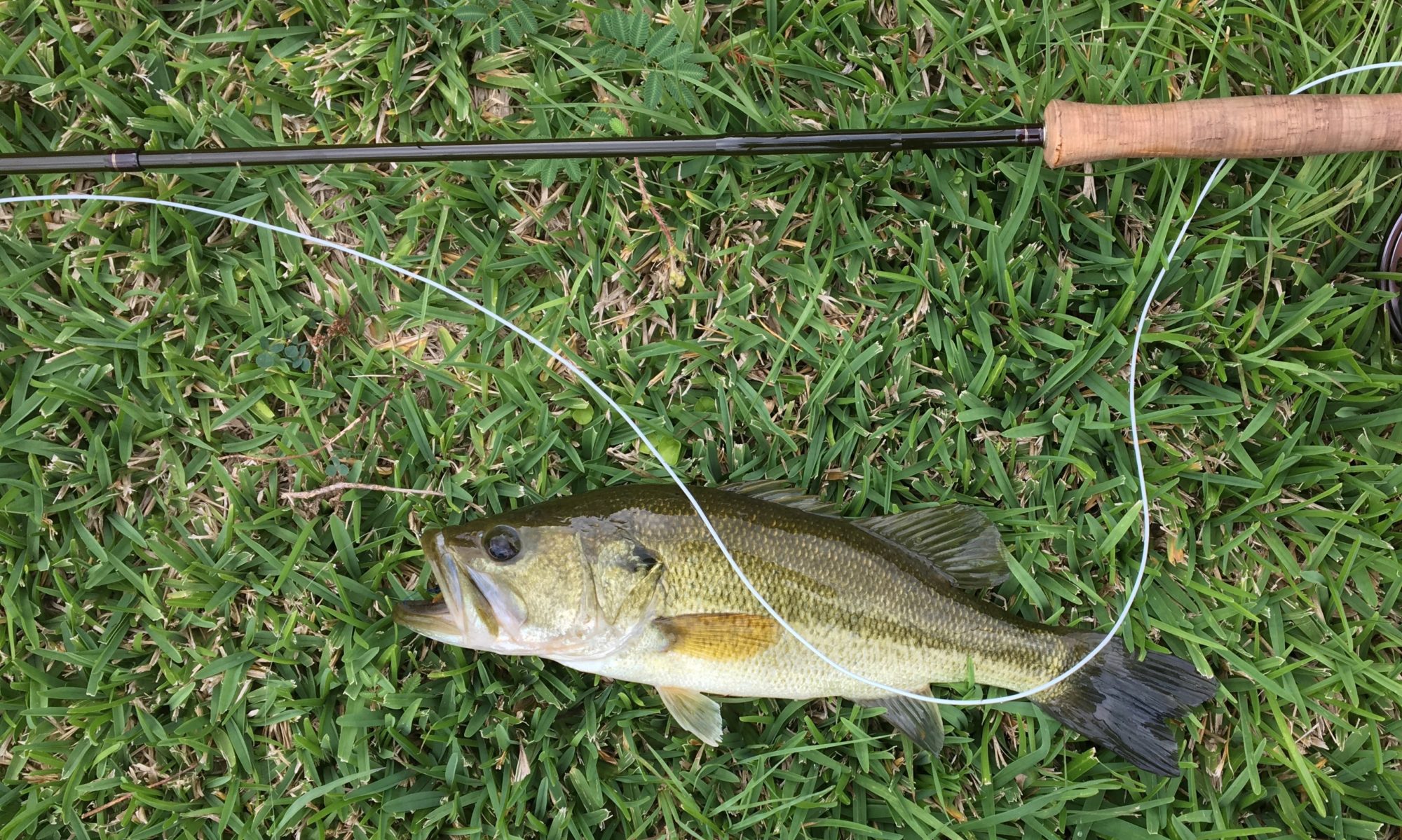
We only used cold water floating lines. In Wyoming and South Dakota we mostly fished with underwater nymphs under indicators. In Nebraska I caught those extraordinary bass on black Pat’s rubber legs fished as streamers.

Our Car

This was a road trip, so a few things about our car.

Pre-trip my car had about 50,000 miles on it. The week before the trip we had scheduled maintenance done, and on the dealer’s recommendation had a brake job and I replaced the battery. I had the tires rotated at Discount Tire. I installed a Victory 4×4 rear window molle panel and upper shelf for storage in the cargo area, and re-mounted the fly rod vault on the roof rack. The upper shelf and the rod vault were useful, the rear window molle panel wasn’t but it looked manly. The fly rod vault holds four assembled fly rods, and rod vaults are apparently required by law in Colorado. They’re certainly common enough.

In addition to the rod vault I bought a Pelican gear box and mounting hardware from REI. I got the smallest box to minimize wind resistance, but it didn’t hold enough stuff. I should have bought the largest size.

In Wisconsin years before our muskie guide had demonstrated the cargo drawers in his truck, and since then I’ve wanted a set for our SUV cargo area. Plenty of companies sell cargo drawers for pickups and SUVs, but they’re expensive, and I thought that I could build my own. It took me about three weeks of intermittent labor, and the result includes the appropriate number of design flaws. I built two 35″ wide drawers from side to side, 30″ deep from front to back. The lower drawer is about 10″ deep and the top 6″.

I loved the top drawer. I could throw in my sunglasses and reels and rod tubes, my fly boxes and maps and camera, and all the other smallish stuff that would otherwise be rattling around loose in the back of my car, but the stuff I put in the bottom drawer would have done better in a duffel. Or a larger roof box.

What’s worse, the two stacked drawers ate up the back of the SUV, and the first time I went to the grocery after installation I realized that except for the back seat I no longer had anyplace to put groceries. When we stacked duffels on the drawers we couldn’t really use the rearview mirror. The drawers will get rebuilt as two shallower drawers, hopefully by our next road trip.

By the time I rebuild the drawers I figure it will have cost me as much as buying pre-made drawers in the first place.

Buc-ee’s

Buc-ee’s is a chain of travel centers, placed strategically along Texas interstates. The first Buc-ee’s was near Houston in Clute (home of The Great Texas Mosquito Festival). I have a love-hate relationship with Buc-ee’s. Once when I fished Matagorda Bay I parked my car for the day in an out-of-the-way corner of Buc-ee’s Wharton parking lot, and management tagged my car with a semi-permanent sticker that told me to never, ever leave my car in a Buc-ee’s lot again. It took an hour of scraping to get the sticker and the residual glue off my car window. It wasn’t very neighborly, and a polite note would have gotten the message across. I also don’t trust their brisket or kolache (though I do give them points for having brisket and kolache), and I hate crowds. Buc-ee’s interstate travel centers are huge and are always crowded, though there are so many urinals in the men’s room that there’s never a line.

On the plus side for Buc-ee’s, there are things you have to respect. There are all those urinals and the bathrooms are immaculate. The gas is cheap. You can buy many strange and amusing things in Buc-ee’s, from barbecue pits to onesies for the grandchild, they don’t allow 18-wheelers, and they’re spaced along the major routes out of Houston just where you need ’em. They pay their employees well above the minimum wage.

Buc-ee’s has now spread beyond Texas, to, among other places, Alabama, South Carolina, Tennessee, and Florida. On this trip we found one north of Denver. Someday Buc-ee’s will be everywhere, and beaver nuggets and mediocre kolache will be available to everyone.

I made my peace with Buc-ee’s on this trip. I forgave them that window sticker and I suffered the crowds. I bought their relatively cheap gas. I even bought some parched corn and a Rice Crispie treat. I did not buy my grandchild a onesie.

Where We Stayed, What We Ate

Out of our 12 nights, we spent only three in hotels. Two of the hotels were unremarkable, a Holiday Inn Express in Amarillo and a Holiday Inn in Wichita, Kansas. The most expensive hotel, The Rally Hotel in downtown Denver, was across the street from Coors Field where we stopped for baseball. Both the hotel and Coors Field were great, though the Rockies not so much. At check-in they gave us free beer, which was friendly even if it was a Coors. Staying next to the stadium was almost worth the cost, and almost worth the drive through downtown Denver at rush hour.

Because Roo the dog was with us, we felt more comfortable leaving her in an AirBnB than in a hotel on the days we spent fishing. We spent four nights in an AirBnB in Wyoming and three in South Dakota, and both were fine. The one in Wyoming had the better view.

We camped two nights in Nebraska, which meant that our car was packed with camping gear. We’ve owned our tent for most of our marriage, more than 40 years, and it has survived a lot of use. This trip though one of the poles broke. We cobbled together a repair, but I wouldn’t trust it in hard weather. The tent may have seen its last road trip.

Because we were camping and staying in AirBnBs, we cooked a lot. At home we almost always cook, and I’d say we’re adventurous, competent cooks, but on this trip there was no adventure. We ate beef for dinner and bacon for breakfast. We ate steaks. We ate burgers. We ate more steaks and then we ate more burgers. We ate eggs and bacon with toast for breakfast.

We spent a lot of time in grocery stores, which is actually a pretty good way to get to know a place. Mack’s Market in Thermopolis, Wyoming, not only sells groceries, but it has its own liquor store inside, and a gun shop. What more does one need?

I think I’ve covered most of the trip’s restaurant stops in the other road trip sections, except for the pizzas we had in Lander and Thermopolis in Wyoming. This really was a junk food extravaganza. We also had donuts in Amarillo, which would make a pretty good country song, and in Fort Collins, Colorado, which would also make a pretty good country song. The donuts were ok, but I wouldn’t have picked them over a good kolache.

Where We Didn’t Go

I would have liked to see more rivers in Wyoming, and in September we are going to fish for a day in Yellowstone at the end of our Montana trip, probably on the Firehole. 6 I’m already thinking about a trip next May through Wyoming and back to the Green River in Utah.

I’d like to explore more of the streams in the Black Hills, but probably never will.

We didn’t stop for an onion burger when we drove through Oklahoma. We didn’t see the giant ball of twine in Kansas. I guess I’ll be remembered as the guy who never saw the giant ball of twine.

Playlist

I made playlists for Nebraska, South Dakota, and Wyoming, but I have to admit we mostly listened to books while we were driving. “Willow, Weep for Me,” by the Nebraska composer Ann Ronnell was on the Nebraska playlist. It has been recorded by everybody, and we had versions by, among others, Billie Holiday, Frank Sinatra, Julie London, Sarah Vaughan, Lew Rawls, Tony Bennett, Barbra Streisand, Chad & Jeremy, and Sam Cooke. Ronnell also wrote “Who’s Afraid of the Big Bad Wolf.”

Disney pigs, likely from Nebraska.

The other well-known song on the Nebraska list was “Nebraska” by Bruce Springsteen, foreshadowing New Jersey, which will likely be our last state. Omaha and Lincoln seem to have pretty lively alternative music scenes. Mannheim Steamroller is from Nebraska. I’m not a fan of Mannheim Steamroller.

Danielle Ate the Sandwich, from Nebraska and Colorado, plays a ukulele and sings. She is wonderful, witty, and fun.

Ooh, I've got soul, I've got soul
But you'd never know, never know
If you were stuck across the table from me
The terrible dinner guest


The Terrible Dinner Guest, Danielle Ate the Sandwich
Danielle Ate the Sandwich.

There are about 100 songs named “Wyoming,” and all of them are pretty good, though the rap song “Wyoming” by Afroman doesn’t live up to his classic, “Idaho.” The country singer Chris Ledoux is the best known musician from Wyoming, and he’s big on melodramatic story-telling, which for me is not quite the thing unless it involves either Laredo, El Paso, or a girl named Rosalita (also foreshadowing New Jersey).

The best song ever written about Wyoming is “Git Along Little Doggies.” This is jumping ahead, but the best song ever written about Montana is “I Ride an Old Paint.”

I never got around to much of a South Dakota list. The only person on my South Dakota list is Shawn Colvin, though I probably should have included “Born to Be Wild” as a nod to Sturgis. I always enjoy Shawn Colvin, though, so I’m ok with sticking to Shawn Colvin.

Guitar

I played the guitar a lot on this trip, probably because we cooked in our adopted homes and there was more free time in the evenings. In Nebraska, at the state park, after the failed attempt at spey casting on the Niobara River, I sat at our campground and played for a couple of hours while Kris went to Valentine to shop for steaks, bacon, and burgers. A woman with a Denver guitar shop tee shirt came over to talk to me about guitars, and invited us to their campfire that evening. It was a nice gesture, but when I went to bed at nine-ish the campfire hadn’t kicked off. I’m sorry. They might have known someplace to fish.

  1. The Czech singular for kolache is properly kolach, and the plural is kolache. The Texas usage of kolache as the singular and kolaches as the plural is not correct, but it makes a lot of sense to English speakers, and probably Spanish speakers as well. At various times I use all of them. Sometimes I suspect I use all of them in the same sentence. I’m betting my usage would make a Czech baker’s head spin. ↩︎
  2. In Schuelenberg, between Houston and San Antonio, there’s an otherwise good bakery that glazes its kolache. It’s unnecessary frippery, and I’ve only stopped for their kolache once. ↩︎
  3. Verdigre is home of an annual Kolach Days Festival. Wikipedia reports that Kolache are also available in other Midwestern states, including Minnesota, South Dakota, and Prague, Oklahoma. Both West, Texas, and Caldwell, Texas, claim to be the Kolache capitol of Texas, and West does have very good kolache. I’ve never had kolache in Caldwell. ↩︎
  4. Sausage kolache are not even Czech, but a Texas variant. The greatest kolache variant of all is from a Cambodian-owned donut shop in St. Charles, Louisiana, where instead of sausage they stuff their koblasnek with rice boudin. Brilliant. There are now boudin kolache at most independent donut shops in Houston. ↩︎
  5. Graphite fly rods are impossibly light, a matter of a couple of pounds and some stray ounces. What’s more, the newer graphite materials in modern rods allow thinner tip ends than rods from 30 years ago, so that when you’re swinging a nine-foot lever a modern rod will feel lighter than a 30 year-old rod of similar weight. The 30-year old rod Kris was fishing was pretty light, but it likely felt heavier than what she was used to. ↩︎
  6. Most of Yellowstone is in Wyoming. This is one of those factoids that always seems unnatural, like Kansas City being in Missouri. ↩︎

Oklahoma Packing List

Stuff We Took

We took my car. It’s a 2012 diesel with 117 thousand miles. It needs the tires rotated and it uses a bit of oil. It ran great. For our other trips this year we’ve flown and rented, and we’re now pretty proficient at hooking the phone through the rental car radio (if they’re still called radios). We can hook into whatever Mitsubishi or Ford or Mazda mid-sized SUV the rental company gives us with minimal stress and only a few harsh words, but it’s still nicer to be in my car. 

I fished with a 10′ 4 wt. Kris fished with her Helios 3D 5 wt. that I gave her for Christmas last year. Chris the Guide wished it was the softer version, but she cast beautifully. Maybe she missed more strikes because of the hard rod, but man was it fun to watch her cast.  

There’s nothing else remarkable about what we packed except that I bought a bag of Cheetos. You can’t have a road trip without Cheetos, unless it’s a road trip with Fritos and bean dip. 

We ate two dinners the night we arrived, just to try things out: chicken fried steak at Abendigo’s and pizza at the Grateful Head.  Both were excellent, and the local beers were excellent. I no longer eat nearly enough chicken fried steak. We had leftover pizza on the river on Saturday, so two dinners was perfectly reasonable. We stayed at the Hotchatown Country Lodge, and had a breakfast burrito at Adam and Eve’s Coffee Shop before we fished on Saturday.  That place has good coffee. 

Beavers Bend is in the Choctaw Nation, but we missed most of the cultural stuff. We did take a photo of the casino. We also walked through the Forest Heritage Center Museum, which is peculiar, but there’s no doubt this is a lumber town. 

I now believe that forest science research is best carried out in white pumps. 

When we started planning Oklahoma, I asked an Oklahoma fly fishing group on FaceBook where we should fish, and here’s what I got:

• Sandies in the spring, but no specifics on places
• Bluegill, but no specifics on places
• Trout on the Lower Illinois
• Trout on the Lower Mountain Fork
• Smallmouth on the Upper Illinois in the summer
• Stripers on the Lower Illinois in the summer
• Carp, but no specifics on places

Personally, any of those could have been great, and I’d already thought about white bass. End of the day, the Mountain Fork was convenient. Kris already talks about Oklahoma more fondly than anyplace we’ve fished, and we were only really there for one day.

The other place I thought about was the Wichita Mountains. It’s the nation’s oldest wildlife preserve, and notwithstanding Yellowstone it deserves credit for preserving the buffalo. Hiking there once I looked up at a ridge line and watched a dozen elk watching me. They seemed to find me peculiar, and many share their opinion.There’s a series of ponds and small lakes spread through the refuge, and it would have made a good place for bluegill.

What I Didn’t Write About

The Cherokees, slavery, and the Confederacy. There are two recognized Cherokee tribes in Oklahoma. They seem to have split over the Civil War: the larger tribe supported the Confederacy, the smaller the Union. The Cherokee who owned slaves took them along to Oklahoma.

The 1909 Jim Crow amendments to the Oklahoma Constitution. Roosevelt refused to approve the Constitution for 1907 statehood until the Jim Crow provisions were removed, then the state constitution was amended in 1909 to put them back in.

Part of district burned in race riots, Tulsa, Okla, .American Red Cross, 1921, Library of Congress

The 1921 Tulsa Race Riot. One of the bloodiest two day white riots in American history, it’s also known, appropriately, as the Tulsa massacre. Thirty-six African Americans died, and thirty-five blocks of the established African American Greenwood neighborhood were burned to the ground.

Tulsa burning, Alvin C. Krupnick Co., photographer, 1921, Library of Congress

Quanah Parker. I didn’t write enough about Quanah Parker. I didn’t write enough about the Wichita.

Boom Town, by Sam Anderson. It’s on the New York Times’ 100 notable books for 2018, and it’s a fine book about Oklahoma City. It had me checking The Thunder in the NBA standings, and recommending the book. Great book.

Ralph Ellison. Ralph Ellison is from Oklahoma City. I tried to re-read Invisible Man, but couldn’t. It’s a hard book.

The 2018 Elections. There’s now a Democratic congresswoman from Oklahoma City. There’s also a pretty interesting war going on in the Oklahoma Republican Party.

Playlist

I should have known Oklahoma had such great music, but I didn’t. I’ve already mentioned that Oklahoma was the home of five of the finest guitarists I know. And Woodie Guthrie. And John Moreland.

Bob Wills Publicity Photo, C. 1946, Wikipedia
  • John Moreland. In the Throes. I saw a review of John Moreland’s new album in Garden & Gun a few weeks ago, then ran across him in an inernet list of 10 Oklahoma bands you should be listening to now. If Bruce Springsteen sang Americana music he would be John Moreland. This is music about the Broken Arrow, Oklahoma, high school prom. Robin, take note: this is great stuff.
  • The Call. Some random songs. I didn’t pay much attention to them the first time around, and gave them short shrift this time. They probably deserve better. Or maybe not. 
  • Garth Brooks. I think I would like Garth Brooks, but his music is only available on Amazon, and I’m not technologically proficient enough to know whether I can download something on Amazon and listen to it on ITunes. 
  • The Flaming Lips. Yoshimi Battles the Pink Robots. My daughter tells me that The Flaming Lips were one of her favorite bands in high school. Wayne Coyne lives in Oklahoma City, and is a central character in Sam Anderson’s Boom Town.
  • Woodie Guthrie. I’d been listening to Guthrie in Oregon. I downloaded covers of his songs from his 100th birthday celebration at the Kennedy Center and some other stuff. Billy Bragg and Wilco’s “Way Over Yonder in the Minor Key” is the best Woodie Guthrie song that Woodie Guthrie didn’t write.
  • Charlie Christian. Charlie Christian: The Genius of the Electric Guitar. Charlie Christian invented the electric guitar solo, and then died of tuberculosis at the age of 26. He made some fine recordings with Benny Goodman. 
Charlie Christian, Charlie Christian Family Archives
  • Leo Kottke. Acoustic Guitar once did a list once of the 50 greatest acoustic guitar albums. I don’t know where Kottke’s 6- and 12-String Guitar ranked, but I remember the review. The record came out in 1969, and they guessed that more joints were rolled in college dorm rooms on that album cover than on any other. I bet they were right. It at least ran a close second to Sergeant Pepper.
  • Michael Hedges. Hedges was New Age Music, which was once a thing. I had Hedges’ Aerial Boundaries because of that Acoustic Guitar list. He died in 1997 in a car wreck.
  • Roy Clark. “But I Never Picked Cotton.” He died last week. After a near 50-year interval I once again spent way too much time watching Hee Haw, this time on YouTube. His duets with Glen Campbell in the TV heyday were pretty amazing. 
  • Tuck Andress, of Tuck and Patti. Tears of Joy. Andress is such a fine jazz guitarist. He’s also St. Vincent’s uncle.
  • Jerry Jeff Walker, Up Against the Wall Redneck Mother.” She was, after all, born in Oklahoma.
  • Merle Haggard, “Okie from Muskogee.” The companion piece to “Up Against the Wall Redneck Mother.” Together the two songs form the yin and yang of country music.
  • Bob Wills and the Texas Playboys. Bob Wills–For the Last Time. Wills was born in Turkey, Texas, near my hometown, but the Playboys spent a good part of their career on Tulsa radio. I took that as enough of an excuse to include Bob Wills on the playlist. I don’t know how I’ll get him into the Hawaii list. There is a steel guitar. 
  • Cross Canadian Ragweed. Cross Canadian Ragweed. There’s an Americana sub-genre of country out of Oklahoma called Red Dirt Music. I picked Cross Canadian Ragweed because I liked the name, but there are several others, and I suspect some may be better. The Canadian River, by the way, is the longest tributary to the Arkansas River. It starts in Colorado, and crosses New Mexico, the Texans Panhandle, and Oklahoma. 
  • Chet Baker. Chet Baker Sings. Chet Baker is a cross between Billie Holiday, Miles Davis, and James Dean. 
  • Jimmy LaFave. Texoma. More Red Dirt Music, LaFave left Oklahoma for Austin, and died last year. I can’t say enough good things about LaFave.
  • J.J. Cale. Troubadour. The guy who wrote “After Midnight.”
  • Jimmie Webb. The guy who wrote “Galveston” and “Wichita Lineman.” 
  • Hoyt Axton. The guy who wrote “The Pusher,” “Never Been to Spain,” and “Joy to the World.”
  • Leon Russell. Carney. I always figured “This Masquerade” was a cover of a much older song. It’s not. 
  • Blake Shelton. Red River Blue. There was absolutely nothing memorable about Blake Shelton, except Kris yelling turn him off every time one of his songs shuffled through. My daughter told me that this is a sub-genre of country known as Bro’ Country, which is mostly about drinking, driving pickups, and admiring young women. I did think the song about the honey bee was cute, but then Kris yelled at me to turn it off.
  • Reba McEntire. Reba. Reba has a nicer voice than I expected, and she handles her material well. Some of the material is decidedly mediocre. Some is pretty good. 
  • Gordon MacRae. “Oklahoma!” and “Oh What A Beautiful Mornin’.” If you can keep from singing along to “Oh What A Beautiful Mornin”’ you’re a better man than me. That goes into my master road trip playlist, just for the joy of singing along. 
  • David Frizzel and Shelly West. “You’re the Reason God Made Oklahoma.” In 1981 this was number 1 on the country charts for seven weeks. It is a lovely song, and makes me pine for cold nights on a prairie country road in a pickup. Ok, it’s probably totally manufactured Nashville country, and you can’t go home again, but it’s still a lovely song. 

Guitar. 

I took the Kohno since I didn’t have to worry about airplanes.  My shoulder hurt by the end of the day, but my hands never did, so I worked on Mazurka Marieta by Tarrega. I memorized it a long time ago, and it was one of those songs I never seemed to forget, but then I forgot it.  Relearning went quickly though. 

Broken Bow, Oklahoma

Saturday we fished with Chris Schatte on the Lower Mountain Fork River. I was going to brag that I caught two fish for every one of Kris’s, but then Kris caught another fish. It wasn’t a day with a lot of fish, but I never remember much about catching a lot of fish. I remember specific fish, not multitudes. 

We picked the Mountain Fork because it was in Oklahoma and close enough for a long weekend drive. The names are a bit confusing. It’s the Lower Mountain Fork River, which is a tailwater below Broken Bow Lake, which is in Beavers Bend State Park. It’s near the towns of Hochatown and Broken Bow, just past Idabel. It’s a pretty trout river within three hours of Dallas/Fort Worth and Oklahoma City, and there are a bunch of smaller cities, Norman, Lawton, Tyler, Longview, Shreveport, Texarkana, that are even closer.  It’s popular. It’s pretty.

To be fair, most of the folk in that photo were an on-the-water class, and if we’d walked further upriver we would have probably walked away from the crowd, but in the afternoon we picked our bit of river and fished that bit. I figured that it would get me ready for fishing in New York and Connecticut and Montana, all the crowded places. I’ve never fished much with crowds, and usually I tend to cast and move. There wasn’t much casting and moving.

We had fished a different part of the river that morning, and there were fewer people. It was theoretically a better place to fish, but at least this trip we didn’t get any strikes. Chris the Guide thought that three days’ heavy generation had put down the fish.  

Southeastern Oklahoma looks like Wisconsin. The trees are different, sure: I didn’t see a single cypress knee in Wisconsin, but at the end of the day lumber is business in both places. Driving out of Oklahoma Saturday evening there was lumbering machinery and lumber trucks everywhere. The cheese is better in Wisconsin, and the cheese curds, but Hochatown, Oklahoma had Stevens Point beat for pizza, and they both had good beer.  Even the weather, mid-November in Oklahoma and late September in Wisconsin, was pretty similar. I’m not sure if there’s been a freeze yet in Beavers Bend.

Out of curiosity we would probably have gone to Mountain Fork sooner or later, and might go back again, but the river’s probably happiest without us. People should go to the Mountain Fork because it’s their river, not because it’s a destination river. I suspect there are rivers all over the country just like it. Good places to go for days and weekends year after year, places that satisfy the need for pretty but close enough for frequent fliers, a place to know and criticize and praise, and maybe love.

We fished nymphs and emergers under a bobber without added weight. I missed a bunch of strikes, especially at the end of the swing when I made a few short strips before picking up the line. I was casting well enough, and at one point I fished three flies without killing anybody. I didn’t get hopelessly tangled until it was time to quit for the day, and then we quit for the day. 

Mid-afternoon I lay down on the bank and took a long nap.  Kris said I slept for about an hour, and that’s fine with me.  I guess people moving upriver had to step over me, or at least around me, but nobody tripped or kicked. It was a fine river for a nap, and I’ve napped by many fine rivers. If I did a product review of the FishPond Summit Sling, I would note that it’s exactly the right size to use as a pillow for napping bankside. For me that’s not a small consideration.

I watched Kris the Angler cast and she was casting beautifully.  Last year she didn’t cast so beautifully. 

When I planned Oklahoma I had thought that we would fish without a guide. I wouldn’t have used emergers, and I wouldn’t have known where to fish, but sooner or later, this trip or the one after or the one after that, we would have caught fish, but we fished with Chris the Guide because he was a freshman at my high school when I was a senior, and I got to spend the day talking about people and places we knew, the Osbornes and Joe Chat, what businesses were left downtown in our hometown, Johnson’s Jewelry, and what was wrong with the town’s water system. Chris has a good life: they picked Broken Bow because land is cheaper in Oklahoma than in Colorado. They bought some acreage. They built a house. He started guiding. They own an Airstream and his wife does triathlons and they go to Canada and Minnesota in the summer. It all sounded great to me.  

Plus I caught my fish. 

True Grit

Few things have messed with my head longer than True Grit, beginning with the 1969 movie starring John Wayne. I own a copy of the book, but I didn’t read it until we started planning our trip to Oklahoma. In 1969 I wouldn’t have imagined that the book was anything better than a Louis L’Amour novel. Of course then I couldn’t think of many things better than a Louis L’Amour novel. I might still like Louis L’Amour if I still read him, but I’ll save that for North Dakota. 

The problem with the John Wayne movie was that the geography was all wrong, and at thirteen I knew it. Everyone knows the plot. Fourteen year-old Mattie Ross enlists one-eyed Marshall Rooster Cogburn to go with her into Indian Territory to bring her father’s murderer to justice. Mattie picks Cogburn because she believes him to be a man of true grit. Comparing myself to Mattie and Rooster, I knew that I didn’t know much about grit, but what I did know was the geography of the movie. I knew Indian Territory was Oklahoma, and I had been in and and out of Oklahoma all my life. I knew the movie landscape was southwestern Colorado, and we went to southwestern Colorado and New Mexico from time to time for vacations. One didn’t get on a horse in Fort Smith, Arkansas, cross a river, and end up in Ouray, Colorado. 

I couldn’t believe that the moviemakers could be so stupid (at best) or dishonest (at worst). I even cobbled together an explanation: the Indian Territory of 1870s Oklahoma was bigger than current-day Oklahoma, and the San Juan National Forest was within its borders. That was wrong of course, but it never occurred to me that the moviemakers picked their locale because southwestern Colorado is prettier than northeastern Oklahoma, no slight at all to northeastern Oklahoma. Southwestern Colorado is prettier than just about anyplace.

The Coen Brothers version of the movie is impossibly true to the book, and its tone and language are altogether artier than the John Wayne version. The Coen Brothers version stars a brilliant 13-year old girl, not a 22-year old. It stars the Dude, not the Duke. But it also makes its nod to the original, and for me in the most confusing way possible: by filming in the same landscape.  The Coen’s choice messed with my head anew, even though by then I had realized that it was a matter of artistic choice, not reality.  

So I finally read the novel, and now it’s joined together with the movies to mess with my head.

Take, for instance, LaBoeuf. A part of me says that of course there is a Texan in this novel, just as there is a Texan in Bram Stoker’s Dracula. If you’re going to write a novel about bravery, you surely do need a Texan companion to prove the act is not only brave, but extraordinarily brave. Matt Damon’s LaBoeuf (pronounced Lebeef) is excellent. In the original movie, however, Glenn Campbell (who was the very thing in his day, and who played guitar on Pet Sounds) is almost unbearably stilted. Did he know it? Is he such a bad actor? Was this art? I doubt it was purposeful, and then I doubt my doubts. It’s hard to understand such horrible acting.

Then there is the comedy. True Grit and Portis’s other novels are considered some of our best under-the-radar stuff. And the book and the movies are set in a real world with a real history. There was a hanging Judge Parker, and the incursions by Parker’s marshals into Indian Territory began the end of Indian Nation sovereignty. Portis gets his history right. Everybody thinks the novel is brilliant, and it is.

And everybody thinks the novel is comic.

I don’t really get it. Maybe to somebody who thinks southwestern Colorado is northeastern Oklahoma the novel is comic. I listen to Mattie Ross’s narration, fine as Portis has made it, and I hear a mildly exaggerated version of my  aunts talking. I watch Rooster Cogburn (who rode with Quantrill), and I see the righteous and the unrighteous, the just and the unjust, and the line is crossed back and forth from day to day, from moment to moment. Rooster Cogburn and Mattie Ross are forces in both opposition and harmony: unconscious Presbyterian rigidity and riding with Quantrill. Is Mattie comic? It’s a comedy that is hard to pinpoint.  Mattie doesn’t tell jokes. She isn’t amusing or witty. This isn’t a book of pratfalls, and it’s not picaresque like, say, Little Big Man. It is comic only in how Mattie’s uncompromising force collides with the world and overwhelms it. Maybe it is only the exaggeration (and in my mind the very slight exaggeration) that is funny.

So 50 years after I first watched John Wayne as Rooster Cogburn in a southwestern single screen theater on a little town square I’m still wrestling with True Grit

 * * *

I’ve been preparing for Friday’s trip to Broken Bow.  It’s 30 degrees outside, and I hope it warms up just a bit in the frigid north of Oklahoma where it’s even colder. When we went to Wisconsin in September the guide required studless wading boots to protect his boat, and I had dutifully removed our studs and put them away where I wouldn’t lose them. Then I promptly lost them.

In Oregon we’d waded with Patagonia River Crampons, and they worked great, so if I didn’t find the studs I wouldn’t necessarily need to replace them. Studs aren’t much. They’re short sheet metal screws that screw into the bottom of boots, but once they’re labeled with a brand name at a fly shop they get a bit pricey. Maybe they’re tungsten or aluminum or gold or some such. Since we don’t use felt-soled boots anymore, studs are the minimum needed to keep your footing on slick rock. 

The older I get, the more I worry about falls in rivers, and along with studs I now use a wading staff.  I’m a wobbly tripod in the watter, and in a few years I may drop the fly rod altogether and just carry two wading staffs. If a fish comes along I’ll point at it. The staff I use is a Folstaff, a shock-corded tent pole that with a bit of a shake snaps together at five joints. Putting it away is sometimes a bit of a struggle, and the first few times a joint got stuck I used a vice and some vice clamps to separate the sections. I’ve discovered over time that with a bit of wiggling the joints separate well enough, though not altogether easily, and having the separated sections get away from you and snap back together is almost as annoying and as common as a good tangled leader. 

I like my staff, with its collected scrapes and darkened cork handle, but largely because of the separation anxiety I found myself on Saturday eyeing a new Fishpond staff at the shop. It extended like a photographer’s tripod. I imagined that it wouldn’t take desperate measures to put it away, but that it also wouldn’t extend with that satisfying snap.  

Meanwhile Kris looked for the studs and didn’t find them either, but she reminded me that I’d put them in a plastic bag, not a box.  This morning I went right to them and they’re back in the boots.  Now I’d just like a bit warmer weather, and we do need to clean our boots.