Road Trip, Part 4, Packing List, Smith Falls State Park to Houston, June 20-22, 2025.

Kolache

It’s a toss-up between a good kolache1 and a good donut, but I’d probably choose the kolache because they’re less common. Pretty good donuts can be found in lots of places, but the best kolache are found only on the edge of the interstate in small towns. In Texas they’re common enough, and in one of the best things you can say about anyplace kolache are common in Nebraska.

Kolache are Czech, re-homed by Czech immigrants to Texas and the Midwest, and are most often compared to Danish. It’s not an apt comparison. Danish probably originated in Austria, are often glazed, and like croissant are made with a laminated dough. Kolache should never be glazed,2 or laminated, and they feature a mildly sweet pillowy yeast dough.

Kolache are about the size of a biscuit. The center depression is filled with either a fruit preserve, sweetened cream cheese, or sweetened poppy seeds. A kolache without any filling would be a tiny bread loaf, not a kolache, and there’s no such thing as a sausage kolache. Except there are sausage kolache, but more on that later.

Many years ago I witnessed a panel discussion by a group of Tex-Czech bakers, who said that traditional kolache were filled with prune preserves, sweetened farm cheese, or poppy seeds. The panel members had all grown up on small Central Texas farms during the Depression, and explained that their mothers baked the big three because prunes were very cheap, everybody–meaning every Czech farm family–had a cow and made their own farm cheese, and that there were always poppies in the farmyard. I guess that in addition to farm cheese all those Czech farm wives made their own opium.

Kolache are filled with all kinds of fruit, not just prunes. I’d probably eat any kolache offered, but if they’re available I usually order one or more of the big three: a farm cheese, poppy seed, or a prune. At the kolache counter in Hruska’s in Ellinger–which sells my favorite kolache and where there’s always a line–the woman behind the counter once beamed when I ordered all three and said that those were the three kinds of kolache that her mother always made. That touch of tradition made both of us happy.

I don’t know the history of Kolache in Nebraska, or even how I knew that Nebraska, like Texas, loves kolache, but we had a campsite reserved for three nights at Smith Falls State Park near Valentine, Nebraska. Since by the first morning we had our Nebraska fish (or more precisely I had my fish and Kris had decided not to fish), the next morning we packed up our campsite a day early and took a 150 mile frolic out of our way to Verdigre, Nebraska, the self-proclaimed Kolach Capitol of the World.3

The dough in Verdigre Bakery’s kolache is a little different from Texas kolache. It’s less puffy, denser, more bite sized. . . Maybe the dough is a bit less sweet. After extensive sampling I couldn’t tell any difference between Texas and Nebraska fillings. The picture above is of poppy seed, so I guess opium is also a farmyard cash crop in Nebraska.

The lady in the Verdigre Bakery said that Texans sometimes stop by for kolache, but that we always asked for sausage kolaches. Kolache with sausage are not actually kolache, but klobasnek (or pigs in a blanket). Calling klobasnek “sausage kolaches” is common usage in Texas, and they’re made with the same dough as kolache. Still, even if it’s common usage, the misuse greatly annoys some Tex-Czechs.4 Kolache lovers from other states are just confused.

From Verdigre we drove another 180 miles out of the way to Omaha, because we had never been to Omaha, and somewhere during the drive to Verdigre we decided that this was our big chance. The College World Series was scheduled to start the next day, and Omaha’s streets were crowded with LSU purple and gold. I didn’t see any Coastal Carolina fans, which was the other team in the Series, and like their fans the Coastal Carolina team didn’t show up much for the World Series. We saw the stadium, and the lively district around the stadium, then drove on to Wichita, Kansas, where we spent the night. During that round-about meandering we crossed into Iowa, so I guess we actually drove through nine states, not just eight. The next day we drove 560 miles home from Wichita, a day earlier than we had planned.

Gear

In Wyoming they told us to bring six weight rods, which is a heavier rod than is normal for trout, but these were big fish in heavy current, so a six weight was a good idea. In South Dakota we used five-weights, which is the most common rod for trout. I tried a three weight spey rod to fish the Niobara River, but that didn’t go too well. I had Winston rods, Kris had a very old 1991 Orvis Rocky Mountain six weight, and she said it was so heavy she could barely lift it.5 I suspect she might have been exaggerating just a bit. She also had an Orvis Helios 3 five weight, and there were no complaints from her about the five weight.

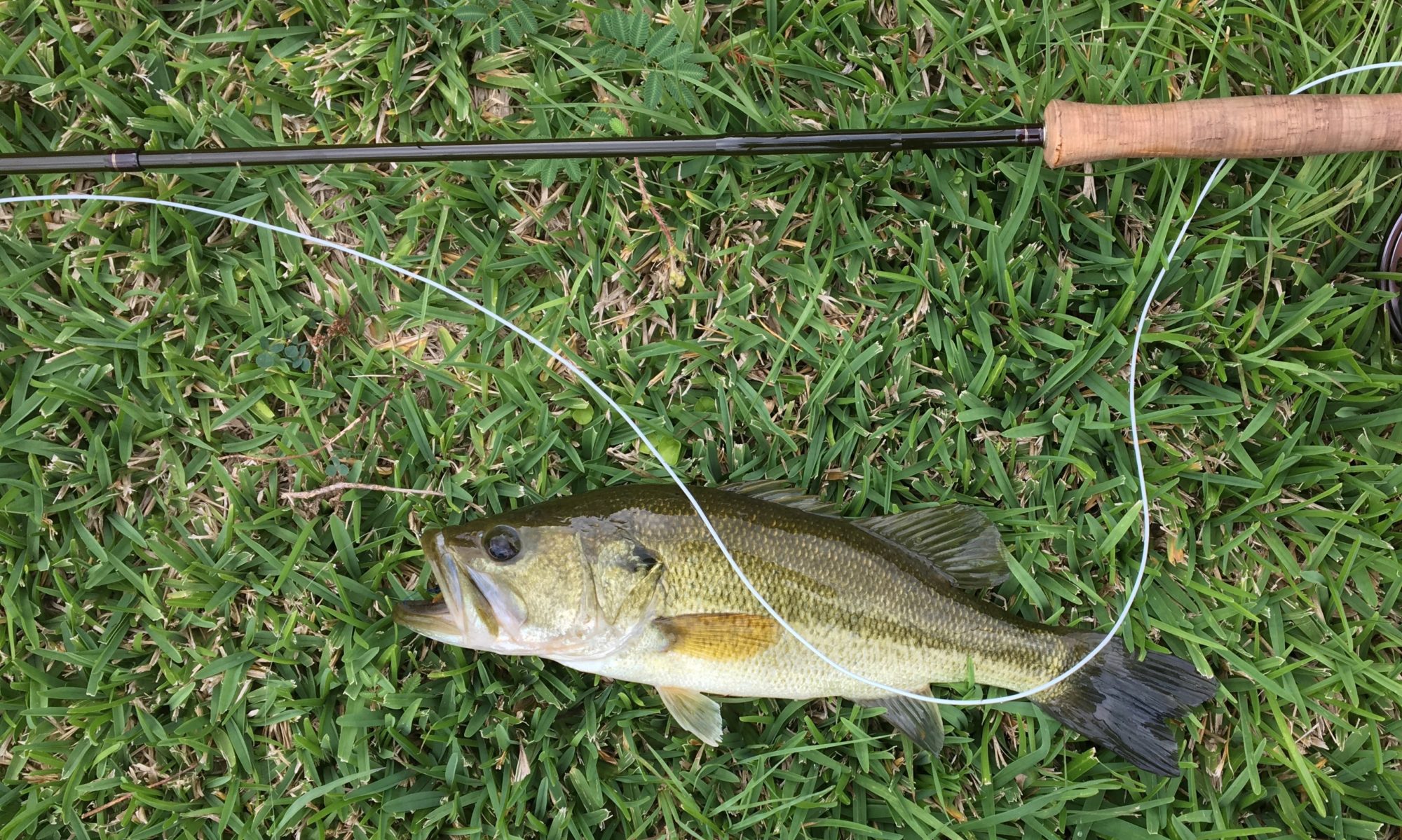
We only used cold water floating lines. In Wyoming and South Dakota we mostly fished with underwater nymphs under indicators. In Nebraska I caught those extraordinary bass on black Pat’s rubber legs fished as streamers.

Our Car

This was a road trip, so a few things about our car.

Pre-trip my car had about 50,000 miles on it. The week before the trip we had scheduled maintenance done, and on the dealer’s recommendation had a brake job and I replaced the battery. I had the tires rotated at Discount Tire. I installed a Victory 4×4 rear window molle panel and upper shelf for storage in the cargo area, and re-mounted the fly rod vault on the roof rack. The upper shelf and the rod vault were useful, the rear window molle panel wasn’t but it looked manly. The fly rod vault holds four assembled fly rods, and rod vaults are apparently required by law in Colorado. They’re certainly common enough.

In addition to the rod vault I bought a Pelican gear box and mounting hardware from REI. I got the smallest box to minimize wind resistance, but it didn’t hold enough stuff. I should have bought the largest size.

In Wisconsin years before our muskie guide had demonstrated the cargo drawers in his truck, and since then I’ve wanted a set for our SUV cargo area. Plenty of companies sell cargo drawers for pickups and SUVs, but they’re expensive, and I thought that I could build my own. It took me about three weeks of intermittent labor, and the result includes the appropriate number of design flaws. I built two 35″ wide drawers from side to side, 30″ deep from front to back. The lower drawer is about 10″ deep and the top 6″.

I loved the top drawer. I could throw in my sunglasses and reels and rod tubes, my fly boxes and maps and camera, and all the other smallish stuff that would otherwise be rattling around loose in the back of my car, but the stuff I put in the bottom drawer would have done better in a duffel. Or a larger roof box.

What’s worse, the two stacked drawers ate up the back of the SUV, and the first time I went to the grocery after installation I realized that except for the back seat I no longer had anyplace to put groceries. When we stacked duffels on the drawers we couldn’t really use the rearview mirror. The drawers will get rebuilt as two shallower drawers, hopefully by our next road trip.

By the time I rebuild the drawers I figure it will have cost me as much as buying pre-made drawers in the first place.

Buc-ee’s

Buc-ee’s is a chain of travel centers, placed strategically along Texas interstates. The first Buc-ee’s was near Houston in Clute (home of The Great Texas Mosquito Festival). I have a love-hate relationship with Buc-ee’s. Once when I fished Matagorda Bay I parked my car for the day in an out-of-the-way corner of Buc-ee’s Wharton parking lot, and management tagged my car with a semi-permanent sticker that told me to never, ever leave my car in a Buc-ee’s lot again. It took an hour of scraping to get the sticker and the residual glue off my car window. It wasn’t very neighborly, and a polite note would have gotten the message across. I also don’t trust their brisket or kolache (though I do give them points for having brisket and kolache), and I hate crowds. Buc-ee’s interstate travel centers are huge and are always crowded, though there are so many urinals in the men’s room that there’s never a line.

On the plus side for Buc-ee’s, there are things you have to respect. There are all those urinals and the bathrooms are immaculate. The gas is cheap. You can buy many strange and amusing things in Buc-ee’s, from barbecue pits to onesies for the grandchild, they don’t allow 18-wheelers, and they’re spaced along the major routes out of Houston just where you need ’em. They pay their employees well above the minimum wage.

Buc-ee’s has now spread beyond Texas, to, among other places, Alabama, South Carolina, Tennessee, and Florida. On this trip we found one north of Denver. Someday Buc-ee’s will be everywhere, and beaver nuggets and mediocre kolache will be available to everyone.

I made my peace with Buc-ee’s on this trip. I forgave them that window sticker and I suffered the crowds. I bought their relatively cheap gas. I even bought some parched corn and a Rice Crispie treat. I did not buy my grandchild a onesie.

Where We Stayed, What We Ate

Out of our 12 nights, we spent only three in hotels. Two of the hotels were unremarkable, a Holiday Inn Express in Amarillo and a Holiday Inn in Wichita, Kansas. The most expensive hotel, The Rally Hotel in downtown Denver, was across the street from Coors Field where we stopped for baseball. Both the hotel and Coors Field were great, though the Rockies not so much. At check-in they gave us free beer, which was friendly even if it was a Coors. Staying next to the stadium was almost worth the cost, and almost worth the drive through downtown Denver at rush hour.

Because Roo the dog was with us, we felt more comfortable leaving her in an AirBnB than in a hotel on the days we spent fishing. We spent four nights in an AirBnB in Wyoming and three in South Dakota, and both were fine. The one in Wyoming had the better view.

We camped two nights in Nebraska, which meant that our car was packed with camping gear. We’ve owned our tent for most of our marriage, more than 40 years, and it has survived a lot of use. This trip though one of the poles broke. We cobbled together a repair, but I wouldn’t trust it in hard weather. The tent may have seen its last road trip.

Because we were camping and staying in AirBnBs, we cooked a lot. At home we almost always cook, and I’d say we’re adventurous, competent cooks, but on this trip there was no adventure. We ate beef for dinner and bacon for breakfast. We ate steaks. We ate burgers. We ate more steaks and then we ate more burgers. We ate eggs and bacon with toast for breakfast.

We spent a lot of time in grocery stores, which is actually a pretty good way to get to know a place. Mack’s Market in Thermopolis, Wyoming, not only sells groceries, but it has its own liquor store inside, and a gun shop. What more does one need?

I think I’ve covered most of the trip’s restaurant stops in the other road trip sections, except for the pizzas we had in Lander and Thermopolis in Wyoming. This really was a junk food extravaganza. We also had donuts in Amarillo, which would make a pretty good country song, and in Fort Collins, Colorado, which would also make a pretty good country song. The donuts were ok, but I wouldn’t have picked them over a good kolache.

Where We Didn’t Go

I would have liked to see more rivers in Wyoming, and in September we are going to fish for a day in Yellowstone at the end of our Montana trip, probably on the Firehole. 6 I’m already thinking about a trip next May through Wyoming and back to the Green River in Utah.

I’d like to explore more of the streams in the Black Hills, but probably never will.

We didn’t stop for an onion burger when we drove through Oklahoma. We didn’t see the giant ball of twine in Kansas. I guess I’ll be remembered as the guy who never saw the giant ball of twine.

Playlist

I made playlists for Nebraska, South Dakota, and Wyoming, but I have to admit we mostly listened to books while we were driving. “Willow, Weep for Me,” by the Nebraska composer Ann Ronnell was on the Nebraska playlist. It has been recorded by everybody, and we had versions by, among others, Billie Holiday, Frank Sinatra, Julie London, Sarah Vaughan, Lew Rawls, Tony Bennett, Barbra Streisand, Chad & Jeremy, and Sam Cooke. Ronnell also wrote “Who’s Afraid of the Big Bad Wolf.”

Disney pigs, likely from Nebraska.

The other well-known song on the Nebraska list was “Nebraska” by Bruce Springsteen, foreshadowing New Jersey, which will likely be our last state. Omaha and Lincoln seem to have pretty lively alternative music scenes. Mannheim Steamroller is from Nebraska. I’m not a fan of Mannheim Steamroller.

Danielle Ate the Sandwich, from Nebraska and Colorado, plays a ukulele and sings. She is wonderful, witty, and fun.

Ooh, I've got soul, I've got soul
But you'd never know, never know
If you were stuck across the table from me
The terrible dinner guest


The Terrible Dinner Guest, Danielle Ate the Sandwich
Danielle Ate the Sandwich.

There are about 100 songs named “Wyoming,” and all of them are pretty good, though the rap song “Wyoming” by Afroman doesn’t live up to his classic, “Idaho.” The country singer Chris Ledoux is the best known musician from Wyoming, and he’s big on melodramatic story-telling, which for me is not quite the thing unless it involves either Laredo, El Paso, or a girl named Rosalita (also foreshadowing New Jersey).

The best song ever written about Wyoming is “Git Along Little Doggies.” This is jumping ahead, but the best song ever written about Montana is “I Ride an Old Paint.”

I never got around to much of a South Dakota list. The only person on my South Dakota list is Shawn Colvin, though I probably should have included “Born to Be Wild” as a nod to Sturgis. I always enjoy Shawn Colvin, though, so I’m ok with sticking to Shawn Colvin.

Guitar

I played the guitar a lot on this trip, probably because we cooked in our adopted homes and there was more free time in the evenings. In Nebraska, at the state park, after the failed attempt at spey casting on the Niobara River, I sat at our campground and played for a couple of hours while Kris went to Valentine to shop for steaks, bacon, and burgers. A woman with a Denver guitar shop tee shirt came over to talk to me about guitars, and invited us to their campfire that evening. It was a nice gesture, but when I went to bed at nine-ish the campfire hadn’t kicked off. I’m sorry. They might have known someplace to fish.

  1. The Czech singular for kolache is properly kolach, and the plural is kolache. The Texas usage of kolache as the singular and kolaches as the plural is not correct, but it makes a lot of sense to English speakers, and probably Spanish speakers as well. At various times I use all of them. Sometimes I suspect I use all of them in the same sentence. I’m betting my usage would make a Czech baker’s head spin. ↩︎
  2. In Schuelenberg, between Houston and San Antonio, there’s an otherwise good bakery that glazes its kolache. It’s unnecessary frippery, and I’ve only stopped for their kolache once. ↩︎
  3. Verdigre is home of an annual Kolach Days Festival. Wikipedia reports that Kolache are also available in other Midwestern states, including Minnesota, South Dakota, and Prague, Oklahoma. Both West, Texas, and Caldwell, Texas, claim to be the Kolache capitol of Texas, and West does have very good kolache. I’ve never had kolache in Caldwell. ↩︎
  4. Sausage kolache are not even Czech, but a Texas variant. The greatest kolache variant of all is from a Cambodian-owned donut shop in St. Charles, Louisiana, where instead of sausage they stuff their koblasnek with rice boudin. Brilliant. There are now boudin kolache at most independent donut shops in Houston. ↩︎
  5. Graphite fly rods are impossibly light, a matter of a couple of pounds and some stray ounces. What’s more, the newer graphite materials in modern rods allow thinner tip ends than rods from 30 years ago, so that when you’re swinging a nine-foot lever a modern rod will feel lighter than a 30 year-old rod of similar weight. The 30-year old rod Kris was fishing was pretty light, but it likely felt heavier than what she was used to. ↩︎
  6. Most of Yellowstone is in Wyoming. This is one of those factoids that always seems unnatural, like Kansas City being in Missouri. ↩︎

Road Trip, Part 3, Rapid City, South Dakota, to Smith Falls State Park, Nebraska (48) June 18-21, 2025.

There aren’t a lot of lodging choices near Valentine, Nebraska. Valentine, population 2,633, is tucked away from bigger cities. It’s north of the Valentine National Wildlife Refuge, east of the Samuel R. McKelvie National Forest, and south of South Dakota’s Rosebud Indian Reservation. Mission, South Dakota, population 1,156, is 32 miles north. The closest town to the east is Springview, population 242. Omaha is 304 miles east.

So we camped at Smith Falls State Park on the Niobara River. From Rapid City to the park was 219 miles, the shortest leg of our road trip. We crossed through the south unit of Badlands National Park and the Pine Ridge Reservation, including a stop at the site of the Wounded Knee Massacre. With a median household income of $36,424 and 49% of the residents below the poverty line, the Pine Ridge Reservation is as poor as America gets, and when we entered the reservation a sign suggested counting how many places on the reservation people could get jobs. I counted one, a National Park satellite office. They didn’t appear to be hiring.

Badlands National Park

Wounded Knee is a solemn place.

Wounded Knee Cemetery

I don’t remember why I picked Smith Falls State Park, and it turned out to be an odd choice. There is good fishing in Nebraska. In the south, where I-80 cuts across Nebraska from Omaha to Cheyenne, there are construction fill-ponds that parallel the interstate corridor. They’re developed and maintained for recreation, and from all reports are a great opportunity for fly fishing for bass.

We didn’t go there.

There are also reels of charming videos of trout bums catching tiny trout out of tiny streams in Nebraska grasslands. I am not a trout bum, but if you live in a van and have a three- or four-weight rod, there’s probably quality Nebraska fishing in memorably isolated landscapes. You just need to take the time to explore those landscapes.

We didn’t go there, either.

We had a two week road trip to fish three states. We had two days in Nebraska. In Wyoming and South Dakota we’d fished with guides, and like as not we’d have caught fish if we’d spent most of the day standing on our heads humming Cole Porter tunes. In Nebraska, we had to figure it out ourselves, so there was limitless opportunity for failure. To find fish we had to rely on studying maps and the Google and then wait until we got there to figure out if we’d picked wrong. And of course we’d picked wrong.

Through Google, I found DIY Fly Fishing’s guide to fly fishing in Nebraska. First on DIY’s Nebraska list was the Niobara River.

Niobara River, Smith Falls State Park, Nebraska.

Smith Falls State Park is on the Niobara, so I guess I figured yeah, that’ll work. There’s a river! There are some falls! We can fish! After our trip, after we got back home, I realized that the Nebraska Game and Parks Commission advises that the stretch of the Niobrara River supported for trout fishing–in other words it’s stocked–is above Box Butte Reservoir from the Wyoming border. Smith Falls is a long way on the wrong side of Box Butte Reservoir. Smith Falls is a nice place, a pleasant, lovely place, but it was the wrong place.

When we checked into the campground I told the young woman staffing the desk that I needed to catch a fish. “You’re in the wrong place,” she said. She was very young and I assumed would be of no help, but this was a country girl who knew her country, and she whipped out a brochure for Keller State Recreational Area, roughly 50 miles east, and started pointing out places in Keller to fish.

I did try to fish the Niobara at Smith Falls. It was water, so I figured there must be fish, but the river was hard to parse: it moved fast and lacked obvious structure except for the banks themselves. It was a fantastic tubing river. Had we floated downriver in a canoe and pounded the water at the banks with woolly buggers we’d like as not have caught something–I don’t know what but something . . .

For randomly wading in and tossing flies though, it was pretty difficult. The banks were so overgrown that the only place I could get into the river was at the canoe launch. I had a three weight trout spey rod, so I tied on a wet fly under a Pat’s rubber legs and made some random casts.

Spey rods were historically fished on Scottish salmon rivers, and are three or four feet longer than normal fly rods, which are already about nine feet. Depending on how well you cast them spey rods are either awkwardly long or elegantly long. With my casts they tend toward the awkward.

The extra length gives spey rods a big advantage: you can roll cast forward without a back cast, so your fly shouldn’t tangle in the brush behind you. I promptly started tangling in the brush behind me. Now if I had had a guide, the guide would have told me, Neil, you idiot, you’re laying the rod out horizontally behind you so the fly goes into the brush, but I had no guide. Three nights later it hit me: Neil, you idiot, you were laying your rod out horizontally behind you so the fly went into the brush.

Three nights later. I’m quick that way.

Guides are worth the money. If we’d had a guide, we wouldn’t have been at Smith Falls State Park. I got frustrated trying to fish the Niobara and went back to the campsite to play the guitar.

The next morning we drove to Keller State Recreational Area. At Keller there are five ponds, imaginatively named Ponds 1-5. The brochure said that Ponds 1-4 are warm water ponds with bass and sunfish, my kind of place, while Ponds 4 and 5 are seasonally stocked with trout. Bone Creek also cuts through the park, and is also stocked with trout.

Bone Creek, Keller State Park

Kris said she would birdwatch and didn’t fish. Each of the ponds was about the size of a city block, and a grandfather and grandkid fishing bait at Pond 3 told me that they had caught a bass, but the pond was weedless and oddly sterile. Nothing moved. Just looking at the pond I didn’t think that there was anything in it that was living. I worked my way down the east bank, stopping every few feet to throw out some casts, but nothing followed my fly. The one sunfish I hooked flipped off before I could land it.

At Pond 5, I dug out a random trout fly to cast while I watched the surface. There were tiny–very tiny–fish slaps out in the middle of the pond, and I watched a pod of 10-inch rainbows, maybe eight, drift through the shallows between the bank and a concrete water intake. I think they were desperate to find the exit. For me stocked trout ponds are unhappy places. The fish can’t reproduce and can’t survive past the first harsh weather, whether heat or cold. My heart wasn’t in it.

Pond 4 though was glorious, mucky, weedy, it looked like home. I tied on a small streamer and immediately started catching small bass on a line of weeds about 20 feet from the bank. Glorious scum! Glorious weeds! This was fishing I understood.

They were tiny bass, perhaps stocked but I thought more likely this year’s crop from the spring spawn. I was catching similar small bass at home near Houston, with maybe a month’s more growth. These fish were thrilling, not least because they were my Nebraska fish, but also because I thought that if I kept at it, casting along the same line down the length of the pond, maybe switching to a popper, I’d catch something respectable. Maybe I’d catch something as big as a pound. Then Kris called. She couldn’t find her car fob and couldn’t lock the car. It was hot. She and Roo the dog were bored. Come now.

I had my Nebraska fish. Kris and Roo were bored. That was all the fish we needed in Nebraska.

Nebraska

Nebraska was a Train Stop

The first eastern track for the transcontinental railroad was laid near Omaha in 1863, during the Civil War. Starting a major construction project in the middle of a war isn’t the most obvious thing, but before his election Lincoln was a railroad lawyer, he believed in the future of railroads, and he wanted to keep California, newly acquired and separated from the East by the Sierras, the Rockies, and the Great American Desert, from leaving the Union. He could have just sent the Californians candlesticks. Candlesticks are always a nice gift.

Currier & Ives, “Westward The Course Of Empire Takes Its Way,” lithograph, 1869.

The railroad was constructed by the Western Pacific, Central Pacific, and Union Pacific Railroads, at a cost in current dollars of $3.5 billion. Construction was funded by stock sales, federal and state bonds, and federal land grants. The railroad wasn’t actually transcontinental. It didn’t go from, say, Baltimore to San Francisco, but there was already a network of trains in the East. The Transcontinental linked the existing eastern network to the West Coast through the largely unsettled West.

Serious talk of a transcontinental railroad began in the 1850s, and there were actually three proposed routes. A proposed northern route went through Montana to Oregon, a Southern route went through Texas, New Mexico, and modern Arizona,1 and the central route went through what would be Nebraska, Wyoming, Utah, and Nevada. Severe cold presented too many technological problems for the northern route, and the supporters of the southern route kinda lost their influence after secession. You snooze, you lose.

Omaha is now Nebraska’s largest city because of the political maneuvers of Council Bluffs, Iowa. In 1854 the acting Nebraska territorial governor–acting because the appointed territorial governor got to Nebraska and promptly died–figured that if the train took the central route, then it would certainly go through Nebraska’s capital, wherever that might be. Council Bluffs wanted to be the train’s starting point, and Council Bluffians were developing Omaha directly across the Missouri River. The acting Nebraska governor, an Iowa boy, declared Omaha the territorial capital. I’m guessing lot prices skyrocketed, and Omaha and Council Bluffs got the train.

In 1867 when Nebraska became a state, every other Nebraskan wanted to punish Omaha for its hubris, so they moved the capital. Lincoln was chosen as the new site. To defeat the move, Omahaians loaded the proposed move with stuff they thought would kill it. If the capital moved, then the state prison would also be in Lincoln, and the new state University would be in Lincoln. Omaha was betting that if it loaded Lincoln with all the good things the move would fail and Omaha could keep the capital. It didn’t fail. The University of Nebraska is in Lincoln. The Nebraska State Penitentiary is in Lincoln.

Omaha still had the train, and it also has the College Baseball World Series.

Geography

At about 77,200 square miles, Nebraska is the 16th largest state by area, and with a population of about 2 million, it’s the 38th most populous state. That gives folk plenty of elbow room.

It is largely treeless prairie that divides into two sections. To the right of the 98th meridian Eastern Nebraska is part of the Dissected Til Plains. Western Nebraska is part of the Great Plains. As a child of the Great Plains, if I had stood in the front yard and looked due north, only Kansas, Oklahoma, and a bit of Texas would have kept me from walking over to Nebraska, and it’s perfectly possible that there were no trees to hinder my path.2 Of course if it had been February we’d like as not have been sharing a Canadian arctic blast, and in April we’d have shared a dust storm or two and some tornadoes. In summer we would have shared dry heat, wheat, and cattle.

From https://www.freeworldmaps.net/united-states/nebraska/nebraska-rivers-map.jpg

The Dissected Til Plains don’t make it as far south as Texas. They basically run from Minnesota down to Kansas, centered on the Missouri/Iowa state line. If you have a yen to grow corn, look to the Til Plains, young man. This is Green Acres country, and it’s the place to be. It was formed by glaciers, and as they retreated the glaciers left plenty of flatness and plenty of rich soil.

It’s a mildly humid region, defined under the Koppen system as a Humid Continental Climate, with four distinct seasons and big shifts in seasonal temperatures. That means in summer, eastern Nebraska gets mighty hot. In winter it gets mighty cold. It would be a great place to see the leaves change, if only there were any leaves. It is not humid like New Orleans, but it’s the last breath of mildly moist air before the Great Plains. Most of Nebraska’s population and its largest cities, Omaha and Lincoln, are in the Dissected Til.

https://unitedstatesmaps.org/wordpress/wp-content/uploads/2022/04/rainfall-maps-of-us-1536×979.jpg

The Great Plains (and the American West) begin at the 98th meridian, roughly on a line north from Fort Worth, as decreed by Walter Prescott Webb. It is a semi-arid region unique not because of topography or geology but because of the lack of rainfall. Looking north along the 98th, to the right it rains at least 20 inches a year. To the left, stretching to the Rocky Mountains, it rains less than 20 inches a year. It is the beginning of the cultural West, and Webb, who loved the cowboy, says it is the land of barbed wire (bob war, if you want to talk like a native), windmills, and the revolver. It was also the land of the Plains tribes and the great buffalo herds. And the Dust Bowl.

The Missouri River borders Nebraska on the east, and continues north through the Dakotas into Montana, where it and its drainage is one of the great fly fishing destinations.3 The Republican River swerves through southern Nebraska from Colorado and on into Kansas.4 In central Nebraska the North and South Platte descend from Colorado to form the plain ol’ Platte, which then joins the Missouri between Omaha and Lincoln. North Nebraska has the Loup River,5 then the Niobara. We’ll be fishing in the far western Niobara region, just below the South Dakota Black Hills and above and to the left of the Nebraska Sandhills.

Population

As of 2024, the estimated population of Nebraska is 2,005,465. That’s less than the population of any of Los Angeles, New York, Chicago, or Houston. It is a smaller population than the 35 most populous metropolitan statistical areas. It’s smaller than the Nashville-Davidson-Murfreesboro SMA, but larger than San Jose-San Francisco-Oakland SMSA.

More than 76.2% of the population is Anglo, 5.5% Black alone, and 12.9% Hispanic. Native Americans are 1.7% of the population.6 As already mentioned, it’s a big state without a lot of people, and there are only 25.5 people per square mile. New Jersey, the densest state, has 1,263 people per square mile. Nebraska has fewer people per square mile than Nevada (29) and more than Idaho (24).

Wikimedia Commons

Nebraska’s population is concentrated in the east. Omaha on the eastern border with Iowa has a population of 483,335, Lincoln, just a bit south and west, is 294,757. The Omaha and Lincon SMSAs contain more than half the state’s population. Of Nebraska’s 93 counties, 66 have populations of less than 10,000, and 11 have populations of less than 1,000. Of the smallest ten counties by population, all are located central to west, well west of Omaha.

Farm in Custer County, Nebraska, 1886, Nebraska State Historical Society.

In a European sort of way, Nebraska is ethnically diverse. More than 40% of the population identifies its heritage as German. That’s presumably a combination of railroads advertising Nebraska settlement in Germany in the late 19th century, European economic depression, and available land. There are also sizable populations of English and Eastern European settlers, and I’m certain there’s at least a smattering of Swedes.7

Nebraska is a meat-packing state, and it has a history of foreign-born and African American immigration to man the meat plants. Attitudes toward non-European immigration have been decidedly ambivalent, and from time to time, in the 1930s and the 2000s, immigration of recruited Mexican workers was followed by repatriation campaigns. There really is nothing new under the sun.

Politics

Nebraska gained statehood in 1867, before it had the required population. Presumably statehood was pushed through the Republican Congress to support the 14th Amendment. The same thing happened with Nevada during the Civil War, though there was also silver involved. Nebraska had its own connection to silver, with William Jennings Bryan, a Nebraska boy, electrifying the nation with his Cross of Gold speech at the 1897 Democratic national presidential convention.8

William Jennings Bryan, Grant hamilton, 1896, Judge magazine, New York City.

Nebraska was (and is) an agricultural state, and Nebraska politics were central to the rise and fall of the Populist Party in the 1890s. The Populists were a Southern and Midwestern farmer’s party with mildly socialist leanings, and by 1890 Populists controlled the Nebraska legislature. They passed a bunch of progressive legislation, including secret ballots, mandatory education, free textbooks, an eight-hour day (10 hours for farms), and railroad rate regulation. They pushed for public ownership of the railroads. Bryan coopted Populism, and as the new leader of the national Democratic Party folded the Populists into the Democrats.

From 1894 to 1900, Nebraska elected Populist governors. After 1900 there was a mishmash of Democrats and Republicans, leaning Republican. Since 1994, all of Nebraska’s governors have been Republican.

Nebraska voters now pretty much vote Republican. Nebraska is the only state with a unicameral legislature, and in the current legislature there are 33 Republicans, 15 Democrats, and one independent. There are no Populists. Probably leftover from its Populist days, it seems like every statewide office in Nebraska is elected, from Governor down to the university board of regents. A bunch of the elections are non-partisan, but all of the partisan statewide positions are held by Republicans.

Nebraska and Maine are the only states that allocate their electoral votes by Congressional District, which actually makes a lot of sense to me, so while Donald Trump carried 59.32% of Nebraska’s statewide popular vote in 2024, Kamala Harris carried Omaha and Lincoln, and Democrats received one of Nebraska’s five electoral college votes.

Wikipedia, 2024 Nebraska presidential results by county.

Nebraska Pride

I have the sense that no state instills more pride in its children than Nebraska. It’s generally admirable, but it was insufferable when the University of Nebraska Cornhuskers had better college football teams than the University of Texas.

In addition to a unicameral legislature, the University of Nebraska is also unicameral, having rolled both its land grant agricultural college and state university into one campus. Such thrift seems uniquely Nebraskan.

The University of Texas has gone to Omaha for the College World Series 38 times, which is the record. The University of Southern California holds the record for titles, with 12.

  1. And just a wee bit of Mexico, which led to the Gadsden Purchase. In 1854, planning for the southern railroad route, the US gave Mexico ten million dollars and received Tucson, Yuma, and the lefthand side of southern New Mexico. Ten million dollars went a lot further in 1854 than it does today. You couldn’t buy Greenland for that now. ↩︎
  2. This is gross exaggeration. There are often trees on the plains where there’s water, and in shelter belts. In Texas there were mesquites (though they were invasive from South Texas because of over-grazing). ↩︎
  3. I haven’t fished the Missouri in Montana, but I have in North Dakota. I didn’t catch anything. Together with the Mississippi and the Ohio, the Missouri forms the world’s fourth largest river system at over 3,900 miles. I haven’t fished the Ohio, either, or for that matter the Mississippi. ↩︎
  4. The Republican River Flood of 1935 was one of the Nebraska’s worst natural disasters, resulting in 113 deaths. Before the Europeans, the Pawnee farmed beans, corn, and pumpkin along the Republican River with the occasional jaunts afield for buffalo. In Kansas, the Republican joins the Missouri before the Missouri joins the Mississippi at St. Louis. ↩︎
  5. Loup is French for wolf, so French fur traders must have made it to Nebraska. ↩︎
  6. Native Americans in Nebraska included the Sioux, the Pawnee, the Sac and Fox, and the Omaha. Much of the indigenous population was displaced south to Oklahoma. There are eight remaining reservations in Nebraska, for the Ogallala and Santee Sioux, the Omaha, the Oto, the Pawnee, the Ponca, the Sac and Fox, and the Winnebago. ↩︎
  7. This is because my friend Clark, whose family is Swedish, is from Nebraska. I was surprised when at least half of Nebraska’s population wasn’t originally from Sweden. ↩︎
  8. The amount of dollars in circulation was limited by the value of the gold owned by the federal government. Western and Southern farmers wanted silver coinage to increase the money supply, spur inflation, and make their existing debts easier to repay. Bankers didn’t. ↩︎

Happy New 2025!

We’re on the last leg, though I’m pretty sure that fish don’t have legs. Six states to go, and our plan is to finish the last six this year. New Jersey, Massachusetts, South Dakota, Nebraska, Wyoming, and Montana . . . We completed the South last year with Georgia and South Carolina, and the Southwest with Utah and Arizona. We’re saving Wyoming and Montana for last.

Nothing is planned, except a trip to Montana in September and then a few days at the Old Faithful Inn fishing in Yellowstone. I keep thinking I need to plan, but in January–on January 6 no less–it’s hard to have much faith in the future. What a black day.

I keep thinking that I should calculate things like how many miles we traveled, how many nights we spent, how much money we spent, and how many species of fish we’ve caught. Maybe I will, but not today. Today maybe I’ll think more about Wyoming. Wyoming is a good place to fish.

We won’t be the first people to catch a fish on the fly in each state, but we have earned some great stories, and we’ve met some great people. Someone said to me recently that when we finished we could start again.

God no.