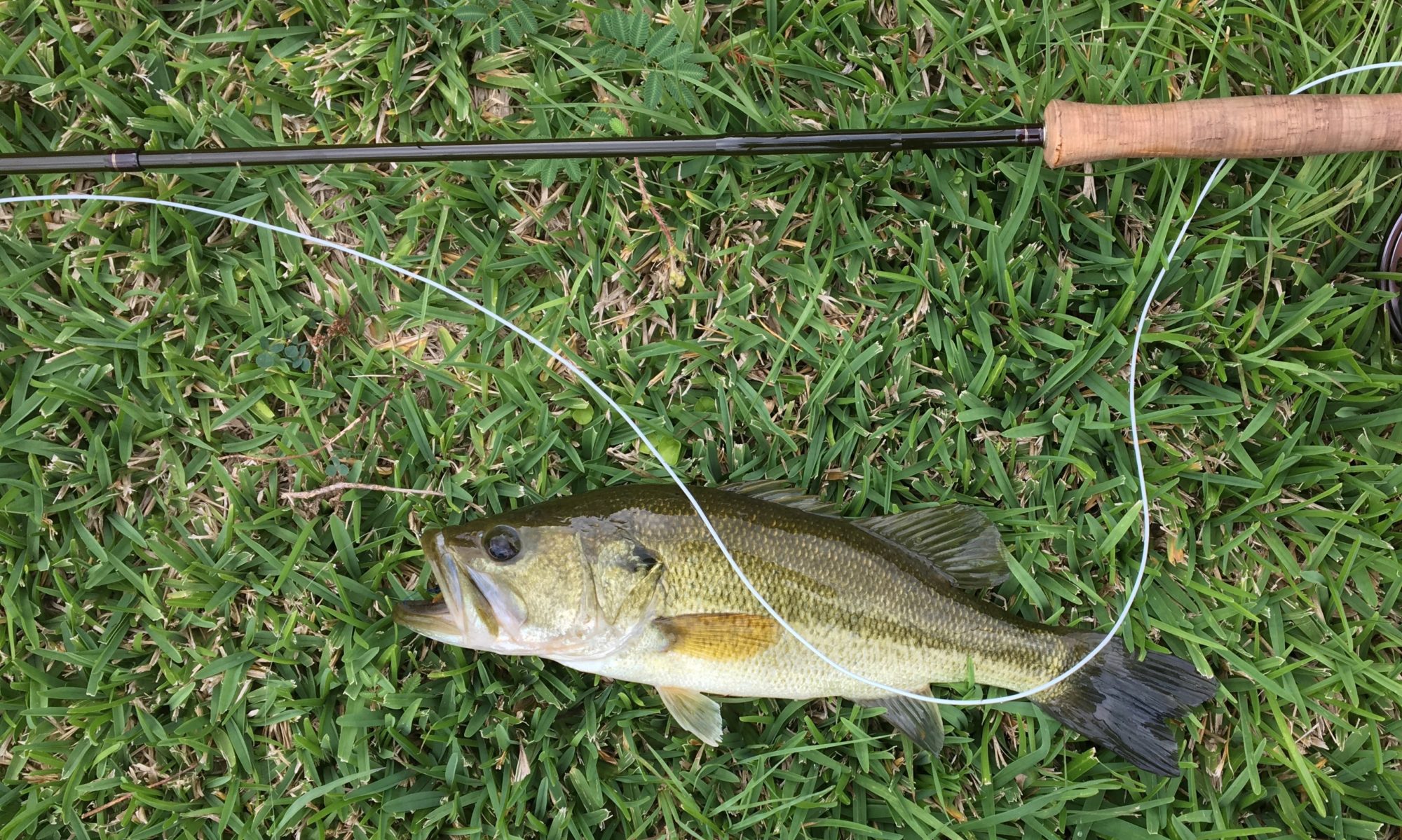
I shot a fish in Reno

From The Great Train Robbery, 1903, directed by Edwin S. Porter.

This is a blog post with footnotes. [1]

Reno Fly Shop has a podcast, and it’s good. It’s an interview format with some national fly fishing personalities and some Nevada or California locals with local knowledge. The episodes are each about an hour, which is just right for my morning stumble around Rice. The host, the shop owner Jim Litchfield, is a generous and engaged interviewer, but the podcast always gets around to Pyramid Lake and the Truckee River. That can be a bit of a stretch for some of the national fly fishing personalities, so the locals have a decided advantage.

A recent podcast was with Meredith McCord, who is not local to Reno, but like me is from Houston. She spoke at Texas Fly Fishers last year. I don’t know her, but from the audience Ms. McCord seems lively and personable, with a Southern Girl’s penchant for girly casual wear and plenty of well-coiffed hair. She also has a penchant for IGFA records.

The IGFA is the International Game Fish Association, which apparently exists to keep lists of world records and establish rules for catching big fish. Like fly fishing competitions, it has little to do with the rest of us.

On the podcast Ms. McCord was talking about her IGFA records–she holds about 9,000. [2] The talk on the podcast sooner or later got around to IGFA records for cutthroat trout, all of which are from Pyramid Lake. The IGFA doesn’t differentiate among subspecies of cutthroat trout, a cutthroat is a cutthroat is a cutthroat, so a westslope cutthroat from a tiny stream in Montana is in the same swimsuit competition as a massive Lahontan, and it’s no contest. On the other hand there are male and female records, not differentiated by the gender of the fish but by the gender of the angler. I’m pretty sure the records are kept separate so that a boy won’t need to feel bad about being beat up by a girl.

Following are the women’s records for cutthroat:

IGFA Women’s Fly Fishing Records for Cutthroat

If reports are right and ten- to 20-pound Lahontan cutthroat trout are reasonably common at Pyramid Lake, then these records are ready to be broken. [3] Even I could probably land a trout a bit bigger than two pounds on 20 pound tippet. Of course I’d have to change my self-identification, and nobody makes that kind of decision just to catch a fish.

Looking at the list, the second column is the problem. The second column represents a recent rule change that requires a minimum weight for record fish based on the weight of the tippet. The change was adopted after some records were already set, which is why some of the cells are blank: one way or another those records met the new rule requirement. The rule change might attest to the sportsmanship of IGFA rulemakers, but I suspect it probably goes more to the credibility of a 1 lb 12 oz fish being the record cutthroat for 16 pound tippet.

The change requires that for a fish to establish a record, it must weigh at least half of the weight class of the tippet. [4] You don’t put a bantam weight in the ring with a heavyweight and still call things sporting. Of course there’s a four pound tippet class for tarpon, and catching a 100 pound tarpon on a four pound tippet seems more like needless cruelty than sport, so, like I said, credibility is a better explanation than sportsmanship.

Because many of the women’s cutthroat records are oddly low, Pyramid Lake is prime for new records, particularly for women. Listening to Meredith McCord in the podcast I started wondering if Kris would like a record of her own.

The tackle side of establishing records is pretty straightforward. You can fish with any kind of rod as long as it is at least six feet long and is generally recognized as a fly rod. An Orvis Practicaster probably doesn’t cut it, but anything else sold as a fly rod is probably fine. Same goes for reels. [5] Your line can be any kind of fly line and backing. Really the tackle rule comes down to this: if you’re using tackle that’s generally recognized as a fly rod, reel, and line, then from (a) inside the knot attaching your leader to the tippet to (b) inside the knot attaching your tippet to your hook, your class tippet, the one that tests 2 or 4 or 16 or 20 pounds, has to be at least 15 inches long. That’s pretty much it: at least 15 inches inside the knots. It can be longer, but it can’t be shorter. [6]

Now once you sort out the whole gear thing, the conduct thing [7], and the species identification thing [8], you get to the real problems: the weight and length thing, and the fly thing.

Notwithstanding that I’ve got this whole list going on of fish-I-caught, I’m not a particularly ambitious angler. I want to catch a fish in Kansas, but in Kansas I’d be perfectly happy if it was a six-ounce sunfish. I also understand that from the fish’s perspective fishing is a pretty cruel thing to do. I’m not going to stop fishing, but all in all I want to play a fish quick and get it back in the water so that it can go on about its business of killing and eating stuff and fish sex. I’d kill a fish and eat it, but I don’t really like to clean fish. I’d just as soon put the fish back.

But when I put them back I want them to survive, and our notions of how to handle fish for fish survival are evolving. There are the great guidelines from KeepEmWet Fishing, most of which involve keeping the fish wet, using a net, using barbless hooks, and reducing handling.
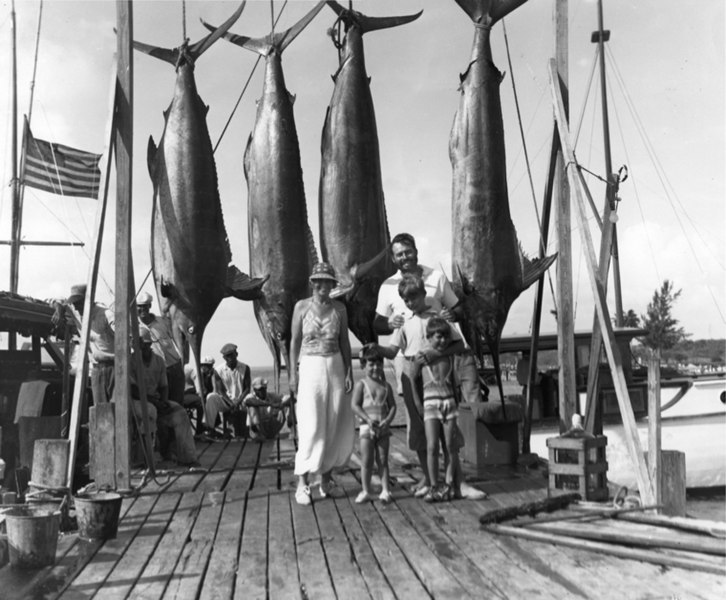
File:Hemingway and Marlins.jpg
Ernest Hemingway and family with four marlins, 1935, Bimini, Ernest Hemingway Photograph Collection, John F. Kennedy Presidential Library and Museum, Boston, Massachusetts, Public Domain.

I’ve assumed that IGFA records were all established with dead fish, and that’s not right. While there’s nothing I see in the IGFA rules that prohibits killing fish, IGFA is a partner of KeepEmWet, and has adopted its own rules, guidelines really, for releasing fish. [9] However good the angler, and however good the angler’s intentions, [10] establishing a record requires handling, and there’s a tension between any handling and keeping a fish alive. The IGFA has established procedures for handling and weighing fish aimed at release, and the pictures in my head of dangling dead fish are wrong, or at least unnecessary to establish a record. [11] Still, all in all, all of this folderol seems a lot of trouble, and I’d just as soon not bother. If sometime Kris wants a record, I’ll surely help, but I don’t think I’ll mention it to her. Don’t you mention it to her either.

In addition to the weight thing, there’s the fly thing. Saltwater anglers hate the 12 inch bite tippet regulation [12], which according to rumor is too short to effectively deal with tarpon. For freshwater anglers, the really dumb part of the IGFA rules is a prohibition against droppers. [13] Only single flies are allowed, one supposes to discourage snagging, but really? It’s not like fishing droppers isn’t one of those things done since Dame Juliana Berners, and everybody fishes at least tandem flies when they nymph. The last known person to fish a single nymph was in 2006, and that was only because he’d lost his dropper in a tree. From what I can tell all fishing in Pyramid Lake involves dropper-rigged nymph fishing or streamers, and the practice is to fish tandem streamers. The IGFA rule is inconsistent with how anybody fishes, and I’m not setting any records until the rule is changed. Hah! Showed them. Let them defend their vaunted credibility now.

The Booke of haukynge, huntyng and fysshyng, with all necessary properties and medicines that are to be kept, Tottel, 1561, http://www.luminarium.org/renascence-editions/berners/berners.html

[1] Lawyers love footnotes of all things. Some of the best stuff is always in the footnotes. I wish I could figure out how the text notation could jump to the footnote, and vice versa, but I can’t, so there you are. If you want to read the footnotes you’ll just have to do it manually. Sorry.

[2] Ms. McCord holds a lot of records, but I made up the number 9000. It just sounded good.

[3] IGFA measures things by kilograms, but I skipped straight to the stateside pound translation. If you want to get back to the IGFA designation a kilogram equals 2.2046 pounds.

[4] If you’re paying close attention, this is probably confusing because the chart gives the minimum weight for 16 pound tippet at 8 pounds, 14 ounces. Even by my low math standards that is more than half of the weight of the 16 pound tippet class. That’s because the IGFA doesn’t use good ol’ American tippet, but some kind of European stuff measured at 8 kilograms. The 16 pounds is an approximation of eight kilograms. Eight kilograms weighs more than 16 pounds. Who knew?

[5] The exact language of the reel rule is as follows: “The reel must be designed expressly for fly fishing. There are no restrictions on gear ratio or type of drag employed except where the angler would gain an unfair advantage. Electric or electronically operated reels are prohibited.” I guess that you couldn’t use a Tenkara rod because the reel for the rod isn’t expressly designed for fly fishing. Maybe someone could argue that the absence of the reel was expressly designed for fly fishing, and that counts for reel design. This is a shame, since I reckon that all of the saltwater Tenkara anglers are out there right now trying to beat the record for sailfish.

[6] At this point you should be asking yourself how the heck do I know that my leader actually tests at that weight? There are pre-tested tippet spools you can buy from companies like Courtland, which should provide consistent break points over the length of the line. This differs from how most of us buy tippet, which actually has less to do with the break strength than the tippet diameter. We don’t really care if our .015 diameter tippet measures a bit more than 8 lbs over its length. Record setters do, and you have to send your leader and tippet in for testing with your record application. You’d think these IGFA people think that fishers are all liars, or at least poor judges of their catch.

[7] This is gross over-simplification, but the conduct rules pretty much come down to catch the fish as you normally would, don’t actually shoot it, and except for netting or gaffing in the final stage, don’t let anybody help you land the fish.

[8] Take lots of pictures of the whole fish. Take pictures of the fish from every conceivable angle. If there’s going to be any doubt of the fish’s species, The IGFA recommends you take the fish to your nearest ichthyologist for identification. I kid you not. A photo has to show the full length of the fish. A photo has to show the rod and reel used to the catch the fish. I think a photo has to show the scale used to weigh the fish, and I think I’d send in a photo of the scale in the very act of weighing the fish. Scales are notorious liars, as anybody with a bathroom scale knows.

[9] One supposes best practices for keeping fish alive doesn’t include taking the fish to the nearest certified scale. The scale certification rules confuse me, but I gather that the best scales are spring scales—not digital as one would expect—and that Boga grips are considered good scales, but not good fish handling devices if you’re using them to hang fish up by the lips. Lip hanging is both hard on the fish’s jaw and on their internal organs, which will come as a shock to us largemouth bass anglers. IGFA will pre-certify your scale for a charge and a membership fee, or will certify the scale after the fact. Then of course you run the risk of having used a bad scale, plus you still have to pay the membership fee.

[10] Now if I were a particularly devious sort of record chaser, and I’d caught a record fish, then I might conclude that if I release a fish and it lives long and prospers, then somebody could break my hard won record next year with the same fish. I don’t know how the minds of record chasers work, so maybe none are that sort of devious.

[11] Apparently the best way to weigh a fish is in a cradle or a net, so you have to establish the weight of the sling or net and subtract it. I’ve got no idea what the IGFA requires to establish the weight of the sling or net.

[12] In addition to the class tippet rule there is also a special rule for bite tippet, which is important for fish like tarpon. That’s a whole other discussion. Twelve inches.

[13] If you’ve read down to this footnote, and you don’t know what a dropper is, then I’m a more engaging writer than I thought I was, or you’re one of my children and you’re humoring me. If you think about fly #1 tied to a fly line, and then fly #2 tied to a piece of line tied to the hook bend of fly #1, fly #2 is the dropper. The whole thing together is a dropper rig.

Another Interlude

On Thursday we leave for Hawaii, which for some odd and I suspect Southern reason I pronounce Huh-wah-yuh, which Siri can’t understand when I call up my playlist. We should spend today packing, which we won’t. What do we take? Some shorts, some shirts, some wading boots. The couple of 9 wt rods we gave each other for Christmas. A guitar. We fish with Captain Jesse Cheape of High Tide Fishing, a full day on Friday and a half-day on Saturday. After that we’ll sightsee. I think sightseeing is required by the nature of the thing.

It is the second farthest distance we’ll travel, closer than Alaska but further than Maine. I’ve actually practiced casting some, which is frustrating and unrewarding. I’m such a mediocre caster. I’ve tried to keep up my Hawaii reading, and have been through a couple of additional Hawaiian books–The Descendants by Kaui Hart Hemmings, which was very likable, and Dreams from My Father by Barrack Obama, which was about his birth in Kenya.

I guess my thoughts have moved on to Mississippi, which I’ve been working on for May, and Florida which I have to go to in February. I’m beginning to despise Florida and its uncatchable fish, but the Astros open there in April, and if we fail again in February (with a one-day fishing trip to the Keys) maybe we’ll make a fourth trip in April.

Hawaiian music hasn’t really grabbed me: it’s melodic, sweet, all major keys and thirds and fifths and pure tones. I’ve been cheating on Hawaii with Mississippi Blues. It shares a slide guitar, but not much else.

Frontispiece, Life on the Mississippi, The Baton Rouge, 1883, Gutenberg.org.

I also cheated on Hawaii with Mississippi books, and re-read Twain’s Life on the Mississippi. It is such an essential book. It’s only a bit more than a six-hour (read eight-hour) drive from here to Vicksburg, and we could visit the battlefield memorial and the National Cemetery over the long Martin Luther King weekend. Of course with the government shut-down nothing at the National Cemetery would be open. It’s too bad all presidents aren’t required to be born in Kenya.

Early on Twain also traveled to Hawaii (née the Sandwich Islands) and wrote a series of letters from there for a San Francisco newspaper. I didn’t find the letters particularly illuminating, though Twain liked the place immensely and always talked of going back.

I’ve tied some leaders which won’t turn over, and some flies which won’t catch fish. I’ve also bought some flies, almost all of which are some kind of spawning shrimp, which is the only fly I can ever seem to remember on Captain Cheape’s list. I do own a bunch of bonefish flies, almost none of which are on said list. I’ll haul them along anyway.

Meantime the weather here in Houston is as good as it gets: clear, windless, dry, and cool, 61 degrees this morning with a high of 71 degrees. There’s a mockingbird singing through the open door to the porch. Maybe I’ll go look for black bass this afternoon, or spawning crappie. Yesterday we took the skiff out on Galveston bay, and the combination of cold weather and still air left the water clear. We saw some redfish, too.

Didn’t catch those either. We did get some excellent oysters and ceviche at the Black Pearl Oyster Bar on 23rd Street.

Biloxi Marsh

I caught my Louisiana red.  It was three or four pounds, a decent fish for Texas but nothing special for Louisiana where redfish are larger.  It’s caught though, and Louisiana is done.

We fished the Biloxi Marsh Wildlife Management Area, a  36,644 acre estuary 40 miles east of New Orleans, owned by the Biloxi Marsh Lands Corporation and leased to the Louisiana Department of Wildlife and Fisheries, subject to mineral rights. The Biloxi Marsh Lands Corporation was founded in the 30s to own the marsh and lease land for oil and gas exploration.  I suspect it was a transfer of public lands to private parties for the benefit of Huey P. Long, his friends, and his family. It was probably formed after oil had been discovered but before state lands were leased.  If that’s not the case, if the land was always private and it was all on the up and up, I’d be pleasantly surprised, but it wouldn’t change my opinion of Huey P. Long. If he didn’t run that scam in the Biloxi Marsh he ran it somewhere.

On a Saturday in August the Marsh was mostly empty.

The marsh looks like how a marsh is supposed to look: flat and watery and grassy. It’s shallow, but it’s no Caribbean flat, and it’s too far north for mangroves. There’s no clear water or sandy bottom.  It’s muck, mostly, muck and oysters, and not a  place for wading. When the pole went deep in the mud black ooze came up with the pole.

We launched out of Campo’s Marina in Yscloskey.  Yscloskey was originally settled by Spanish Canary Islanders in the late 18th century, and in 1900 was still a Canary Islander descendent fishing village. That Campo surname probably isn’t random.

Yscloskey was destroyed by Katrina–the New York Times reported there was nothing left intact but a single light bulb and a garden hose–but it looks well enough now.  It was busy on Saturday for the blessing of the fleet at the start of the shrimp season. The shrimp boats as often as not flew Confederate battle flags, along with plenty of pennants, the Louisiana state flag, the American flag, and some other flags I didn’t recognize. There was lots of red, white, and blue and purple and gold.

*  *  *

You’re never very far from a discussion about Katrina in New Orleans. It’s not the same city, literally. What held people in New Orleans before Katrina was extended family networks and the Ignatius J. Reilly state of being: if you were born in New Orleans and lived in New Orleans you as likely as not never went anyplace else unless it was 90 miles to LSU.  Katrina forced people to leave, and after Katrina the family networks were damaged.  Cousins who left for Houston or Dallas or Atlanta got new jobs and better houses and schools and never came back. Twelve years later in the Treme near Willie Mae’s Scotch House there are still boarded houses.

*  *  *

Kris caught two reds. She hooked a big red, at least 20 pounds, but got distracted and the fish broke off.  You can’t multi-task when landing a 20 pound fish. Lesson learned. I learned a lesson too.  Fishing the second day with a New Orleans hangover isn’t that much fun. I really didn’t need that final Sazerac even if it was the Sazerac Bar, and I didn’t need the Abita with the oysters at Felix Oyster House to start the evening, and I certainly didn’t need what came in between. Lesson learned. Also, take insect repellent, and use the insect repellent you take.

Our guide, Bailey Short, used big heavy flies, 10 weight rods, and 20-pound leaders.  It was big stuff, much bigger than I’d expected.

He polled slow. There was no hurry to get anyplace because we were already there. Thorough, he said, you gotta get to the spot and be thorough. There were fish where we were, and we needed to take our time and spot them. Sooner or later we did, even if we didn’t catch them.

We talked to Bailey about the fall and winter months, the supposedly best months, but he said that the fish were just as big in the summer and that everybody now had heard about the big winter reds. There was so much winter pressure with interloper guides rolling in from Florida and Texas that July and August were in some ways better. He showed us lots of fish and we got lots of shots. Bailey did great, and was great company, but the fish didn’t cooperate. It certainly wasn’t my hungover casting. That’s my story and I’m sticking to it.

When we left Yskloskey for the airport Kris said she wanted a burger but I said po’boy and at the turn on to the highway Yelp! told us that the Last Stop Grocery and Deli sold po’boys. We sat out under the awning in the Gulf breeze and listened to the insect sounds and watched the jungle green on the side of the road. It was the perfect last moment in Louisiana.  Good fried shrimp po’boys too.

Flies, Leaders, and Devil Rays

At the end of the month we fish two days with Captain Court Douthit somewhere near Tampa. Captain Douthit inherited us, so I hope his Zen or at least his sense of humor is on. He’ll probably need it. Three or four months ago I tried to book with the Orvis-endorsed guide in Tampa.  I’ve had luck with Orvis guides, but no luck here: he was booked.  I found another guide with a boat I liked, booked the dates, and sent in the deposit.

Turns out I tried to pick a guide by his boat and instead picked a movie star.  In May he canceled our trip because of his schedule with Animal Planet. Who knew? It’s probably for the best, since on fishing videos you have to yell at your fish like Vikings taking scalps. We’re not much good at that.

Anyway when he canceled he was nice enough not to just drop me: I guess I’m not quite that prom date. He passed us on to Captain Court, and it looks ok. Captain Court has a cool boat, a 1994 Hewes, with a relatively new engine, and I like his website. I like that he took off a summer to hang out with his kiddo, which seems a long way from taking scalps, and he doesn’t seem to require that the clients in the photos on his website yell at their fish.

* * *

As it happens I’ve tied a lot of tarpon flies, all tied on 1/0 hooks for the smallish resident tarpon of Belize. That may be small for Tampa, or maybe not. I have no idea what fish want in Tampa, or what we may fish for.  To be honest I’d be perfectly happy puttering around mangroves looking for snook in the roots or redfish in the grass. Are there mangroves? Is there grass? I don’t know.  As to flies though I gather that if you put a fly into a tarpon’s zone, the tarpon’s not real selective about the fly. Maybe even a McGinty would work.

Of course there’s that whole casting-into-the-zone thing which is a problem, and so far even when I’ve had lucky casts the tarpon haven’t taken my fly. Maybe the casts weren’t lucky enough.

Dimock, Anthony Weston, The Book of the Tarpon, 1911, at 108.

Like the tarpon, tarpon folk don’t seem overly concerned with fly selection. Bill Bishop in High Rollers says he only carries three patterns in shades of dark and light, dark for clear water and light for cloudy. Or was it the other way around?  On a quick internet survey everybody seems to push at most four or five flies. Even by bass and redfish standards that’s sparse. For bass I’ve got more than three different kinds of poppers, not to mention various streamers, woolly buggers, frogs, and McGinties. You probably can fish for tarpon with a McGinty, but nobody knows it yet.

I tied a lot of tarpon flies during Hurricane Harvey.  I like tying tarpon flies because they’re big, and even in these late days I can still see them, and we were going back to Belize in November after Harvey. Our house didn’t flood, and we never lost power, but for three days our street was a storm drain.  There was nothing to do but watch the weather, watch the water rising, tie flies, and joke on Facebook that I was waiting for the tarpon to show up in our yard.  They never did. After a day or so even I stopped joking on Facebook.

What tarpon people are concerned with are leaders. On the internet you can find a dozen ways to tie a tarpon leader, and each leader’s proponents seem certain as to their efficacy. I didn’t know there was so much righteousness in the cause of leaders.

First off there’s the whole IGFA leader standard. Everyone agrees a 12-inch bite tippet is too short. I’m sure that somewhere deep in the heart of the IGFA tower in downtown Nantucket there are sincere discussions among high-level executives of how, if the bite tippet were lengthened, it would treat all those prior 12-inch tippet record holders unfairly. Get over it. Remember Roger Maris.

Meanwhile in Belize guides recommend a straight 6-foot 60-pound leader.  It’s not a good  idea. Tarpon are the prey of bull sharks and hammerheads, and sometimes you want to break the fish off.  That’s not going to happen with a 60-pound straight leader. You also want the leader to break if the line is wrapped around your leg, your neck, or your guide. Getting pulled into the water with the bull sharks and hammerheads seems a particularly bad idea.

Plus fly lines have a breakage strength of less than 40 pounds. I’d rather break my leader than a fly line, or a fly rod. So I’ve settled on a 20-pound class tippet. I’ve considered 16 pounds, but that seems pretentious. Anything less than 16 is just cruel.

I used a 60-pound nylon butt section because that’s what the guys at Bayou City Anglers wanted me to buy.  I went to Bayou City in the first place to buy hard 30, but I follow instructions. The whole leader’s about nine feet, +/- 12 inches. The six-foot 60-pound nylon butt is attached to the fly line with a perfection loop, and to the 20-pound fluorocarbon class tippet with an improved blood knot. The twenty-four inch 60-pound fluorocarbon bite tippet is attached to the fly with a Kreh loop knot and to the class tippet with an improved blood knot. All those knots seem impossibly small. I’m sure it’s a total failure, but not because I didn’t think about it.

Who wouldn’t be fascinated by such stuff? Who says fly fishing is arcane?

* * *

Monday we went to Minute Maid Park at Union Station, pronounced MUM-puss, to watch the team formerly known as the Tampa Bay Devil Rays play the Astros.  I wanted to  see the Rays before we went to Tampa. In 2008 the Devil Rays banished the devil, changed their name to the Tampa Bay Just Rays, and got rid of the fish logo and replaced it with a little patch of sunshine.

See that glimmer in the eye of the R? On Monday the Astros played the Tampa Bay Glimmers in the Eye.

I liked the old Devil Ray mascot, but hated their uniforms, now I like their uniforms but I’m dubious as to the little patch of sunshine. I also liked the way Tampa Bay Devil Rays fell off the tongue, though many people thought it clumsy. Los Angeles Angels of Anaheim is clumsy. Dallas Rangers of Arlington is clumsy.  Tampa Bay Devil Rays has some Latin rhythm.

Turner-Turner, J., The Giant Fish of Florida, 1902.

As a team, the Tampa Bay Rays née Devil Rays are perennially a hard-luck lot. since their first season in 1998, they’ve won 1,500 games and lost 1,738, for a .462 winning percentage. The Astros have played since 1962 and have won 4,391 and lost 4,552 for a .493 percentage.  The ‘Stros were in striking distance of breaking .500 a few years back, but then went into their three 100-loss-season tailspin.  Did I mention that the Astros won the World Series last year?

The Astros at .491 are now about the median, with only nine teams at .500 or higher. The Rays lead only the San Diego Padres for the very bottom.  Of course they’re stuck in a division that includes the Red Sox and the Yankees, so life isn’t fair. They’re also in Tropicana Stadium, which is in St. Pete and apparently inconvenient to get to from Tampa.  Along with the Oakland Coliseum, Wrigley Field, and Fenway Park it’s judged one of the worst dumps in Major League Baseball. The Rays consequently don’t outdraw the Tampa Bay Lightning of the NHL. They don’t even play baseball in the NHL.

The Rays did have some great seasons ten years ago, when Andrew Friedman, now with the Dodgers, was their VP of baseball operations. I don’t know Andrew, but he’s a Houston boy, and I know his dad, Kenny. The Rays even made it to the World Serious, and Andrew got a lot of the credit. The Dodgers pay Andrew a lot of money for the lot of credit, but who don’t the Dodgers pay a lot of money? And if he’s anything like his dad he’s a bargain.

As is more common than not, this season is not going well for the Rays. Through Juneteenth they’re 33-39 for fourth in the AL East. They’re also doing some weird rotation maneuvers, starting relievers for two or three innings, because part of their rotation is weak. Monday’s game they had a great start, getting four runs early on Gerrit Cole. Cole came into the game 8-1 with a .240 ERA, and has pitched this season like a Cy Young winner.  Those four runs to the Rays may have been his worst three innings as a Stro.

Cole kept the ‘Stros in it though, finishing seven innings with no more runs. The Rays lost in the bottom of the 9th when their closer, Sergio Romo (with a 5.0 ERA but a pretty good June) gave up a two run walk-off double to Alex Bregman.  Heartbreaking for Rays’ fans, great stuff for Astros’ fans.  If you don’t know baseball know this: a team with a closer with a 5.0 ERA in a one-run game’s got a problem.

Of course the next night the Ray’s fine young pitcher, Blake Snell, pitched a gem against the Astros fine old pitcher, Justin Verlander, to take a one-run game and snap the Astros’ 12-game win streak. The previous evening’s goat, Sergio Romo, now with a 5.46 ERA, got the final two outs. That’s the other thing, if you don’t know baseball know this. The Baseball Gods are cruel, vicious, and capricious, and what goes around comes around.