When I say that we’re going to Alaska, people usually ask if we’re taking a cruise. I gather that cruises go from Seattle up through the Inner Passage, hitting some of the coastal towns along the way. In September, I could sail from Seattle to Alaska on the Carnival Spirit for as little as $579, plus taxes and port costs of $279. Is that per day? That’s cheaper than a flight to Anchorage from Houston.
It doesn’t matter. I can’t fly fish off of a cruise ship.
Photo by Ice Cream for Everyone, Sign at Quinhagak Airport, 2011, from Wikipedia.
Tourism employs one in eight Alaskans. About 2 million visitors arrive in Alaska every year, about half on cruise lines, and tourism is crammed into the four months from June to September. Alaska’s tourism mimics Alaska’s natural world: make hay while the sun shines. Far North winter survival depends on the solar energy stored during the long summer day. Everything blooms, grows, breeds, and feeds during summer, and that stored energy is then converted into winter survival. Alaskan tourism is on the same schedule.
Here’s an Alaska travel tip: everything is cheaper in February. In February, a hotel room that’s $400 in July only costs $150. A car that rents for $350 in July only costs $100. Flights are cheaper. Uber rides are cheaper. If you could find a lodge that thought fishing in Alaska in February was a good idea, the lodge would be cheaper.
There are no fishing lodges open in February, so like everybody else, we’re going now. Tomorrow we fly to Anchorage. Actually, because Houston flights to Anchorage are expensive, we’re flying Southwest on points to Seattle, then we’ll switch to Alaskan Air to fly to Anchorage. It makes for a longer day, but with 11-hour flights the day’s shot whatever we do.
It wasn’t obvious to me, but Anchorage isn’t really a destination, it’s a gateway. Visiting Anchorage seems a bit like visiting Fort Worth, or Albuquerque, or Salt Lake City–all nice cities, but after a day or so it’s time to move on. Because of the lack of roads in Alaska, to get out of town and actually see stuff you have to fly into Anchorage and then go elsewhere, as likely as not by train, or boat, or plane, but usually not by car. Not only are there few roads, but that $350-a-day July car rental is pretty steep. And even post-retirement, driving is just too much of a time commitment.
So we fly to Anchorage, and after a short train excursion and another day of piddling, we fly in a 9-passenger charter plane 300 miles west to the coastal Native Alaskan village of Quinhagak, population 776, elevation 38 feet, on the Kuskokwim Bay of the Bering Sea.
I don’t have any clue about how to pronounce this stuff.
Quinhagak sits on a delta, a huge delta, with more in common geologically with the Mississippi Delta than with Glacier Bay or Denali. We’re going to a flat, treeless coastal plain of raggedy fishing villages and countless mosquitos. Maybe that’s why we picked it. It sounds a lot like home.
Google Earth
From Quinhagak, we travel by jet boats up the Kanektok River, to a tent village where we’ll stay for the next six nights. It’s a nice tent village, at least according to the website. According to the website we’re actually going a’glamping. There are showers, there’s a dining hall, and there’s even a drying tent for boots and waders. Because it’s technically within the boundaries of Quinhagak, there’s no alcohol. Quinhagak is dry.
I didn’t know it was possible to fish without a wee dram at the end of the day. We didn’t notice that clause when we booked, and I suspect they keep it in the fine print. Alaska is marijuana friendly, but we’ll skip that as well.
Google Earth
We’re bringing along a lot of baggage, sort of.
For the flight from Anchorage to Quinhagak, we’re each limited to 50 pounds of luggage and a 15 pound carry-on. There are currently three resident gamefish and three salmon runs in the Kanektok; king salmon, sockeye salmon, chum salmon, rainbow trout, arctic char, and Dolly Varden, ranging in size from 50 pounds to a few pounds. I can’t catch a 50-pound fish on the same rod I’d use for a two-pound fish, and it’s no fun catching a two pound fish on the same rod I’d use for a 50-pound fish, so that means a lot of our weight limit is made up of six single-handed rods, three apiece, plus one big game rod for the king salmon, and a dainty 5 weight just because, well, just because. The big king salmon are usually fished on long, 13-foot double-handed rods, spey rods, so that’s two more rods apiece. Then we’re taking another lighter spey rod for backup. It’s a lot of rods.
Egg-sucking leech
And the rods aren’t really the heavy part. Every rod has a reel, and a lot of the reels are massive things. Those long spey rods are counterbalanced by heavy big game reels that must weigh a couple of pounds apiece, and each of the single-handed rods has both a floating line on the reel and a sinking line on a spare spool. It’s a lot of metal, and along with our boots and waders, fishing gear takes up a good chunk of that 50 pounds.
Intruder
We can bring home 40 pounds of salmon apiece, though you can’t harvest the kings. If we do bring salmon back, it will be the most expensive sockeye ever eaten.
We’re also taking flies, not that flies weigh much, but I’ve been tying flies for Alaska for months. There are big gaudy flies for the king salmon, and smaller flashy flies for the sockeye. Sockeye are filter feeders, and in the ocean feed mostly on zooplankton, but they may also eat small shrimp. The flashy sockeye flies are tied to mimic tiny bright crustaceans.
Flesh Fly
Or maybe not. Who knows why salmon strike flies?
Anyway, the weirdest flies are the trout flies. In the Lower 48, trout flies are mostly lovely, delicate things with lovely, delicate names like quill gordon, prince nymph, meat wagon . . . ok, forget that latter. They imitate mayflies, or caddis flies, or stoneflies, or perhaps a wind-blown hopper or small baitfish or crayfish.
In Alaska the flesh flies imitate rotting salmon.
Flesh flies, mice, leaches, egg-sucking leaches, sculpin, fish eggs . . . there’s no part of this that sounds lovely and delicate. The lodge lists bass poppers in its fly lists.
At least the forecast is for warm and sunny days in Quinhagak. Just kidding
We fished with Bert Ouellette on the Housatonic River, and mostly we fished with Bert’s stuff. We had rods, but Bert said we’d use our rods, a 5-wt for Kris and 6-wt for me, for dry flies. we never fished dry flies, so we never used our stuff.
Instead we fished Bert’s 6-weights, good Orvis Recon and Orvis Helios 3 rods, with sinking lines for bait-fish streamers and a complex leader at the front of a floating line for deep underwater nymphs. For non fly-fishers, I could go into endless detail about all this but your eyes would glaze and you’d wonder off to the kitchen to see what’s in the icebox. It’s not worth the explanation. Leave it be that they were very good rods, set up in pretty sophisticated ways for fishing the river as well as we could fish it. It all worked.
We were fishing out of a drift boat, and never waded in the river, but it was raining the first day so we wore our waders as rain gear. Because we had studs in our boots–think hob-nailed boots, but with screw heads, not nails–we didn’t wear our boots in Bert’s boat. Since we never got out of the boat, neoprene stocking feet were fine.
I’ll only indulge in one bit of fly fishing arcana. At the end of the second day Bert told me that his dry fly leader–remember, we didn’t get to fish dry flies–was usually 25-feet long. The leader is the (usually) nine feet of monofilament line that attaches to the end of the thick plastic-covered fly line. The fly line is the heavy part of the whole business that actually casts, and the leader connects the fly to the fly line. I’m usually feeling mighty lucky if I can cast 25 feet of the fly line, and Bert was fishing 25 feet before he reached the line. He promised to send me the formula, and when I get it, I’ll look at it and gape. I doubt that I’ll ever be brave enough to fish a 25-foot leader.
Restaurantsand Inns
In northwestern Connecticut, we were in the land of the cute country inn. There was a cute tiny town every 15 miles or so, with some cute restaurants, and some cute shops selling electric bicycles or Shaker furniture, and a pretty covered bridge and then another pretty covered bridge and some charming barns, and all of it with just a whole lot of charm and prettiness and cuteness and smartness.
I keep a running list of places to stay or eat or fish in different states, and the White Hart Inn, Salisbury, Connecticut, was on my list, probably cadged from some magazine article that caught my eye, and it was near enough to the Housatonic for us to stay there.
The original part of the Inn was built as a farmhouse in 1806. Here’s the Inn’s description from its website:
The property features 16 guest rooms, three dining rooms, a taproom with a full-service bar, two outdoor dining patios, a large porch with drink service, a ballroom and café. The artwork of Jasper Johns, Frank Stella, Terry Winters, Donald Baechler, Hugo Guinness and Duncan Hannah is displayed throughout the premises.
I have to admit, I’ve got no clue who Terry Winters, Donald Baechler, Hugo Guinness, or Duncan Hannah are, but I’m certain it’s my loss. What’s worse is that I noticed none of the artwork displayed through the premises. I did have two great dinners in the restaurant, and it was a completely cute and smart and charming place. Score.
Fly Shops
There are no fly shops in northwestern Connecticut. Bert said there was one, but then one day it was open and then the next day it was closed. I’m going to use that as an excuse to tell you about the fly shops we visited in New York.
We started the trip at Joan Wulff’s casting school in the Catskills, near Livingston Manor, New York. There are actually two nearby towns, Livingston Manor (which has its annual Trout Parade), and Roscoe (“Trout Town USA“). Look, I’m a relatively unsophisticated trout angler, and always feel that if I catch a trout, the fishing gods for some peculiar reason have smiled on me for my innocence and devotion. The Catskills though are the area where American trout fly fishing developed, and reached a level of sophistication that still defines the sport. The Catskills have had other things going on–Jewish Borscht Belt humor for instance, and Hudson River School painting. In recent years it’s become a destination for Brooklyn hipsters seeking a weekend in the woods. But trout, and fly fishing, have been the area’s mainstay for 150 years.
In Roscoe, New York, there are three fly shops on one street. Roscoe, population 541, has almost as many fly shops as Houston, population 3 million. In Livingston Manor, just up the road from Roscoe, there is Dette Fly Shop (which actually moved to Livingston Manor from Roscoe). Dette opened in 1928, and inside it looks exactly like a fly shop from Diagon Alley. It’s now owned by the third generation of Dettes. I’ve been tying flies for Alaska, and had a list of obscure materials that I couldn’t find in Houston. Dette had it all, and the counter help led us down aisles packed with obscure bits of fluff and feathers to find a dozen different colors of the very thing crammed into a bin stacked underneath another bin.
It was highly entertaining, and going there and looking at the place is a pilgrimage for every fly fisher. It was so packed with stuff that they displayed fly rods on the ceiling because there was otherwise no space. On. The. Ceiling.
Charles Ives, Wallace Stevens, and Mark Twain
I ran into Charles Ives and Wallace Stevens–figuratively, not literally–at roughly the same time, in Mrs. Miller’s American Literature class my junior year in high school. She played The Unanswered Question in class for us, and ever since I’ve had a fondness for Ives. I don’t think it’s misplaced, though Kris would disagree. She found the number of Ives pieces I had on my Connecticut playlist annoying.
Charles Ives, 1913
Me on the other hand, I love Ives. I love listening for the Easter eggs in his music, and the complications, and the moments of intense serenity. I read once that Ives is hard for musicians because of the dissonances, rhythmic tumbles, and linear incoherencies. To me that’s the fun of it, but I did download a lot of Ives.
Ives was born and raised in Connecticut, attended Yale, then owned and ran an insurance agency in New York. He is considered the originator of modern estate planning, at least by Wikipedia. He wrote his music in obscurity, but was wealthy enough to be a New York music patron and to fund, from time to time, performances of his music. He wrote music for 20 years, then more or less stopped. He may be the fifty states’ most significant composer. Me, I just find the notion of two marching bands in the town square playing different tunes at the same time completely believable, and delightful.
Stevens, on the other hand, is a different kettle of fish. He was born and raised in Connecticut, attended Harvard, then worked as an insurance company lawyer in Hartford. Does this sound familiar? His poetry is obscure and difficult. Does this sound familiar? I had to write an essay about the Emperor of Ice Cream.
Take from the dresser of deal,
Lacking the three glass knobs, that sheet
On which she embroidered fantails once
And spread it so as to cover her face.
That essay still embarrasses me. Did Mrs. Miller think that a 15-year old would understand what death has to do with a roller of big cigars from the preceding verse, or concupiscent curds? I didn’t, but I take comfort now in knowing that even though I like the poem, and could probably recite it by memory with a wee bit of preparation, I still have little clue what’s going on.
Stevens was apparently kind of difficult. There is the famous punch-out of Stevens in Key West by Ernest Hemingway, instigated by a probably drunk Stevens, but better still is the famous put-down of Stevens in Key West by Robert Frost, whose poetry is, at least, mostly comprehensible:
“The trouble with you, Robert, is that you’re too academic.”
“The trouble with you, Wallace, is that you’retoo executive.”
“The trouble with you, Robert, is that you write about– subjects.”
“The trouble with you, Wallace, is that you write about– bric-a-brac.”
Bric-a-brac. Was there ever a harder slam? And it was, after all, a sheet on which she embroidered fantails once. If that ain’t bric-a-brac, what is?
Sylvia Salmi, Wallace Stevens, 1948.
Anyway, for 50 years I’ve off and on tried to read Wallace Stevens with some comprehension, appreciation, and intelligence. I’m a failure. Sometimes there are moments of brilliance that make it through to my small brain–“death is the mother of beauty“–sometimes there are moments of sublimity–“for she was the maker of the song she sang./The ever hooded, gesturing sea . . . “–but mostly I’m just stupidly baffled. I should give it up, but I probably won’t.
Mark Twain, an adopted Connectician, wasn’t born in Connecticut, and didn’t attend either Harvard or Yale. He did move to Hartford in 1873 and became a director of the Hartford Accident Insurance Company. As a director he gave a brilliant speech on the importance of accident insurance:
Certainly there is no nobler field for human effort than the insurance line of business–especially accident insurance. Ever since I have been a director in an accident-insurance company I have felt that I am a better man. Life has seemed more precious. Accidents have assumed a kindlier aspect. Distressing special providences have lost half their horror. I look upon a cripple now with affectionate interest–as an advertisement. I do not seem to care for poetry any more. I do not care for politics–even agriculture does not excite me. But to me now there is a charm about a railway collision that is unspeakable.
Mark Twain, Speech on Accident Insurance, 1874.
Unlike that other Hartford insurance man, Wallace Stevens, Mark Twain is mostly comprehensible.
Pizza
New Haven is particularly famous for its pizza. Bert said we had to have the pizza on our way back to LaGuardia, and said that since we wouldn’t go through New Haven we should stop at the Frank Pepe’s in Danbury. Frank Pepe is credited as the originator of New Haven style pizza, The Guardian claims that the original Pepe’s pizza in New Haven is the best in the world, and The New York Times says that even the Pepe’s outlets are consistently good.
We ate at the Danbury outlet. It was the best pizza I’ve ever eaten. Dear Lord, please let me eat that pizza at least once again.
I’d show you a picture of the pizza, but we ate it before we thought about a photo. I did get a picture of the box.
Where We Didn’t Go
I’d like to have visited the Mystic Seaport Museum. Maybe when we go back to Rhode Island we’ll sneak across the border.
Playlist
Charles Ives, of course.
Did you know the Carpenters are from Connecticut? Karen and Richard. My senior year in high school, they had to be the most popular singers in America, and I thought then that if I never heard Close to You Again, my life would be richer for it. I despised them.
The Carpenters and Richard Nixon, 1973, White House Photo.
Look at that hair! The Carpenters’ hair is pretty remarkable too.
I suppose that I’ve mellowed since I was 17, but if I hadn’t gone to Connecticut I would never have heard Close to You again. And I was right. I would have been richer for it.
On the day that you were born the angels got together
And decided to create a dream come true
So they sprinkled moon dust in your hair of gold and starlight in your eyes of blue
Who can say those words with a straight face, or at least a crippling dose of irony. The only thing I can say is that there are worse things on a Connecticut playlist. Michael Bolton is also from Connecticut.
Laura Nyro is from Connecticut, and I love Laura Nyro. Sometimes the only thing better than Laura Nyro is listening to covers of Laura Nyro: And When I Die by Blood Sweat & Tears, Wedding Bell Blues by the 5th Dimension, Stoney End by Linda Ronstadt (ok, ok, and Barbara Streisand), Eli’s Coming by Three Dog Night . . . Such good stuff.
Laura Nyro, circa 1968, from Wikipedia
I came across an interesting Laura Nyro factoid, that after Al Kooper left Blood, Sweat & Tears, but before David Clayton Thomas, the band invited Laura Nyro to be the lead singer. She turned them down. Lordy, Lordy, what might have been.
The jazz pianist Horace Silver is from Connecticut, and there’s a very good big band song, Connecticut, that was recorded by Judy Garland and Bing Crosby, and by Artie Shaw. I liked the song Kylie from Connecticut by Ben Folds a lot.
Willie Deville of Mink Deville is from Connecticut, and after his punk phase he moved to New Orleans and recorded some terrific Americana, including covers of Spanish Harlem and Come a Little Bit Closer. John Mayer is from Connecticut, and is perfectly acceptable.
It was, all told, a pretty good playlist, though Kris got sick of all the Charles Ives.
I remember when Mrs. Miller played The Unanswered Question for us, she left me thinking that the question unanswered was something big, existential, the meaning of life and whatnot . . . When I hear it now I amuse myself by substituting other questions: Would you like to go to prom? What’s for dinner? Where did you fish? I guess those are pretty big questions too, and in my experience as like as not to be unanswered.
Guitar
I took the Kohno and played a good bit, especially on the front porch of the Beaverkill Valley Inn in New York, mostly trying to relearn a transcription of Cadiz by Albeniz. Bert promised that he would send a decal for my guitar case, and I need to follow up.
Early May we fished the Housatonic River with Bert Ouellette. We booked two days , but after 20 minutes we’d landed matched rainbow trout, and then one or the other of us really never stopped catching fish. It was dandy fishing both days.
We found Bert through Orvis, which makes finding guides easy. Deciding on the Housatonic in the first place was harder. The Farmington River is the best known Connecticut river, and while we were at the Wulff School our fellow students from Connecticut–just about every third citizen of Connecticut was at the Wulff School for casting lessons–insisted that the Farmington was the very place to fish. I started having buyer’s remorse for booking the Housatonic.
Now mind, I don’t know much about Connecticut rivers, but I’ve been looking at Connecticut as a fishing destination off and on now for three years. The impression I have–almost certainly wrong–is that the Farmington is smaller, wadeable, and very pretty, but it’s also more crowded. The upstate Housatonic, more remote and harder to fish without a boat, is less crowded. We saw some anglers wading, but it didn’t look easy. We only saw two other boats, and one of those was a couple of UConn graduate students counting radio-tagged fish.
We fished out of Bert’s ClackaCraft drift boat. Drift boats are funny looking row boats, usually around 16 feet long, 6 feet wide at the beam, and pointed at the bow and stern to move forward or backward in current. Drift boats are best known for their radical, rocking-horse rocker that lets the rower maneuver through rapids. All things being equal, if given a choice between a rubber raft and a drift boat, I’d get in the drift boat every time.
Bert was good company . . . On the other hand Kris and I badly misled Bert. By the time we got to Connecticut, we’d been practicing casting for two solid days. We will probably never be better casters than we were for the two days we fished with Bert. Bert thought we were pretty good casters, though I disabused him as quickly as I could by catching my fly in every other tree along the bank, and tangling my line into implausible knot combinations just to prove it could be done. It wouldn’t be a fishing trip without that sort of thing.
Bert rowed the drift boat, changed out flies, told stories, told us which side of the boat to fish on and how, and untangled my tangles. He tried to teach me some stuff about downstream drifts, and why I was tangling my line so often–apparently when something happened in the water, when either I caught a snag or I had a tug from a fish, I’d jerk the rod up and then suddenly stop, so that the line met itself coming and going. I did manage some world-class tangles.
The upper Housatonic is pretty big, perhaps 150 feet across, tree-lined with hardwoods, hemlock, and pine, and protected from development along one bank by a railroad right-of-way. It falls out of the Berkshire Mountains and deeper, slower water and shallow riffles break up long stretches of steady current.There are rocks everywhere, ancient metamorphic gneiss I think, pushed up along the continental plates to form the Berkshires and the rest of the Appalachians. In fast water the rock gardens jut out of the river to challenge the rower, and in the longer deeper drifts they lurk underwater to snag flies. Particularly my flies.
The weather in early May was just like fish like it, cloudy and drizzly and a bit cold. On sunny days fish are more visible to overhead predators and can be even more skittish than their norm. Overcast makes them happy. Even with the cloud cover we watched a bald eagle dive to catch a fish, and then bicker over its catch with an osprey. The eagle kept the fish. Usually it’s the other way around, and I suspect before we saw it that the eagle had already forced the osprey to drop the osprey’s fish. I think we only saw the second part of the drama.
Upstate Connecticut is second-home country, and the bank without the railroad is dotted with interesting houses. It gave us something to talk about between fish, but the houses, even the uglier houses, were surprisingly unobtrusive. Everything is tempered by the woods.
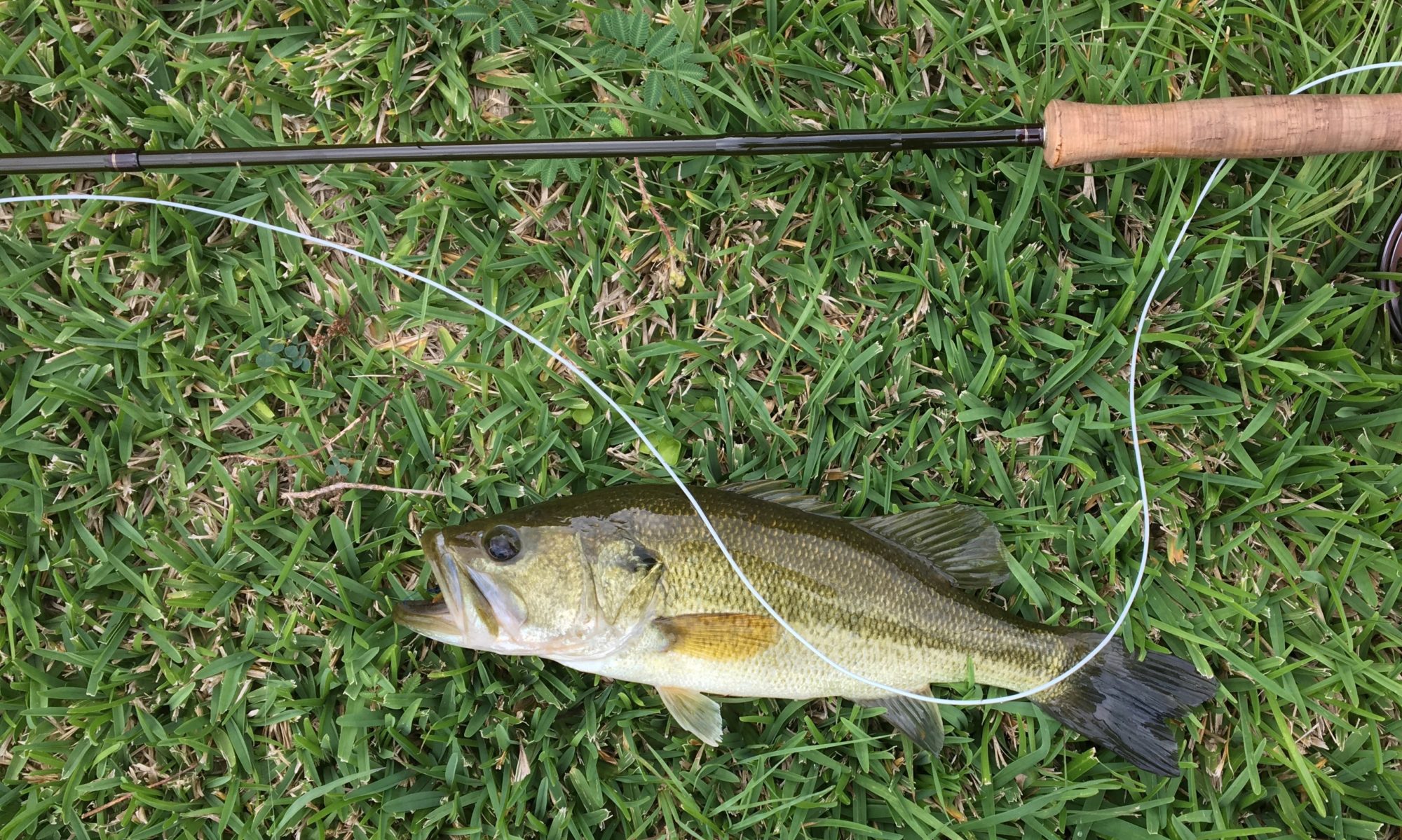
Over our two days we caught rainbow trout, brown trout, smallmouth bass, and one native yellow perch. I’d never seen a yellow perch, and it was in full spawning colors and full of eggs. Kris wanted to rush it to the maternity ward. Bert noted that it was funny that the one native fish we caught was the most tropical-looking of the bunch.
Nothing was happening on the surface of the river, so I fished with nymphs some of the time, and some of the time with streamers. Kris fished with streamers, sometimes with two on her line at once. A nymph is supposed to imitate bug life underwater, and Bert set up a drop-weight rig with clinch weights at the bottom underneath a surface bobber, so that the flies floated in the current close to river bottom and the bobber would indicate a take. Streamers usually imitate underwater baitfish, or sometimes crawfish (or in saltwater, shrimp or even crabs), and are what I’m most used to fishing. You have to let the nymphs float along with the current, and in my ideal world they would float along at the same speed as the boat. All I’d have to do is relax and watch the bobber, and that’s a job I’m probably competent to do. Of course the world doesn’t much pander to me, so nymphing usually consists of mending and adjusting the line until it drifts too far and you have to start over. It can be a lot of work.
Streamers meanwhile are retrieved across the current. Bert had us do something odd with the streamers. If you think about retrieving with a conventional rod and reel, you retrieve by cranking the reel, and unless you do something with the rod the retrieve tends to be steady. To give the lure action, you twitch the rod and hesitate or speed up during the retrieve. With a fly rod, the reel ain’t in it, and all the retrieval is done with your line hand, usually your left hand if you’re right-handed. The streamer always has a bit of up and down action because the retrieve has built-in stops and starts.
That wasn’t enough for Bert. He had us twitch the rod to impart even more motion to the streamers. No one had ever told me to twitch the rod tip on a streamer before, but it worked. It was kind of fun, too–I felt just like a real fisherman. We caught a lot of fish. Now I’m going to try it on my favorite bass pond.
Trout love mayflies of all things, and trout anglers love it when trout feed on the surface on rising mayflies. Not all mayflies are the same, and not all mayflies rise at the same time–different species will rise over the course of the spring and summer from April to October. Still, all mayflies of the same species do rise more or less together, otherwise they’d be coming off the river randomly and never hook up to party and reproduce the species. They have to plan ahead. Girl mayfly can’t text boy mayfly and say let’s us hook up on Tuesday in a couple of weeks.
Mayflies live most of their lives underwater as hideously ugly nymphs, and then emerge from the surface as pretty and delicate duns that mate, lay their eggs back in the water, and then die. Their out-of-water lives are so short that they don’t have mouths. There’s no drinkin’ at mayfly parties, though they do kinda dance. The emergence of those duns kicks off the prettiest (and most fun) kind of fly fishing, dry fly fishing, culminating during each hatch with the evening spinner fall when the spent mayflies fall dead back into the river en masse. When you talk to trout anglers, they talk a lot about which hatch is going to rise when, and what time to be on the river for the spinner fall.
Meanwhile, here in Texas, about as close as I get to fishing hatches is switching to bass popping bugs when the dragonflies show up on the bass ponds. I prefer blue for early season, and yellow as things get hot. Hotter.
The Hendrickson mayfly hatch is supposed to be the first major hatch on the Housatonic, but at least for now it’s apparently disappeared. I saw two lonely Hendricksons rising from the river in what should have been the heart of the Hendrickson season. Other mayflies will certainly hatch later, but it’s something you hear through the grapevine, that major hatches on major rivers, because of drought, climate change, whatever, are disappearing. It’s an odd thing to be worried about in these later times, but there you are.
So we fished nymphs and streamers, caught fish, and talked with Bert. What good company he was, what good fishing it was. By the end of the second day, I was worn out, and was sitting quiet at the back of the boat, watching Bert row and Kris fish. And fish. And keep fishing. Bert said that he’d never had a woman fish so hard from his boat, and I suspect Kris will think for all time that Bert says the sweetest things. Meanwhile back in Houston I reported Bert’s line to our kids and they laughed. When could Mom ever do anything she’d latched onto in moderation?
We went to Connecticut and caught fish. It was our state number 30, but on the way to Connecticut we went to New York to the Wulff School of Flyfishing for a two-day casting clinic. We’d been to the Wulff School before, in 2019, and when we went we caught our New York fish in the Beaverkill. Before we took the trout class. The trout class includes things like “Knots You Can Tie” and “The Bugs We Like Best.” There was a lot of casting then, but this time it was all casting. A lot of casting. Then some more casting. And then we went out to the pond to cast.
I signed us up for the casting clinic for Kris’s January birthday because, unlike me, Kris’s fishing is limited by her casting. My fishing, on the other hand, is limited by my head. Maybe I’ve made some progress in my life-long battle against stupid, but that correction is more than I could hope for from a casting clinic.
Joan Wulff wrote the book on fly casting; one of the good books anyway. If you want to learn to cast a fly rod, get Joan’s book. Then go take some lessons because, while it’s great for review, learning to fly cast from a book just ain’t likely.
I do have problems with my cast. If you imagine a fly cast, there are two parts to it: there’s the back cast, where the fly line rolls out beautifully behind you. I can’t see it while I do it, but I’ve been told I have a great back cast. I suspect this is a little like being told you have a great butt, not that I recall ever being told I have a great butt, but if I were so told I’d be flattered. On a day-to day basis though, in and of itself, it’s generally not very useful.
The school’s founder, Joan Wulff, is a great caster. She won the National Fisherman’s Distance Fly title in 1951 with a cast of 131 feet. Between 1943 and 1960, she won 17 national titles–not the women’s title, mind, but the all of ’em, men-can-compete-too-if-they-can-just-keep-up title. In 1960 she took the New Jersey distance casting competition with a winning cast of 161 feet. That’s more than half a football field, and about 101 feet further than I can cast on a really good day. She was a pretty, petite woman in 1960, and that hasn’t changed.
Joan married Lee Wulff in 1967. Lee Wulff was the sort of famous angler who, as a kid back in the 60s, I watched on Sunday afternoon fishing shows after football was over. If you didn’t watch famous anglers on Sunday afternoon fishing shows back in the 60s, you really missed out–it was a lot better than football. Lee created a whole series of flies, the most famous being the Royal Wulff. it’s certainly as pretty as a fly can be. He popularized catch and release fishing. He died in an airplane crash in 1991.
Mike Cline, Royal Wulff, Wikipedia, 2008
In 2002, Joan married Ted Rogowski, a Cadwalader, Wickersham & Taft patent attorney, which, in the legal vernacular, is an elite lawyer at a white shoe law firm. He was a friend and fishing companion of Lee. He was a co-founder of the Theodore Gordon Flyfishers in New York, and, according to the patent lawyer board member I talked to at the Beaverkill Valley Inn (they were there for their annual dinner), Rogowski was an author of the Clean Water Act and one of the folk responsible for founding the EPA. At 93 he was featured on the cover of Fly Tyer magazine with his article “A Better Way to Tie Mayfly Wings.” It’s a good article, though not having tied a lot of mayfly wings, I can’t vouch for it being better.
Rogowski also represented Ted Williams during Williams’s Sears days. The guy knew Ted Williams.
Joan is now 95. She was around for most of our class and made sure the instructors remembered everything. There were four instructors,** and Kris and I had met all of them before–there’s a lot of consistency at the Wulff School. We had caught our New York fish with Craig Buckbee on the Beaverkill. He seemed happy enough to see us. He must not have remembered my casting.
Anyway, there are two parts to the cast, the back cast where the line rolls out beautifully behind you, and then the forward cast where the line rolls out beautifully in front of you. To each of the back cast and the forward cast, there are three parts to create that roll: the loading move, the power snap, and the follow-through. The instructors drill this in the class, explain it, demonstrate it, hold your hand to show you how it feels, yell it across the pond, and whisper it in your ear while you sleep.
What a forward cast is supposed to look like.
What’s great at the school is the consistency of the message. They’ve been teaching the same thing over and over and over for 40 years, and there’s real value in that consistency. If anybody deviates, Joan’s there to pull them back into line.
And the casting instruction works. At least it works if you can do it: there’s no magic cure for ineptitude. My problem is that I’ve got this cute butt on the backside and a mess on the front. There’s the loading move, the power snap, and the drift that perfectly rolls out the line behind me, and then on the forward cast I skip the loading move and move straight to the power. Wham.
A tailing loop. How my cast looks way too often.
It’s not that maybe 70% of the time through long adjustment to bad habits I can’t get the line to go more or less where I want it to go. I can cast well enough using my sloppy ways to catch fish and maybe even fool some people some of the time, but it’s not good. About every fifth or sixth cast my line is going to cross itself (there’s a name for what happens, a tailing loop), and the line is going to puddle 30 feet out and tie itself into knots. It’s ugly. It’s inefficient. It’s frustrating. It’s all my fault.
A common result of my lousy forward cast.
It’s what I’ve learned. I know it, my muscles remember it, and I don’t know if I’ll ever get over it. It’s certainly mild as bad habits go, a lot milder than stupid, but it’s a mess.
Sometimes I just cast backwards. I’ve got a really cute butt.
** Sheila Hassan from Boston, Mark Wilde from Vermont, Dennis Charney from State College, Pa., and Craig Buckbee from Livingston Manor, New York. These are great people. Each of them separately guides and gives casting lessons, and Dennis is associated with a fly shop we visited in State College, Pennsylvania. State College is mostly known for its fly fishing and its ice cream.