Nymphing at the South Holston River Lodge, July 28-29, 2020

Whoever dubbed the larvae that skitter around the stones on the bottom of rivers as nymphs had a peculiar sense of humor. This is a proper nymph:

After that this is at best a disappointment, if not a horror:

Unless of course you fly fish for trout, in which case you’re all in with the latter, and wouldn’t know how to tie a proper imitation of the former.

If you don’t fly fish, this takes some explanation. There are, more or less (and ignoring a bunch of important stuff altogether), three ways to fly fish for trout. If you fish on the surface with a fly that imitates surface bugs, that’s dry fly fishing. If you fish below the surface with a fly that imitates baitfish, that’s streamer fishing. If you fish with a fly that imitates larval bugs that swim or saunter along beneath the surface, that’s nymphing.

In North Carolina and Tennessee we went a’nymphing, and over four days’ fishing it was kind of a master class. Nymphing is more often than not the most productive way to trout fish, though historically it was thought unsportsmanlike by some. Frederic Halford, the English Father Of Modern Dry Fly Fishing, said just say no to nymphs, while G.E.M. Skues, the English Father Of Modern Nymphing, would infuriate Halford by tempting with a variety of seamy sinking flies. The residue of that argument hasn’t completely gone away.

Nymphs.

Still, that controversy has mostly gone by the board, but anglers who nymph like to think that they’re doing something mildly disreputable. I don’t fish with dries often, but in some ways it seems the simpler method: to paraphrase Bull Durham, see the bugs, match the bugs, float the fly. That whole match the bug thing is a mystery, bug hatches being a tall tale pawned off on unsuspecting Texans, but still, if hatches did exist one would know one’s task. See the bug, match the bug, float the fly.

Meanwhile nymphing has taken on all manner of unexpected complexity. There’s Euro nymphing and the varieties thereof; French nymphing, Polish nymphing, and Czech nymphing. There are dry dropper rigs, and more different kinds of indicators (think bobbers) than would seem quite seemly. One writer touts New Zealand indicators sheared from the wool of a certain breed of high-country New Zealand sheep, while another swears by plastic globes only slightly smaller than beach balls. Those little foam tape tabs are making a comeback, and a friend makes his indicators from small party balloons. If you want to go online and search, you can find at least a couple of reams of discussions on building nymph leaders using bits of metal, different colored lines of different diameters, human skulls, and barbarous incantations at midnight.

It seems altogether fitting that the high priest of modern nymphing, George Daniel, was at the South Holston River Lodge when we were there. You’d expect that the guy who wrote the book on modern nymphing, Dynamic Nymphing, would be kind of nerdy, but Daniel is a young, handsome guy, tall, tan, and fit, and doesn’t even seem to wear a monocle. All-in-all it was kind of intimidating. If John McPhee can look exactly like a shad fisherman, why couldn’t George Daniel have the decency to look like a nymphing nerd?

***

The South Holston River and the South Holston River Lodge are in the northeastern corner where Tennessee, Virginia, and North Carolina come together. President Roosevelt built a bunch of dams on rivers up there as part of the TVA projects, giving the lie to those who think government never benefits anybody. In addition to social security, Roosevelt created a fine trout fishery. The 14 miles of South Holston trout river is fed by releases of deep cold lake water from the South Holston Dam, at a fairly constant 47°, so that even in the middle of the summer when water temperatures can otherwise be too hot for trout, or in the middle of winter when water temperatures can otherwise be too cold for folk, the South Holston is fishable, and more than fishable: it is an extraordinarily buggy river with estimates of up to 8,500 fish per mile, mostly brown trout, and mostly wild trout.

8500 is a lot of fish.

Because of dam releases for power production the river flow can change radically over the course of a day. Jon Hooper, the chief factotum, head guide, and general manager of the lodge told us that because it had been dry, flows could be below 100 cfs, but that in high water the flows could be above 2500 cfs. Apparently the river can go from 60 feet from bank to bank to 100 feet from bank to bank in less than an hour, and then do it again the next day. Wading’s not safe when the water’s rising. That was ok with us. We fished from a drift boat.

You can’t fish gin-clear water at 100 cfs the same way you fish gin-clear water at 1500 cfs. We were nymphing, of course: there’s supposed to be an excellent sulphur and baetis hatch from time to time on the river, but I’ve never seen an excellent hatch and I won’t be fooled by the stories these non-Texans tell me. Our guide, Brandon Barbour, was way ahead of us, so in the morning with the water low we fished tiny size 22 midge nymphs on tiny 6x tippet. If you’re argumentative, 6x tippet is in fact split hairs. The water was slow and clear, and the fish educated, so that’s what we used. The indicator was a small bit of yellow foam tape. That was our first method of nymphing during the trip: light tippet, light indicator, tiny weighted flies, and no weight added.

What did we see in Tennessee? We mostly saw a tiny press-on foam indicator floating in a square foot of river, because that’s what we watched to know if a fish took our fly.

In the afternoon Brandon took us higher on the river, closer to the dam where released water would reach first. We ate lunch and watched water rise on the legs of a wader until it made all of us nervous. I guess it finally made the angler nervous too, because he finally left the river.

Brandon liked the fishing better at higher flows. He said the fish had less time to study the flies, and had to react quicker. The problem was that to get the nymphs down in the swift current Brandon had to add weight, and then add more weight, and then add a couple o’ more bits of weight. All of this weight, four or five BB sized pinch on weights, was at the very bottom of the rig, then two nymphs were tied onto the uncut tag ends of surgeon’s knots, about three inches from the leader itself. This wasn’t 6x tippet.

At the top of the rig was a particularly large plastic indicator, a Thingamabobber. The indicator had to be large enough to suspend the hooks and weight below it. The weight would bounce along the bottom, and we’d have to distinguish the bottom bounce from the fish take. You’d think that something involving nymphs and called bottom bouncing would be more lewd than it was, but what it lacked in prurience it made up for with fish.

Jam-stop Thingamabobber

What did we see in Tennessee? A big orange thingamabobber getting jiggy while we bottom bounced. That could well be a metaphor for the modern world. It sounds meaningful anyway.

Casting the light rig was pretty easy. We weren’t casting far, 20 or 30 feet for the most part. I seemed to roll cast a lot, and every now and then would throw in a fairly standard cast. The bottom-bouncing rig was a different matter. I tried a standard cast once and got a clump of BB weights to the center of the back, hard enough to evoke what I suspect was an unmanly shriek. Casting the rig required a water haul, laying out the line behind and then using the drag of the water to load the rod when I pulled it forward. I expect it wasn’t pretty. No fish were going to come out of the water for my shadow cast, but it was better than a clump of weights to the back of my head.

We fished the Holston with Brandon the first day, low water early and high water later in the day. The next day we fished the Holston with Brandon at low water in the morning and then moved over to the Watauga, another nearby tailwater, for higher flows in the afternoon. Because the Holston was so low, everybody else was on the Watauga as well. That was ok, it wasn’t combat fishing, but it’s a smaller river and drifting along we had plenty of lively and pleasant companions, and caught fish.

***

I always think the same thing when I travel, could I live here? Would I like to come here and stay? I liked where we were, and on the way down the river the first day I got Dolly Parton’s “Tennessee Mountain Home” stuck in my head while I fished. Technically it wasn’t Dolly Parton’s version, it was Maria Muldaur’s version (which I know better, but which honestly isn’t as good). I liked it in my head. I liked the South Holston River Lodge and Jon and Lynne and Brandon and the chef, J.D., and all the other people at the lodge who took care of us. I could live there, on that river. I won’t, but I could.

Plus I really liked the nymphs.

I went fishing

You may not know this, but it’s a peculiar time. On a Saturday back in April, the first time I’d left the house after my office shut down, I went to Houston Dairymaids and they delivered cheese curbside. I ordered barbecue from Pinkerton’s and they delivered curbside. We picked up a curbside order at Houston’s big liquor store, Spec’s. We were out of Four Roses bourbon, and running low on gin. It’s that kind of time.

It’s been too windy this spring for the Bay, so except to fish on our local bass ponds that day’s trip from one curbside delivery to another is about as much as I’ve traveled. I haven’t been to a restaurant except to pick up take-out. I’ve been into a grocery store, but even for groceries I usually order online and pick up curbside.

I continue to work, though it feels odd, disconnected, like working on holiday. My firm laid off some employees and reduced salaries for most employees. Those decisions were beyond my pay grade, and my heart ached for affected friends and colleagues. I completed a project for a bank, advised a client whose rental car and hotel revenues had suddenly stopped, and participated in a lot of conference calls. Kris cut my hair. She needs to cut it again.

I postponed our trip to Arkansas. We were supposed to go April 4, to fish the Little Red. I offered to pay the guides for the delayed trip when I canceled, but they said come when we can. I’ve prepaid our guides for our July trip to North Carolina. I worry about how my guide friends are doing.

This is not a warbler.

The warbler migration has come and gone.

I wear a mask when I go into stores or the office, but not when I run. I wash my hands more than before. I’ve cooked a lot, and I try to keep my daily workout schedule, with more discipline than enthusiasm, but that’s always been the case. I don’t read books as much as I should, and play the guitar constantly, working through all the jazz method books I’ve collected over the years, filling notebooks with diagrams of chords with strange names like G7(b9) and Ab m7b5. I’ve been working through the songs in the sixth edition of the Real Fake Book, most of which are jazz standards that I’ve never heard. Did you know that Airegin by Sonny Rollins is Nigeria spelled backwards? I didn’t know the song at all.

I read a funny quote about jazz guitarists, that they make a living playing wrong notes.

At least once a day I read the Houston Chronicle, The Texas Tribune, The Washington Post, The New York Times. I haven’t watched TV much. There’s no baseball, so what’s the point? I did watch videos of George Floyd’s death. The Floyd protests in Houston came past our office building, and I half-heartedly planned to go downtown and stand on the street in support, but they closed our building for the big march and the stationary part of my half-heartedness won. My daughter went. If I’d known she was going I’d have gone with her. My Houston neighbors reacted to the death with surprising restraint and civility. I was worried about coronavirus, and Kris was sick from some other bug that we thought might be coronavirus, so I stayed home.

It wasn’t coronavirus, but man was she sick, and it frightened us.

There are now two Black Lives Matter yard signs on our block. It’s a pretty diverse block, with both doctors and lawyers. There are no African Americans. There are Asians, Middle-Easterners, a Scot, a couple of gay households, an Austrian professor of mathematics, plenty of everyday garden variety white folk, and a Chinese-American geophysicist who is Kris’s go-to expert on local birds. . . I’m proud that two of my neighbors have signs.

Meanwhile my friend Melvin posted on Facebook that as an adult black man he’d been stopped a dozen times by police for no cause. Was it a dozen, or was it ten? One was too many for one of the best men I know. A black work colleague told us that he never ran in his neighborhood without a baggie with a drivers license and a business card. Someone wrote that responding to Black Lives Matter with a statement that All Lives Matter is a bit like responding to your wife’s query about your love for her with a statement that you love everybody. It might be true, but it’s not relevant.

Two acquaintances, maybe three, died of the virus, one black, two white. My friend Peggy told me her brother had died.

I’ve thought a lot about Colin Kaepernick. In the immediate aftermath of Kaepernick’s knee, I was disappointed that something important, continued institutional violence against blacks, was trivialized into something unimportant, whether it was acceptable for a football player to take a knee during the National Anthem. It was actually two players, Kaepernick and Eric Reid, who took the knee, and there was an article in the Chronicle last week interviewing Reid’s brother on the Texans, Justin, who said the same thing, that the narrative got twisted from a protest against police violence to an uproar about flag disrespect. There was a difference though between my reaction and Justin Reid’s. My reaction was to blame Kaepernick for the twisted message. I was wrong. I guess it just goes to show, it’s easy to blame the victim.

Did I mention that I’ve been through lots of Four Roses?

I’ve spent some hours most weekends drifting in a canoe on the lakes at Damon’s. I have a solo Wenonah, a lovely little thing, made for travel, and I’ll sit in the canoe and drift across a pond while I cast. I caught a four or five pound catfish one day, a four pound bass another, both on a six weight Winston with a Hardy Marquis reel. I’ve caught a lot of smaller bass and sunfish, bluegills and greens, and they always bring more joy to me than any other fish. My cast right now is very good, and I’ve tied a lot of flies too, variants on BBBs, with possum dubbing and long soft hackle guinea hen collars that I’d bought for steelhead flies. Don’t tell anyone, but while I’m home I can tie during conference calls.

Looking at the photos of me holding the big bass and catfish with a boga grip, the results aren’t good for catch and release. I’ve decided to use a net from now on, even for warmwater fish.

My mother loved guinea hens. She always said they were better farm guard than dogs. Maybe I’ll get some guinea hens for our yard, during the pandemic there’s not as much traffic on my street as there used to be. Maybe I’ll get a Black Lives Matter sign.

American Shad (Alosa sapidissima)

Hugh M. Smith, Shad (Alosa sapidissima), Fishes of North Carolina, Plate 5, North Carolina Geological and Economic Survey, Vol II, E.M. Uzzell & Co., 1907, Raleigh, N.C., Freshwater and Marine Image Bank, University of Washington.

Like the glamorous salmon, American Shad are anadromous–when shad spawn they migrate from salt water back to their natal river. Unlike the glamorous salmon, American shad are potbellied algae eaters. To my eye they are decidedly unglamorous, but shad anglers are devoted. There is a fine blog dedicated to fly fishing for shad, Shad on the Fly, and plenty of other information on the web, and of course John McPhee, our greatest nonfiction writer, wrote The Founding Fish because of his devotion to shad on the fly rod. Shad on the fly is a thing. Maybe not the biggest thing, maybe it doesn’t rival tarpon or steelhead or bluegill, but it’s at least as much of a thing as standing on a ladder in Pyramid Lake for Lahontan cutthroat.

Have you ever seen a picture of John McPhee? I’d read plenty of McPhee, off and on, and will certainly read more, but I don’t know that I’d ever seen his picture. I hold him in such esteem that I kinda expected Paul Newman, or maybe James Stewart.

John McPhee. From http://www.princeton.edu/main/news/media/resources/pictures.xml. I stole this from Wikipedia, which stole it from Princeton, which seems to say if you aren’t using the photo for commercial purposes you can steal their photos. Hope so.

That picture actually makes me happy. McPhee, notwithstanding his Princeton and Oxford education, his professorship at Princeton, his Pulitzer, and more than anything his lifetime’s worth of essential writing about the natural world, looks a lot less like Paul Newman than a guy who fishes for shad. That’s satisfying.

Unlike Pacific salmon, American shad can return to the Atlantic after spawning, and in northern climes can spawn and return for several seasons. Their US Atlantic range, and the range of their smaller also-fishable cousin, the hickory shad, covers much of the East Coast, from the St. John’s River in Florida to Maine. There are also shad in the Pacific Northwest, imported by that other cross-country migrant, Americans. They are fished commercially in both the Atlantic and Pacific, but it’s in rivers that they are a sport fish.

Photo of a Plankton Fly, Robert Rauschenburg, White Painting, 1951, Robert Rauschenburg Foundation, https://www.rauschenbergfoundation.org/art/series/white-painting.

Why shad bite is kind of a mystery, though it’s likely either territorial aggression or sexual frustration. Shad are mostly filter feeders, planktivores, so they aren’t a traditional fly fishing target. The photo of my favorite plankton fly has a lot in common with Robert Rauscheburg’s white paintings. It’s an easy fly to tie, but hard to fish. It’s not clear that shad feed at all in freshwater, but in saltwater they also feed on small shrimp and fish, so shad flies tend to remind me of bonefish flies, which usually imitate small shrimp or fish.

In Colonial America shad were so common on the East Coast that they were a major component of the Colonial springtime diet. They were generally thought delicious:

The Shad is held in greater estimation by the epicure than by the angler. When properly in season, it is considered by many the most delicious fish that can be eaten. Fresh Salmon, or a Spanish Mackerel, or a Pompano may possibly equal it; but who can forget the delicate flavor and juicy sweetness of a fresh Shad, broiled or ‘planked;’ hot from the fire; opened, salted and peppered, and spread lightly with fresh May butter.

Norris, Thad, The American Angler’s Book, 171, E.H. Butler & Co., Philadelphia, 1864.
Map of US American Shad Distribution, USGS

Apparently they are also extraordinarily, difficultly, perversely bony, and nothing short of uncommon skill or nuclear annihilation can handle the bones. The current literature suggests that they may have been less the Founding Fathers’ favorite fish than, salted and preserved in barrels for year-round consumption, the Founding Fathers’ slaves’ necessary fish. It’s probably some of both, but in any case shad consumption has fallen out of favor.

The hen’s roe is also eaten. I can find, for instance, relatively recent shad roe and bacon recipes online from Food and Wine, Martha Stewart, and the New York Times. Martha Stewart has a video, and watching Martha separating a shad roe sack is . . . memorable, and creepy. The roe is usually prepared wrapped in bacon, so one wonders whether the appeal is the roe or the bacon. Everything’s better with bacon. Since we will theoretically be in the shad’s territory during the run, I’ll try to find someplace to eat shad, though I’m not sure Kris is convinced, and I’m squeamish about the roe. In 1864, Thad Norris (whose quote about the most-excellent deliciousness of shad appears above) said nothing about eating the roe, but reported that it makes good bait.

Shad’s population decline probably explains shad’s eating decline as much as anything. Damn, Dams. Shad declined not from over-fishing, not sport fishing, not climate change, but dams. If all goes well we will fish the Brandywine in Wilmington, near Bullroarer Took’s old place, and until 2019 the Brandywine dams had stopped much of the Creek’s shad run for more than a century. In 2019 the 115-year old Brandywine Creek dam, first in line from the Christina River and ultimately the Atlantic, was breached in Wilmington. That should help, but the City Dam, a mile further along, is next in line. Wilmington depends on the City Dam for its water supply, so it’s not going away. There’s discussion of ladders, and of rock ramps, but apparently nothing is happening. Imagine building a dam today without provision for fish migration? Even upstream beyond City Dam there are eight additional dams on the Brandywine, some dating back 200 years. There’s not much call for water-powered gristmills in these late days, but demand is apparently enough to stop the shad migration.

Brandywine Creek, Wilmington, Delaware near Tookville, Google Middle Earth.

* * *

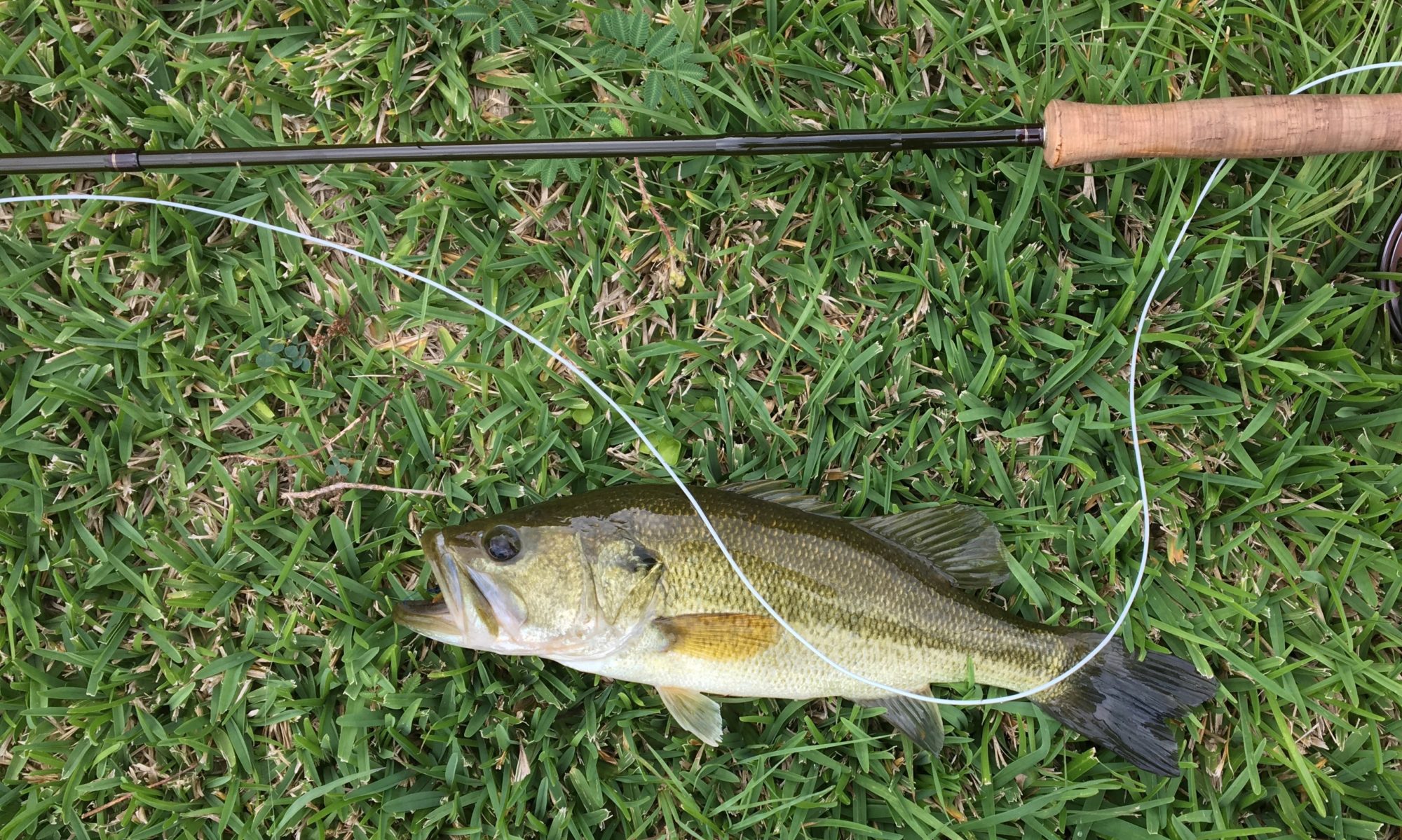
Yesterday I fished for largemouth for the first time this year. It was windy, as windy as I can remember fishing, but for whatever reason it didn’t bother me. I fished an olive pine squirrel leach, cast across a back channel at Damon’s Seven Lakes, and caught four bass, three small, one about two pounds. They were pretty; dark and fat, ready for the spring spawn. Kris fished for a few minutes, but then got her binoculars out of the car and looked for birds. She said there were coots, but I didn’t take it personally.

Olympic Peninsula Steelhead, February 9-10, 2020.

I didn’t catch a steelhead on the Olympic Peninsula. I caught fish. I foul-hooked a couple of whitefish, landed two or three small rainbow—I remember a par and a smolt—and caught one nice 18” rainbow. I also caught a Dolly Varden. I didn’t know that Dolly Varden are named after a Charles Dickens character from the novel Barnaby Rudge, 1841. Dolly Varden are a pretty fish, with bright silver and pastel yellow jewels along their back and sides. Naming a pretty fish after a pretty Dickens’ character is such a 19th century sort of thing, you gotta like it.  There was also a style of women’s dresses called Dolly Varden, which I suspect was named after the Dickens’ character and not the fish. The dress doesn’t much resemble the fish.

William Powell Frith, Dolly Varden, 1842, oil on canvass, The Victoria and Albert Museum. This is not the fish.

Kris had worse luck than me.  She foul-hooked a whitefish, and her waders leaked. She was cold and wet and miserable the first day. It looks like a manufacturer’s defect, so back to Patagonia they go.  

We fished with Ryan Steen of The Evening Hatch, and stayed at The Evening Hatch’s lodge on Lake Quinault.  We don’t stay at a lot of lodges, but they are fun, and when we have, in Argentina and Belize, it’s been pretty luxurious, for us pretty glamorous. The Evening Hatch lodge wasn’t exactly luxurious, but it was very nice and the food was great and the coffee was excellent. It was less like a glamorous destination than when as a kid we visited my aunts’ house in Texarkana. The food was great at my aunts’ house too, though both aunts being Church of Christ there was nothing to drink but ice tea. Jeff and Jan Cotrell ran the lodge, and filled in well for relatives. If they weren’t younger than us they’d have made a great uncle and aunt. If we’d just played a bunch of dominoes it would have been my childhood all over again. 

I caught the Dolly Varden on the Quinault River, above Lake Quinault. We floated from early to late, I’d guess six or seven miles, alternating between wading and swinging streamers with Spey rods, and nymphing with artificial salmon eggs, either plastic beads or yarn. The eggs were seven or eight feet under a bobber, and the point was to let the egg drift deep while we rafted downriver.  We were fishing 9 foot 8 weights, with the bead drifting below a swivel and lead pencil weight crimped to the leader. Some folk would say that’s not fly fishing at all, but it takes some care to throw that monstrous rig without damaging your guide or yourself. I mostly managed.

Dolly Varden trout, Salvelinus malma malma, adult female, The Fishes of Alaska, 1906, Bulletin of the Bureau of Fisheries, Vol. XXVI, P. 360, Plate XL. Wikimedia Commons.

On the single hand rods we fished floating lines with a 30 lb nylon mono butt to 20 lb mono and finally to 15 lb tippet. When the bobber bobbed Ryan yelled SET! SET! SET!, and if I wasn’t watching the scenery I usually did. The set was sidearm, upstream, not a straight up trout set and not a strip set.  The idea was to pull the bead out of the mouth and pull the hook trailing the bead into the mouth. The rig is supposed to result in fewer foul or deep hook sets for trout and steelhead, though because of their small mouths the poor white fish that went after the eggs were always foul-hooked, outside the mouth and in its skin. Maybe that’s why Western anglers don’t really like whitefish. It’s all that foul-hooking guilt.

In the river we drifted the egg along the seams and in the softer water just beyond the seams, and we caught a lot of trees, both drifting and casting.  Poor Ryan lost a fortune in plastic beads and octopus hooks. 

The Olympic Peninsula is a beautiful place, and the rain forest reminded me oddly of New York City back in the 80s, where if you stood still too long you’d get graffitied. Instead of spray paint the rain forest covers everything with moss. It’s lush, with each nook and cranny covered with something green and growing: ferns, moss, the largest red cedar in the world, the largest Sitka spruce in the world, the largest . . . Oh hell, I don’t know. Just about the largest every kind of tree except mesquite and mangrove, and they were probably there too until somebody logged them.  

This is northern spotted owl country, which from its photos is a lovely little owl that doesn’t really deserve its notoriety, but it’s not an easy place for people to live either. There’s tension between the wildness of the place and its human inhabitants. Ryan tells good stories about the area, insightful stories, about backwoods North Carolinians who moved there a century before for logging, and who still live in isolated backwoods pockets; about Theodore Roosevelt creating the national park to save the elk wintering ground for hunters and how he incidentally saved the rivers for salmon and steelhead; about tribal netting of salmon and steelhead; about boom and bust logging and the minimal old growth forests preserved for the spotted owl. 

It can’t be an easy place to live, either for the remaining tribal nations or the loggers, the commercial fishers, or the small business owners. The population is estimated to be a bit more than 100,000, or about 28 people per square mile, which is 15 more people per square mile than my hometown county in Texas, but still . . . It feels more remote, especially on the west side, and especially in the midst of all that isolating forest. Plus in West Texas we had oil and cotton and wheat and cattle, they’ve got trees and fish and tourism, tourism and fish and trees, and balancing wild places with making a living can’t be easy. It’s probably better now. At least for loggers and millworkers forest land is probably better managed, but it will never be perfect, and there’s always spotted owls to blame.

The flip side of all that fecundity is the rivers. The rivers aren’t rich with all the good things trout love, insects, baitfish, crawfish, there are few of them. The rainfall scours the rivers too often, much of the flow is glacial melt or spring water or rainfall, without a lot of organic stuff taking hold, and there’s not the richness in the water that grows concentrations of trout. There is some stuff, but the wealth in the rivers on the Olympic Peninsula is its access to saltwater. It’s salmon in the fall and steelhead in the winter that make the rivers great fishing, but it’s ultimately access to the Pacific, to baitfish and glass shrimp, that make the coastal rivers a destination fishery.

Kris didn’t have all the bad luck.  I failed a cast—this is an important life lesson. You have to end the snap of the snap-T with the rod tip in or near the water or the weighted fly will slam into your rod tip and snap it. Notwithstanding its name, that’s not what the snap-T is all about, it’s not the snap-tip. It was operator error, but operator error that Beulah the rod maker will repair with a small contribution from the operator.  Thank heavens for no-fault rod warranties.

The second day fishing we didn’t swing flies. I don’t know if it was because Ryan wanted to cover more water (we covered a lot of water), or because he was worried about Kris’s wader leak and wanted her to stay dry and warm (relatively warm anyway—we are, after all, from Houston), or maybe because he was sick of watching us flail around with Spey rods and wanted to watch us flail around with single handed rods (I don’t blame him, variety is the spice and all that). We were on a different river, the Clearwater, above where it joins the Queets. Fishing with Ryan was a bit like taking a river tour, only the sights to see were usually just the other side of that seam, closer to the bank, alongside that rock, and this is shallow. Every now and again he’d yell SET!

The Quinault ran through a broader bed with more channels and, as I recall, more riffles and rapids than the Clearwater. There was more rock in the river and on the banks, and more room between the river and the trees. The Clearwater ran in more of a channel, through heavier forest. 

On the Clearwater I came as close as we got to a steelhead. There was a set, a thrash, a feel that this 8 weight may be too small for this fish, a streak of silver at the surface . . . It was enough to know that this is a big fish, to wonder if I could handle this big of a fish, and then it was gone. Just that moment, it lasted no more than that, but then again that’s the kind of lost fish that lasts a lifetime.

We had two days of sun while on the river, and it was amusing that Ryan had no sunscreen in his kit. “The next ten days,” he told us, “it’s rain.” Of course for all I know he was just telling us a tall tale. It may never rain on the Olympic Peninsula, and may always be sunny. I do know there are steelhead though. For a few seconds I hooked a steelhead.