Bones

Jordan, David Starr; Evermann, Barton Warren (1905) Shore Fishes of the Hawaiian Islands, With a General Account of the Fish Fauna, Bulletin of the United States Fish Commission, vol. 23 for 1903, part I, Washington, D.C., Government Printing Office

Given their place in the angling firmament you’d think we’d know more about bonefish than we seem to know. I suppose it’s because all those bones make them hard to eat, but information about the fish itself, as opposed to catching the fish, is spotty. There have been interesting recent studies on spawning, and even for fish bonefish spawning behavior is bizarre and orgiastic, but more on that later. Right now other stuff.

Bonefish show up in the Atlantic, the Caribbean, the Pacific, and the Indian Ocean:  pretty much everywhere there’s some saltwater coast with relatively hot temperatures.  The Bonefish and Tarpon Trust says there are 12 species of bonefish,  all sharing the same genus, Albula

International Union for Conservation of Nature (IUCN) . Albula vulpes. The IUCN Red List of Threatened Species. IUCN 2012.2

Albula vulpes is the species fly fishers chase in our neck of the woods. I stole the range map above from the International Union for Conservation of Nature. The IUCN lists Albula vulpes as near-threatened and its population as declining, naming off all the usual causes, habitat damage, harvests, and recreational mishandling, plus climate change and severe weather.  I hope the IUCN doesn’t come after me for stealing their graphics.  They can have it back if they really want it. It’s a very good graphic though.

Since I’m on a stealing jag, Orvis has an excellent description of bonefish behavior:

Bonefish are usually found in intertidal flats, mangroves, and creeks, and they can tolerate the oxygen-poor water often found in the tropics by inhaling air into a lung-like bladder. Often congregating in schools of 100 or more, bonefish often follow a daily pattern of coming up onto the flats as the tide rises and retreating to deeper water as it falls. . . . Larger bonefish tend to travel in twos or threes, and the trophy specimens are solitary. Bonefish feed by digging through the sandy bottom to root up prey, which are crushed in the fish’s powerful pharyngeal teeth.

Phil Monahan, Fish Facts: Bonefish (Albula sp.), https://news.orvis.com/fly-fishing/fish-facts-bonefish-albula-sp

So like tarpon and gar, bonefish gulp air into a swim bladder, and like redfish they root along using their low-slung mouth to sift up prey.  Just like Mary Ann, they’re sitting by the seashore sifting sand. But Orvis’s description is about flats-frequenting bonefish, and it might better read “Bonefish are usually found [by fly fishers] in intertidal flats . . . ” The truth is that not all bonefish are flats-frequenting (though all are coastal). There are actually two common species of bonefish in Florida, the other species being A. goreensis, which live in channels and are also found around reefs in the Bahamas. A. goreensis is apparently not known as a flats fish, but as a fish that hangs out just a wee bit deeper.

Or maybe it’s A. garcia, not A. goreensis. O maybe A. garcia and goreensis are the same thing. This gets confusing.

Hawaii also has two species of bonefish too. One, A. glossodonta, the roundjaw bonefish is what fly fishers fish for on the Hawaiian flats. The other, A. virgata, has only been documented in Hawaii, nowhere else. Similar to the Caribbean’s A. goreensis, it generally shows up in deeper water. This is all very confusing, and it only gets worse when you start piling on the species and places. The truth is that for fish that dwell in the great big sea, bonefish don’t move around much. The furthest distance traveled by a tagged fish is 146 miles, so I guess populations, even among the same species, are pretty much distinct to particular places. That’s why folk can talk about the bonefish population at Campeche, which apparently used to be healthy, as being largely depleted. That population has to recover, no fish are likely to wander in while out on a spree, and unlike redfish or even salmon no one’s figured out how to reproduce quantities of bonefish in hatcheries.

Meanwhile bonefish aren’t particularly big for such a popular fish. The IGFA all-tackle A. vulpes record is 16 lbs caught at Bimini in 1971. The IGFA all-tackle record for the roundjaw bonefish is 10 lbs 4 oz., taken in Hawaii, and the all-tackle, all-bonefish record is for a 19 lb. smallscale bonefish (A. oligolepis) taken in South Africa in 1962.

I know plenty of people who’ve fished for bonefish in the Bahamas and Central America, but only one who’s fished in Hawaii: Gretchen at the local Orvis (who promised to show me how she ties those magnificent doubled Bimini twists). She was going to Oahu anyway, so she found a flat and went a-wading. I know she didn’t catch anything, and she may or may not have seen any bonefish, but I remember what she did see: she said she saw sharks. They were up on the flats sharing her fishing space. She said she saw sharks and it kind of freaked her out. I don’t know whether they were big sharks, they could have been great whites or moderate black tips or 300 pound tigers or any old thing, and I don’t recall if I asked what they were.  I remember this: she said she saw sharks with her on the flats. That part I remember. Sharks.

I have read that as a general matter only birds, sharks, barracudas, and Hawaiians make a habit of eating bonefish, and of those only the first three have had a real effect on bonefish evolution.  Bonefish can live as long as 20 years and grow as long as 30 inches. Fish in Hawaii average four to six pounds. For bonefish, an eight pound fish is a monster, though African fish may reach close to 20 pounds. The fish appear silver or grey in the water, and the bodies are slender lengthwise and rounded in cross-section. I don’t find them a particularly pretty fish out of the water. In the water, either tailing or ghosting, they are thrilling. 

And pound for pound they are about as powerful and fast as any fish in the ocean. They’re built, after all, to get away from barracuda and sharks. They’re skittish, particularly around my casting, but that’s ok. My casting scares me sometimes.

* * *

It’s winter here, or as close as it gets. We took the skiff out Sunday and saw one redfish at a distance. Kris saw it first, and we watched it’s back and tail come in and out of about a foot of water 150 feet from a spoil bank. Every time we tried to get close though it moved, until finally it was gone.

Notwithstanding the general fish sparseness the days are beautiful, with less humidity and clear water and clear skies. We didn’t see any other fish, but who cares? While I poled the skiff I got to watch a flock of roseate spoonbills (a pink of spoonbills?) huddled on the lee side of the grass against the bitter north wind. It must have been 50 degrees.

Take that Wisconsin.

James Michener

James Michener’s Hawaii is almost 1000 pages long. It’s longer, cover to cover, than the Hebrew Bible, the New Testament, the Koran, and the Book of Mormon combined.  It’s longer than the complete novels of Anthony Trollope or Charles Dickens. It’s not just a doorstop of a novel, it’s a murder weapon: “Colonel Mustard, in the Library, with Hawaii.

If  you start looking for books about Hawaii, Michener’s Hawaii is still on every list.  It was his first mega-book, after having won a Pulitzer Prize for Tales of the South Pacific.  Hawaii is a saga, beginning geologically, preceding through Polynesian exploration, missionaries, sugar planters, dynastic overthrows, and World War II to statehood.  It came just in time for the re-creation of Hawaii as an airline vacation destination. There are The Hawaiians, The Whalers, The Missionaries. There are The Chinese. There are The Japanese.  Thank God we made Hawaii a state, otherwise the book might still be going. 

But early on, in 1959 when Michener published Hawaii, the well-researched sweeping drama was still something new. In the 60s it was a book everyone had read, highbrow to lowbrow. Did the genre exist before Michener? I suppose there were plenty of historical dramas, but no one wrote historical fiction like Michener, where the history itself is the very thing. Michener’s Hawaii has some characters, plenty of them, many of them memorable, but they’re there to move along the sweep of time, the Grand Theme, not for their own sakes. It’s amazing that Michener does as well with them as he does.

And nothing ever happens in Hawaii that’s not Significant.  Nobody hangs out and drinks beer around the pool, or drives to the grocery store. They hang out around the pool and plot the overthrow of the Hawaiian royalty. They drive to the grocery store and burn down half of Honolulu. A woman character appears, establishes her place in the grand family scheme, delivers a message to the hero-of-the-moment, and is then swept out to sea by a tsunami. It wasn’t like she needed to get swept out to sea by a tsunami, but I guess the tsunami was handy, so Michener sweeps her out to sea. Minor character. Minor incident. Time for Time to march on.

From what I can tell even if it’s not a great novel it’s not bad history, and there’s no cannibalism (though there is some human sacrifice). All in all I appreciate Michener’s attitudes towards All Those People. Michener was adopted by a Quaker, and there’s some Quaker benevolence in his attitudes. There is also a tendency in Michener to deal in racial tropes, but it has less to do I suspect with inherent prejudice than how Michener characters are used. They’re not so much portraits as game pieces, like tiles on an old board game, Stratego, Hawaiio.  When you flip them over they display their value: this red tile is worth 10 whaling ships, this blue tile 20 missionaries, this a Hawaiian queen, this a tsunami.  

Hawaii–the state, not the novel–doesn’t seem to have produced great fiction. There are a lot of very good histories, including a bit of a romp, Unfamiliar Fishes, by Sarah Vowell.  There’s James Jones’ From Here to Eternity, and some people like it, but I can’t get over the notion that the hero finds playing the bugle transcendent, or that someone who found playing the bugle transcendent would risk his embouchure boxing. Everything after those implausibilities is tainted.

It also has Hawaii Five-0 and Magnum P.I., both now in remakes, but doesn’t seem to have a significant fictional detective who lives in novels (unless Charlie Chan counts, and that’s its own set of problems). There’s no Dave Robicheaux, Travis McGee, Sam Spade, or V. I. Warshawski. There’s no Spenser. That surprises me. Hawaii seems ideal for that kind of stuff: it’s ripe for a beach novel detective.  Instead it’s got this really long book.

Kānaka Maoli

Kamehameha the Great, King of the Sandwich Islands, c. 1816. Oil on canvas, Anonymous copy, Chinese. The Boston Athenaeum.

There are 1.4 million people in Hawaii, of whom 960 thousand, nearly 70 percent, live on Oahu. It’s the most diverse state in the nation, with a population that’s 25 percent white, 2 percent black, and 37 percent Asian (Filipino, Japanese, Chinese, Korean, and Indian). More than 23 percent of the population reports its ethnicity as multiracial. About 10 percent of the population is Hispanic. About 10 percent of the population is Native Hawaiian, Kānaka Maoli. 

Hawaii is in the Pacific Ocean, 3800 miles and four time zones from Houston. It’s roughly the same latitude as Merida in the Yucatan. There are eight major islands, one of which, Ni’ihau, is privately owned, and one of which, Kaho’olawe, was used until 1990 as a military bombing range. Nobody lives there. Molokai was a leper colony. Lanai, Oahu. Kauai, Maui, and the Big Island, Hawaii, are all  tourist destinations. The largest city, Honolulu, is on Oahu.  

The principal businesses are sugar, pineapples, military, and tourists. 

Hawaii was first settled in the 13th century by Polynesian immigrants, likely from the Marquesan Islands and the Society Islands, more than 2000 miles away. In England, King John was signing the Magna Carta. Robin Hood was in Sherwood Forest, or not. Meanwhile the original settlers of Hawaii were traveling 2000 miles by double-hulled canoe.

First representation of polynesien outrigger canoe made for the exploration of near islands
Biblioteque Nationale de France

Or maybe it was settled in the 5th century, when Rome was withdrawing from Britain and the Anglo-Saxons were coming in from mainland Europe. Arthur was king. Or not. 

Indigenous Hawaii is Polynesian, as is a vast settled area of the Pacific. With the Easter Islands, New Zealand, and Hawaii as the three corners, the Polynesian Triangle, the area settled by Polynesians, covers a whole lot of blue on a map. The Polynesian languages are derived from a Southeast Asia language group out of Taiwan, but genetic evidence traces Polynesian origins to earlier Asian migrants to New Guinea. 

File:Polynesia-triangle.png
The three corners of the Polynesian Triangle: 1: Hawaii, United States; 2: New Zealand; 3: Easter Island, Chile; Other island groups: 4: Samoa; 5: Tahiti, French Polynesia. From Wikimedia Commons, by user Kahuroa. 

Captain James Cook put Hawaii on navigation charts in 1798. He had already made first contact with Australia and circumnavigated New Zealand (to prove it wasn’t part of a larger, undiscovered southern continent), but on his third voyage Cook went and got himself killed by the Hawaiians. It was very unfortunate for all concerned, but particularly for Cook.

Death of Captain James Cook, oil on canvas by George Carter, 1783, Bernice P. Bishop Museum

Before 1798, before 1820 really, the pre-literate history of Hawaii is mostly oral tradition, archaeology, and speculation, just like everyplace else with an indigenous population. Hawaii is different though because the first contacts were well-recorded. It helped that the New England missionaries and their descendants lived in the Hawaiian Kingdom for 70-odd years, plus the Hawaiians themselves quickly became literate. In the 19th Century, Hawaii may have been the most literate country on earth. They also surfed. 

Even after contact the Hawaiians were polytheistic, polygamous, radically hierarchical, and incestuous (at least among the royalty). Historically they had practiced slavery, infanticide, human sacrifice, and capital punishment for breaking the codes of conduct, the kapus, that governed society and religion. It was a jolly sort of place, even if women could be put to death for eating with men, or for eating a pork chop. The last recorded human sacrifice occurred in 1809. 

Notwithstanding speculation about the modern Islanders’ fondness for Spam, the native Hawaiians did not practice cannibalism. They did eat dogs. 

Between 1782 and 1810, Kamehameha the Great waged a war of unification against the other high chiefs, and consolidated island governance. Whalers arrived in 1819, and for the next 50 years Hawaii was a center for Pacific whaling. The same year, Kamehameha II, Liholiho, sat down to eat with women and ended the kapu prohibitions.  He also disbanded the priesthood–the kahuna, both big and small–and destroyed the polytheistic shrines.  

In 1820, Congregational missionaries arrived from New England,  and they and their descendants would wield an outsized influence on the Islands. They brought education, which many Hawaiians took to, and they brought Christianity, which many Hawaiians also took to. The New Englanders were disturbed to find Kamehameha II married to multiple wives, including both his half sister, his first wife, and his sister, his second wife. Apparently that sort of thing wasn’t common in New England, particularly among Congregationalists.

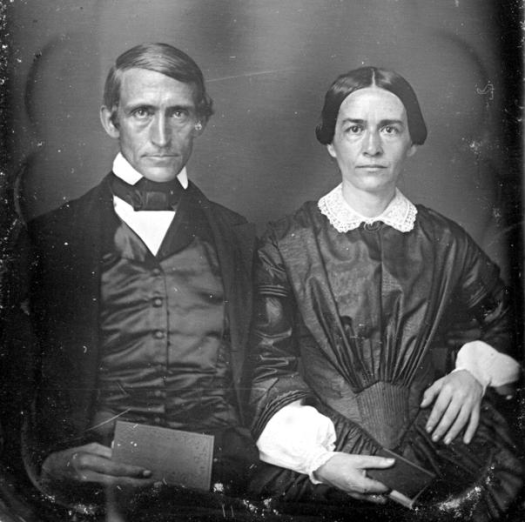
Daniel and Charlotte Dole, c. 1853. 

For a place that developed the ukulele, Hawaii in the 19th century must have been pretty tense. There were the rigid, pious, and fanatical missionaries; there were the licentious whalers and merchant ships coming into port looking to have a good time (and having it); there were the Native Hawaiians who were being marginalized by land privatization and population changes. Large numbers of Japanese and Chinese workers were brought in as agricultural laborers. Commercial interests–as often as not the enterprises of the missionary descendants–were beginning to dominate the economic life of the islands.  To top it off there was international intrigue. Hawaii didn’t have to be American. It could have been French, British, Russian, even Japanese. It could have been Hawaiian.

Sanford B. Dole, c. 1902, Library of Congress

I thought that Texas was the only Republic to enter the Union, and here late in life I’ve realized I was misled. Hawaii was (1) a kingdom under the House of Kamehameha and then the House of Kalākaua, and then (2) the Republic of Hawaii under its president, Sanford Dole. The monarchies weren’t exactly paragons of governmental virtue, but their overthrow involved sugar tariffs, rich sugar planters, the price of sugar, landowning descendants of missionaries, and price subsidies paid to Louisiana sugar interests and sugar beets in Colorado.  Did I mention sugar? I’m sure there were some Dole pineapples in there somewhere. Hawaii was finally brought into the States as a territory in 1898, 100 years after Captain Cook, because our destiny as a world power required a powerful navy, and Hawaii was a key to a powerful navy.  Really.


Liliuokalani of Hawaii. Frontispiece photograph from Hawaii’s Story by Hawaii’s Queen, Liliuokalani (1898)

By 1900, there were only about 30,000 Native Hawaiians. When Captain Cook reached the islands, the population estimates are from 100,000 to one million, but the archaeological record supports a population of up to 300,000. There hadn’t really been wars to reduce the population, not after Kamehameha the Great anyway, but there was plenty of disease, measles, tuberculosis, influenza, and whatnot, particularly tied to ships transporting miners for the 1840s California gold rush. There was also plenty of intermarriage, so that the 20 percent multiracial ethnicity will include many Hawaiian descendants. There was at least some out-migration. With a current Hawaiian-only population of about 140,000, the Native Hawaiian population has grown since the end of the monarchy. 

There is a modern Hawaiian separatist movement, or a lot of them, and unlike other indigenous American people Native Hawaiians do not have sovereignty, so there are also native sovereignty movements (which I think may be different from the separatist movements). 

What’s all this got to do with fishing? No idea. 
 

Hawaii

I’ve never really wanted to go to Hawaii. People tell me that if you get away from the crowds it’s a beautiful place. I’m sure it is, but it’s never much appealed to me. There are so many other places to see, places with deserts and rivers and such. But damn, Willie Nelson. Willie Nelson now lives in Hawaii. That’s tough to ignore.

The contact I’ve had with Hawaii has been pretty casual. My Dad’s first cousin, Houston O’Neil Thomas, U.S. Navy coxswain and son of Sam Houston Thomas, died on the Arizona at Pearl Harbor. I guess that isn’t exactly casual but it was 15 years before I was born, so it was remote. I’ve looked up his name in the Arizona’s dead, and my great-grandmother, Sam Houston’s grandmother, died ten days later, on December 27, 1941, the second family casualty of World War II. Maybe that run-in with Hawaii explains some of its lack of appeal.

Like a lot of bookish teenagers of a certain age I read James Michener’s Hawaii, and I’ve watched enough episodes of Hawaii Five-O to say “Book ’em Dano” with conviction. For years though I thought the lead actor was Darrin McGavin. I’m not much of an Elvis fan either.

I do like the music, or what I know of it. There’s a particular style of guitar in Hawaii, called slack-key.  The name comes from slacking the guitar’s standard tuning to an open tuning.  If the 1st and 6th strings are tuned down, slacked, from E to D, and the 5th string is slacked from A to G, the guitar is tuned to a G chord without the left hand–every beginning guitarists dream. The open tuning changes chording and scales, but there are some famous open tuning players–I always think of Joni Mitchell–and slack key guitar is lovely. This song by Keola Beamer is pretty perfect. 

But open tunings were never enough to make me want to go to Hawaii. I’m not a beach guy, and at least from what I can tell, all of Hawaii seems to be an enormous beach town. I suspect I’m too old to learn to surf, and always was. Or maybe just too pale to learn to surf, and always was. Or maybe just too dubious about my own athleticism.

So last year when I made my New Year’s resolution I was thinking I’ll have to go to Hawaii, and this is the only thing that would ever get me there. I’ve never wanted to go to Las Vegas either, though I did have a layover in the airport once. I wouldn’t mind a layover in Hawaii on my way to Christmas Island.

Maybe I’d think differently if Hawaii was a fishing destination, but it’s not. I think there’s some offshore fishing, but I get seasick, and I think it may be touristy stuff. Of course I guess I’m a tourist. There’s also  spear fishing, but it’s hard to catch and release with a spear. Anyway Hawaiian fishing was unregulated and subsistence or commercial for long enough to deplete much of the inshore fishery, and despite all that ocean there are apparently not a lot of fish. 

And it’s not really known to fly fishers, except as a layover for the Christmas Islands. There is some freshwater fishing in a freshwater supply reservoir near Honolulu, but the only report I’ve read was during a drought, and it wasn’t very appealing. Maybe in better years it’s like any other lake. There are also stocked trout at high elevations on Kauai. Trout fishing in America.

The last decade though there’s been some good press on Hawaii bonefish, o’io. They’re big. Bonefish are a destination fish, and the best places I know, Christmas Island in the Indian Ocean, Los Rocques, Venezuela, parts of the Bahamas, the east coast of the Yucatan, Belize, and South Florida, are destination fisheries. Los Rocques and Christmas Island are supposed to be the best, if you can get past traveling to Venezuela, on the one hand, or the time and money investment of going to a place where there’s one plane a week. The plane! The plane! Book ’em Danno.

Belize and the Yucatan are really the same place separated by a border that the fish ignore. The fish there are smaller, mostly in the one to three pound range, but there are lots of them.  That’s where I’ve fished, Belize, with small, relatively easy-to-catch fish. Big fish are apparently a different fish: warier, faster, stronger . . . The Bahamas is a destination not because of quantity but because it has big fish.

Hawaii is supposed to have big fish, as big as the Bahamas, but the bonefish flats, the places where you fly fish for bonefish, are apparently small, scattered, and mostly on Oahu. Mountainous volcanic islands that pop up out of the ocean aren’t the best places to find flats. There must be something there though. There are lots of guides. Maybe there are lots of tourists? I suspect there are lots of tourists.

It’s also a place where apparently the wind blows hard much of the time, up to 25 knots (that’s a nautical mile, or 1.15 statute miles), and if you do hook a fish you have to keep them out of the coral or you’ll lose the fish. When we go it will also be the rainy season. It’s not ideal. 

But we’ll go, right after New Years.