West Virginia

In West Virginia we’re staying at Elk Springs Resort & Fly Shop on the Elk River to fish for trout, non-native brown and rainbows most likely.  When I called to book, I asked the reservations lady how far it was from the lodge to Washington D.C. .  She didn’t know.  However far it is, I suspect in some ways it’s further.

Virginia and Maryland share a lot of things, but most of all they share geography. Because of a compromise over the national bank that put the nation’s capitol in the South, they share Washington D.C.. On the east they share the Chesapeake Bay. Coastal Tidelands in each state rise from the Chesapeake and both states turn into a fertile Piedmont region above a fall line.  On the west of both are the Allegheny Mountains, which are part of the Appalachian Mountains.

Interestingly, the Appalachians were named by a Texan, Cabeza de Vaca. Not really, but they were named apparently by de Vaca’s Narvaez expedition.

The Southern Appalachians, the mountains of West Virginia, Kentucky, Tennessee, Virginia, Maryland, and North Carolina, are what I think of culturally as Appalachia, but who knows?  Appalachia may stretch from New York to Georgia. I used to think of the area as isolated, violent, poor, and uneducated, with clan feuds and moonshining. Now I can throw in opioids, meth, and Trump voters.

Some of that stereotyping is fair, too. West Virginia, in the heart of Appalachia, became the bellwether state for articles on why white working class voters were voting for President Trump. And they did in West Virginia, by 67.9 percent to 26.2 percent. My guess is they voted for President Trump because they knew Mrs. Clinton thought them a basket of deplorables.

West Virginia had the highest rate of opioid deaths in the U.S. in 2016, at 43.4 deaths per 100,000. Actually, at 75.4 years, West Virginia has the lowest life expectancy of any state except Mississippi.  The only measured category of death where West Virginia isn’t running with the front of the pack is Alzheimers, one supposes because people don’t live long enough to die of Alzheimers. You want to die by accident? Move to West Virginia. You want to die by suicide or gunshot or meth or black lung? Move to West Virginia. Your chances are usually right up there at the top.

Here’s the oddest thing about West Virginia: it’s 93.6 percent white. If someone told me that a state was 93.6 percent white, I’d assume we were talking about Idaho or Utah. Virginia is 68 percent white, 19 percent black.  Maryland is 58 percent white, 29 percent black. West Virginia is 93.6 percent white. That’s a lot of white folk.

Settlement by whites was pretty thorough, but it didn’t really kick off until the mid-18th century.  The French and Indian War was fought in part over the Ohio Valley, which stretches from Pennsylvania down to Kentucky, with West Virginia at its heart. After the release of claims by the Iroquois and Cherokee (surely absent violence), settlers started in. Ok, they started earlier, but they started in now with England’s blessing.  First were Germans, and lots of Scots via Ulster, the Scotch-Irish.

From early on, West Virginia was different from the rest of Virginia.  It was subsistence living that didn’t support slaves, at least until coal mining.

Louis Hine, 1911

During the Civil War there were two areas in the seceding states that were strongly pro-Union, Western Virginia and Eastern Tennessee.  It was Lincoln’s dream that Eastern Tennessee would separate from the Confederacy, but it never did.  West Virginia did. On Amazon you can still find books about why the separation of West Virginia from Virginia was unlawful and unconstitutional.  Get over it.

Coal was the 18th century’s oil. It was the rural industry that turned us into a modern nation. It was and is a bloody, dangerous, unforgiving industry. Coal gave us some of the most violent labor disputes in the nation’s history: think machine guns mounted on train cars and fired into union strikers. Over 150 years coal gave us Mother Jones, strip mining and mountain-top removal and other ecological destruction, mine deaths, and a purchased West Virginia supreme court. it’s all Hatfields and McCoys, one way or the other. It’s always The Wild and Wonderful Whites of West Virginia, but sometimes at the corporate level.

Hills and hollers. It’s beautiful, a friend said. People use words like hollers when they talk about West Virginia.

When I put together my playlist of songs for West Virginia, it wasn’t very long. There was one person who I greatly admire but didn’t expect, Bill Withers, and there was lots of Mountain Music. And of course there was that John Denver theme: take me home.  It’s the most common theme of West Virginia songs: “My Home Among the Hills,” “West Virginia My Home,” “I Wanna Go Back to West Virginia,” “Green Rolling Hills.”  In our minds we love West Virginia. In our minds West Virginia is the idyllic wildness we yearn for.

I also put Appalachian Spring on the play list, and Mark O’Connor’s brilliant Appalachia Waltz.  O’Connor is from Seattle, and of course Copland was a Jewish kid from Brooklyn.  We all have our notions about Appalachia. Take me home.

***

I did finally get a decent photo of a bluegill, a tiny thing that hit a tiny yellow popper and as is their want hit it hard enough to take in the whole thing.  Lepomis machrochyrus. I originally misidentified the fish because it didn’t look like the pictures of a bluegill on the Texas Parks and Wildlife website, and maybe my fish is something entirely different.  Sunfish are wanton little devils, spawning from May to August, and apparently they hybridize readily among species.  This one has the wrong color fins and the colors generally seem off. It’s just as likely that this fish is the product of some unfortunate parental liaison between two breeds of sunfish.

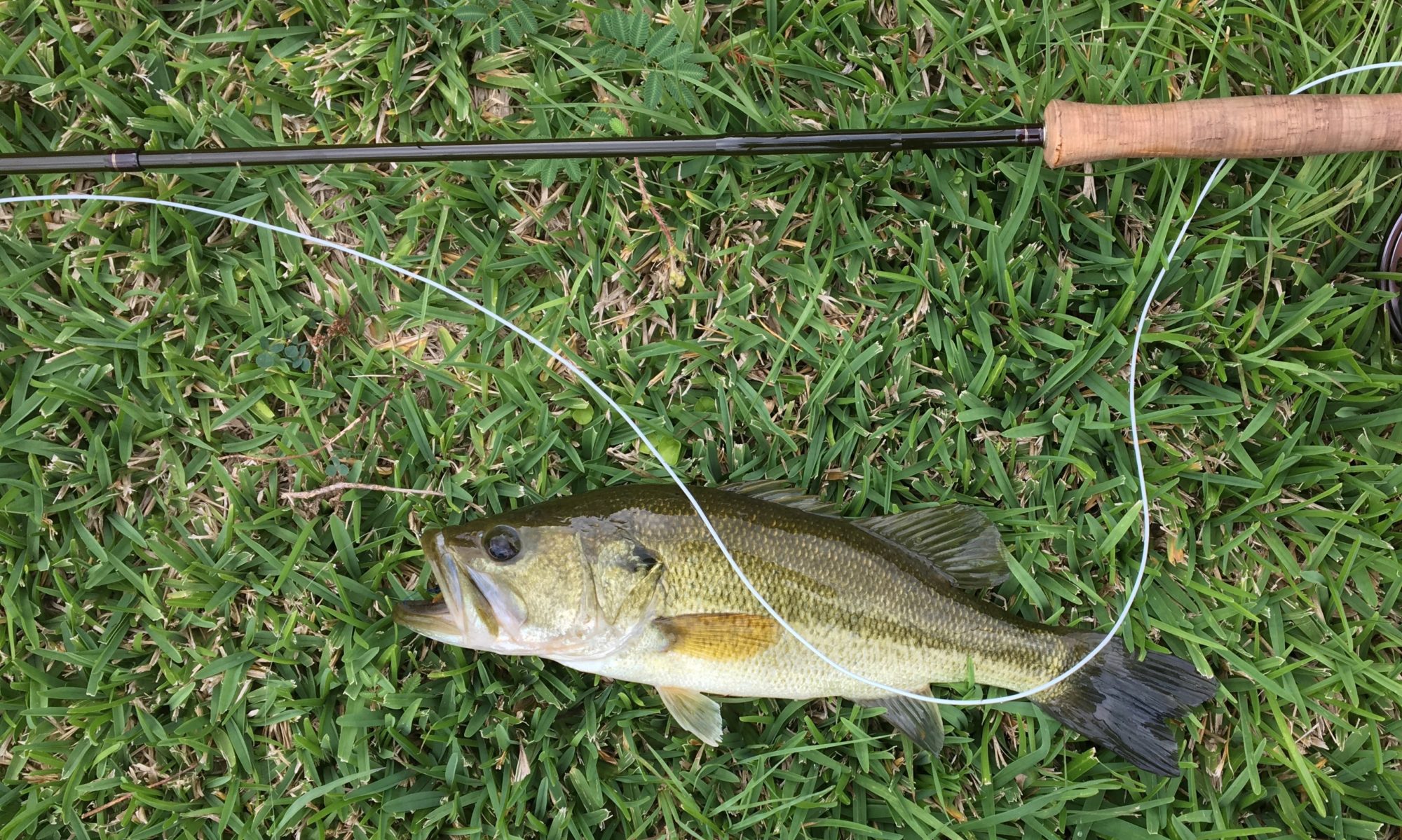
I caught a nice bass on the same tiny fly,  next to the grass in a pond backwater.


Tenkara-san

Kris gave me a Tenkara Sato outfit from Orvis for Valentines Day.  I gave her more or less the same thing, a Temple Fork Outfitters SH 11’6”. She tried hers on the Guadalupe but didn’t catch anything. I tried mine for the first time Sunday, fishing along the banks at one of Damon’s 7 Lakes for sunfish.  I only had about an hour, and kept meaning to switch to a popper but never did. I didn’t see many sunfish, but I caught one small bluegill and three smallish bass.

It took me a while to set up the rod and line, and my set up was . . . creative. Ignoring the instructions I tied some perfection loops and stuck things together. It was close enough to the picture, with the line that came off the rod dangling off the rod tip and a bit of standard leader attached to that. The booklet informed me that Tenkara was fly fishing, not dapping or cane rod fishing. From what I could tell it was about as much like dapping or cane rod fishing as it was like fly fishing, but I fished with a Damon’s owner’s favorite fly, a BBB. “BBB” stands for something, of which “bitchin” and “bream” are part, but I never have had it straight. They’re pretty easy to tie though, and they catch fish.

For me the 10’ rod had a range of 10-15 feet from the rod tip, plus or minus, but it was easy to cast and reasonably accurate.  Tenkara rods don’t lend themselves to long stillwater retrieves, but in a way they’re perfect for spring bass and bream in shallow water.  Every fish I caught hit while the fly was sinking through the water column, not while it was moving.  Toss, wait, toss again, wait. it’s intimate, visual, almost as good as dapping: all but the sunfish was caught when I set the hook after watching the fish take. If I hadn’t just  blundered down the bank not paying much attention, if I’d used just a modicum of stealth, I probably could have done much better, and caught more fish. Of course if I’d switched to a popper I might have caught more fish.

Small Texas Interlude

Yesterday we drove our skiff from Galveston, on the Texas Gulf Coast, 250 miles west on I-10, the highway that in my world stretches from El Paso to New Orleans (but in reality goes a bit further), to a tiny community outside San Antonio, Elmendorf, where we dropped the skiff off at the builder for some work and its motor’s 100-hour service.

We keep the boat in a dry stack, and don’t trailer often. Everything from loading the boat on the trailer to towing it through Houston down the interstate to San Antonio is terrifying.  We’re still married I think, at least no papers have been served on me yet. Kris did an excellent job on that last 100 miles into the New Water Boatworks. Let me say that again. Kris did an excellent job, and I’m sorry I yelled at her. I’m even sorry I offered advice from time to time while she was driving.

We’d planned to fish the Guadalupe late in the day, but it was after 4:00 when we dropped off the boat. We drove to New Braunfels, found our motel, and ate German food and drank German beer at Alpine Haus. After dinner we went to Gruene Hall to listen to music. Chronologically we might have been the elders at Gruene Hall, but as Kris noted a lot of younger folk looked like they’d been ridden hard more miles than us. Listening to the main attraction, Uncle Lucius, was like reading a pretty good mystery novel the plot of which you’d read a half-dozen times before. The opening act, Folk Family Revival, was terrific.

A couple of months ago, three guides from Go Outside Expeditions had done a presentation at Bayou City Anglers on trout fishing on the Guadalupe. They did such a nice job that last week I emailed them about fishing the Guadalupe.  The owner, Chris Adams, said that with the warmer weather the fishing on the Guadalupe was slowing (which was a surprise to me–I never knew it was fast). He recommended fishing the San Marcos.

I was happy as could be. I like the San Marcos, and many years ago had canoed it a good 20 times and had fished it once, but that was old history. It’s a Texas Hill Country river (though not really in the Hill Country), 75 miles long from its start at San Marcos Springs to its confluence with the Guadalupe. It’s lovely, with greenish clear water and good flow and lots of descents through class I rapids. Clovis Culture artifacts have been found at its headwaters, so it’s one of the oldest continuously settled sites in North America. Bank to bank it’s small, just right for goofing around for a day, which means it’s just right for fly fishing.

Prairie Lea between Luling and the town of San Marcos used to have the best kolaches in Texas, but it’s a long way out of the way from nowhere and the shop didn’t last. My high school classmate Mark Morgan’s aunt is the last house on the right on the way from Prairie Lea to the river, and Mark met us at the river because that’s where we met Chris-the-Guide and Mark happened to be in Prairie Lea. Confused? Kris was. What’s to wonder? Mark was there to add local color, mostly orange.

I only ever remember one lazy fishing guide. A redfish guide once dropped me off the boat and told me to stand there and watch for the fish to swim by. None came. I think the guide motored off and took a nap. Chris-the-Guide on the other hand was great. He knew his river and kept us fishing, working his way through downed trees, rowing us into position to cast, ducking when I cast, and  recovering hung flies. It was hard work, dragging the raft over trees and shallow gravel and staying calm while we dropped stuff into the water, including me. The spa treatment was free.

Kris-Not-the-Guide fished most of the day with a popper, I fished most of the day with a weighted streamer, typical bass stuff. Kris fished her Orvis 5 weight, I fished my Winston 6 weight. It all worked fine, just like Chris had said. Chris-the-Guide was a Winston pro-staff guide, and we talked about how nice the Winston rods felt casting but more important how pretty they are. Chris said there were people who didn’t like their looks.  I would never have imagined someone could find those pretty rods boring. You learn all sorts of stuff from guides.

We talked a lot on the way down the river. Chris suggested places to fish in North Carolina and Georgia and Virginia. He grew up a Southern kid, in Georgia, and while his accent passed for Texan he was more polite than us, and he unfailingly addressed me as sir. With age lots of people do, but I suspect that’s how Chris always talks to clients, and that it was something drilled into him by a correct Georgia upbringing.

Nothing we caught was big, the biggest was maybe a pound, but it was lively and fun casting. We pounded the bank, putting the fly as close as we could then taking a few strips then doing it again, just like Chris-the-Guide told us.  There were black bass, Guadalupe bass, sunfish (which I found myself calling perch–I haven’t called them perch in a good 50 years), and warmouth. We caught several black bass/Guadalupe hybrids, and a few purer Guadalupe bass, and Guadalupes being the state fish of Texas, that was particularly satisfying. I like to think that Guadalupes were what Cabeza de Vaca labeled trout when he came through in the 1500s.  The Guadalupe bass behave more like trout than black bass, feeding in faster water off seams and runs in the river. Or maybe Cabeza de Vaca called all fish trout. Or maybe my memory’s faulty and Cabeza de Vaca didn’t talk about trout at all.

We probably caught 15 fish in the five hours we were on the river, which for us is something of a record.

Morgan, the local color at the top of the post and perfectly good fly fisher, had stayed put to catfish bankside where we put in. chicken liver. Doughbait. Eight pound channel cat.


Florida Canals

The highest point in Florida is Britton Hill at 345 feet above sea level, way up in Walton County in the Panhandle.  The average elevation in Houston is 80 feet above sea level, so 345 feet is pretty high. I suspect I’d have to worry about altitude sickness. Florida’s mean elevation is 100 feet.  The low point is the Atlantic Ocean which is, oddly enough, at sea level.

What that means–and I know this from recent experience with our own Hurricane Harvey–when it rains in Florida the water doesn’t necessarily drain. It sits. If it rains fast enough (and in Florida sometimes I’m guessing it rains fast enough) it piles up. To get stuff to drain you have to spend a lot of money on drainage improvements.  I bet in Denver they don’t have to spend a lot of money on drainage improvements. We do here in Houston. I bet they do in Florida.

So there is the South Florida Water Management District.  It oversees 2100 miles of freshwater and brackish canals in south Florida.  Then there are secondary canals run by cities and counties and water control districts. In South Florida there are a lot of canals that exist to move water in flat land where water don’t move.

In 1984 florida introduced peacock bass into the southern canals, both to create a game fishery and to add an aggressive fish that could control the other weird fish, and there’s some weird fish. According to the internet there are

Peacock Bass (photo from Wikipedia), baby tarpon, largemouth bass, grass carp, tilapia, snook,

oscars (from Wikipedia), jaguar guapote, Mayan cichlid, black acacia, clown knife fish,

snakehead (from Wikipedia). I have heard estimates that as many as 80 species live in the canals. Folk have to dump their aquariums somewhere.

Snakehead make excellent eating, but it may be an urban myth that you can’t catch and release.

It is somewhat of a thing in Florida to traipse or kayak along the canals to fly fish for exotics. In July Kris and I saw a presentation at Texas Flyfishers of Houston (which is sort of like the Los Angeles Angels of Anaheim, or the Texas Rangers of Arlington), by Jim Gray of the Austin Fly Fishers, on fishing the canals.  We walked out not intrigued so much as disgusted.  These were some ugly fish.

People fish these canals like I fish for black bass, with 6-8 weights and streamers, and I thought that maybe next week in West Palm we would look for a canal to fish. I chickened out and hired a guide.  I still thought maybe we would squeeze in an hour or so, and I asked the guide about them.  “Fire ants” he said, “moccasins” he said. “Be careful.”

Now honestly, I’ve been bit enough by fire ants to know their misery and its limits, and I have just as good a chance of moccasins hereabouts as I might have in Florida. Still, they’re ugly fish. We’re fishing salt water.