Ocean Springs

Walter Anderson, Detail, Ocean Springs Community Center Mural, 1951.

We fished Saturday and Sunday. That seems like a small thing, we fish lots of Saturdays and Sundays, but so far this year I have caught a tiny bluegill (which was all I caught in January) and two small rainbows (which were all I caught in February). Meanwhile we’ve fished at Key West, Oahu, on the Texas Coast, and in the Hill Country. Since we were in Mississippi to try for another state things were bound to go wrong.

And last Saturday was bad even for March fishing on the Gulf. it was overcast and there was a 20+ knot wind from the south–which meant if we had just stood still and held our arms out we could have visited Memphis. To get to the leeward side of Horn Island we had to quarter the wind eight miles through three-foot slop, the kind of scary slop that in our skiff by ourselves would have left us alternately screaming at each other and clinging to each other in terror, hoping we didn’t die.

Our guide, Richard Schmidt, ran the right boat for the water, a Hell’s Bay Marquesas with a 90 hp Suzuki, and we were always perfectly safe. But Richard was pretty dubious about taking us out in that weather, and my jokes about us being casting impaired didn’t help any. The high wind coupled with the low chance of enough sun to see fish left things pretty sketchy, and when Richard suggested that sometimes his customers were casting challenged, I chimed in that he’d be well prepared for us. The joke fell flat. This was not a funny day. I was worried he was going to turn the boat around.

Instead he took us on to Horn Island. He had boiled crawfish and beer in the cooler, so whatever happened we were going to have a good day, and I would have gone to Horn Island just to see it.

Walter Anderson, Turtle Diptych, Walter Anderson Museum, Watercolor on Two Sheets of Typing Paper, c. 1960.

Horn Island is part of the Gulf Coast Islands Seashore, and it’s a national treasure because, while it’s pretty enough–eight miles of sculpted pines and sugar white sand and dune colors–it’s Walter Anderson’s subject. I kept saying it was beautiful because, well, it was, but it was also beautiful because my eye had been prepared by Anderson. It’s hard not to see Anderson everywhere on the island.

I had never heard of Walter Anderson until I read The Gulf: The Making of an American Sea. Jack Davis spends pages talking about him, and having read Davis the first thing I asked the lady at the front desk at the Walter Anderson Museum of Art was whether he was really crazy? “No,” the nice lady said, “He was just eccentric.” Mississippians being polite have eccentric, us Texans being harsher have crazy.

At dinner Friday Kris and I had talked mostly about Anderson–the lady at the desk said she personally thought he was bipolar, and that may not be crazy all the time but it’s at least eccentric. There were so many things to talk about, about how he lived apart from his family but how still from time to time new children would appear, about how he tied himself to a tree on Horn Island to experience Hurricane Betsy, about his long trips rowing the eight miles to Horn Island to live and sketch, and about his genius. Mostly about his genius. His work is so brilliant, so evocative of the place and more than a bit madly obsessive. How do we all not know Walter Anderson as well as we know Van Gogh, as well as we know Picasso? At least as well as we know Donald Judd?

And Horn Island is exactly what you see when you see much of Anderson’s work. Plus, right off the bat I caught a fish.

It wasn’t a very big fish. It was a 16-inch red that took my fly when I blind-cast to a place that to me looked fishy. The fish was silver, not red or bronze, with the bluest tail I’ve ever seen. Everything in Mississippi has the blues. After that Kris camped out on the casting platform and pretty much stayed there. I napped and ate crawfish, so I was happy, mostly. Kris hooked a redfish, too, a good 20-pounder, but the leader broke. Wind knot? probably a wind knot. There wasn’t a pig tail, so it wasn’t a badly tied connection, and anyway I’m sure that all of my knots are always perfect. The tippet was Rio fluorocarbon so even though the spool was a few years old it shouldn’t have snapped without some cause. Wind knot.

Otherwise while Kris fished I tried to take photos of the bald eagle and the ospreys on the island, and when I walked up into the dunes for a rest break I saw raccoon and seabird tracks in the sand. There was a moment when I was allowed a brief, very short stint back on the casting platform and watched hundreds of schooled sheepshead streaming down the beach, aggregating for their spawn. It is such a living place. We got some sun, and when we did we saw fish. We got some shots.

Sunday the problem wasn’t wind. There was no wind so instead we got fog, heavy fog that Kris and I wouldn’t have braved alone and that nobody else did either, and gnats. Gnats from hell. Gnats that we breathed, and ate, and that searched out every small bit of exposed and un-sprayed skin for a good feed. I was on the platform at one point and I looked down at a bit of hand I’d missed with bug spray and there were at least 200 gnats a’swarming. I have gnat bites on my bald spot. I have a raccoon-ring of welts around each eye where the Buff didn’t quite meet my sunglasses, and where I had avoided spaying bug spray for my eyes. Driving home Sunday, about the time we reached Louisiana, the gnat bites started itching. They were still itching 24 hours later.

Richard ran the boat 30 minutes through fog into the marshes out of Pass Christian, which is pronounced “Pass Christy-Anne,”with just a hint of “-ch-” between the “t” and the “y”. The water wasn’t clear, it had been better when we’d fished the day before, but Richard said that even in the marsh it usually was clear on the east side of the Mississippi. The Corps was diverting freshwater out of the Mississippi River through Lake Pontchartrain into the Gulf to avoid flooding downriver from New Orleans, and it killed the clarity. Apparently it also kills the oysters.

Richard said that beginning in May he guides mostly for jack crevalle on the flats and triple-tail near the crab traps. Kris never did catch a fish, so I’m thinking that means we need to go back. I’ve never landed a big jack crevalle. I’ve never fished for triple-tail. Plus the Mississippi Coast may be as pretty a place as I’ve ever fished.

And on the second day, late in the day, Kris let me on the platform just a wee bit more and I saw a swirl in a couple of feet of water and made a magnificent 90-foot cast to set my fly on the nose of the new world-record black drum. Ok, I’m lying, it isn’t the new world-record black drum, but it was one huge black drum–in the Gulf Coast parlance a big ugly. Richard thought it weighed somewhere between 40 and 50 pounds, so it was at least 60. And of course it’s growing.

And ok, I’m lying. It wasn’t a magnificent 90-foot cast, it was more of a rod-lenth flick. The fly was purple, with barbell eyes and it probably traced its lineage to a Clouser. I was fishing a ten weight Orvis Helios II and a Tibor Riptide (it’s probably important that you know that the Tibor was blue and that my shirt was sea-foam green). People always say black drum are blind, and maybe they are, but this drum made a six-inch rush to my fly, ate it, and I strip set. I really did. I strip-set.

Then everything stopped. The big drum pondered a bit and started to mosey away. It stopped, started moving again, realized it was hooked to something, and then it did something black drum don’t do: it ran. Their cousin the redfish will run, but black drum usually hunker down and make you pull them out. Ok, it didn’t run wild and fast like a permit or a jack, it didn’t twist and jump like steelhead, it ran like a train, straight and hard and purposeful and surprisingly fast, all the way into my backing: bubble-gum pink by the way, I’d never seen it before from that angle. Then when it stopped and figured out it was still hooked it ran some more. And then it ran some more. Richard polled in its direction which helped, but every time I started bringing it back it ran some more. It was big and it ran.

It didn’t take that long to land, less than a quarter hour, but it was some work. When I brought it boatside and Richard lipped the fish with his Boca Grip the hook fell out. We got some pictures, though they didn’t do it justice. Look at those shoulders! That color! That tail hanging halfway to the deck! It may not have been a world record, but it was without doubt the handsomest big ugly ever landed. It probably would have shown better if I’d held it up in front of us, arms extended, but I’m not sure I could have lifted it.

We fished a couple of more hours, and would be fishing still if it were up to Kris and Richard.

I loved fishing Ocean Springs. I have rarely been to a prettier place. Richard was a fine guide, plus he brought crawfish, and once you get past the Biloxi casinos the Mississippi Coast is charming. And did I mention? I caught a big fish–the black drum of the world, the most beautiful black drum ever landed and for that moment I was the handsomest gnat-infested angler who ever landed a fish. There just aren’t better places.

What I Want for Christmas

We’re driving to Ocean Springs, not flying. It’s a ‘fer piece, according to Apple Maps more than 400 miles, mostly east but a bit north (Yankees!), six hours and 19 minutes skirting roughly half of the north shore of the Gulf of Mexico. In our driving time six hours means seven. And 19 minutes.

We leave Friday and will be back Monday. It’s not a blue highway sort of drive, it’s I-10, the interstate that runs from Santa Monica, California, to Jacksonville, Florida, and it’s a drive I know well: from El Paso to Houston but also east. There’s Rao’s Bakery in Beaumont and the donut shop in Lake Charles where the boudin kolache was created. There’s boudin and crawfish pie at the Sausage Link in Sullivan and the 18-mile bridge over the Atchafalaya Basin. If we went earlier, Thursday evening, we could spend the night in Lafayette and go dancing. Last time I checked they still sell Haspel Suits in Baton Rouge. Once we get to Slidell above New Orleans on the northeast shore of Lake Pontchartrain I’m not so familiar with things, and every time I’ve gone as far as Mobile on I-10 I’ve turned north toward Atlanta, but we stop short of Mobile. Mobile will have to wait for a different trip.

We originally planned to fly to New Orleans, rent a car, and drive to Ocean Springs, and I had made all the reservations. A direct flight from Houston to New Orleans is only about an hour, and I’ve always got Southwest flight points: instead of enhanced Medicaid every Texan gets 10- or 20-thousand Southwest points every couple of months. With airport and driving time from New Orleans to Ocean Springs we could make the trip in about five hours. Five hours and 19 minutes. But truth is I love a good road trip, and with flying you lose the imagination of the countryside: that road would be good to bike down, that bayou would be good to canoe, would that farmer let me fish that pond? Could we live here? It’s better than buying a lottery ticket.

Plus there’s seven hours in which we can play the Mississippi playlist and finish listening to Faulkner’s The Hamlet (which I think hilarious and Kris thinks grim) and eat Cheetos and boudin and search for donuts. And how can Kris think The Hamlet grim, at least parts of it anyway? What reasonably empathetic heterosexual (or maybe not even heterosexual) male can’t see the goofier side of his infatuation in Labove and Eula Varner? I’m just lucky Kris didn’t whack me across the head.

So at TroutFest there was one of these from Four Wheel Pop-up Campers:

https://fourwh.com/product/hawk-short-bed-popup-truck-camper-regular-size/

And there was one of these from Into the Wild Overland:

https://itwoverland.com/#

And they were either one about $30,000 as outfitted–they had every possible accessory. My children have been to college and beyond, and I can imagine retirement. I was taken with the notion of driving one of those things to a donut shop in the Rockies. Out of Denver the Into the Wild campers are available for rent for $150 per night. It doesn’t seem to have a toilet, and that might be a deal-killer.

When you start looking around you can find all sorts of folk who have caught fish on a fly, or at least a fish, in all 50 states. There’s a guy and his son who did all 50 states in 50 days, which makes my stomach queasy. There’s a lovely husband and wife who did all 50 states in a year. There’s a guide in southwest Colorado who tallied up his prior experience and realized he only lacked six or so states and went out and got them. But dang, I could spend a year reading books from Mississippi, much less fishing the farm ponds and eating the tamales and listening to the blues. I’m not in any hurry, and spending less than a month in Montana seems like a crime. So this whole RV thing is really appealing.

https://mercedessprinterrvrentals.com/mercedes-sprinter-rental-fleet/

I’d thought next year of a grand Southwestern tailwater tour: the San Juan, Lee’s Ferry, and the Green. I can rent a Mercedes Sprinter Van for 10 days from Mercedes Sprinter RV Rental for about $6000, which is expensive but I wouldn’t at the end of the day have to own the thing, and it’s about the price for one of us staying in a very good lodge for a week in Alaska, not including drinks. I could pick it up in Albuquerque and not have to skip Taos or Chama or Chaco Canyon, and we could drop it off in Salt Lake City. We could also drive on that tailwater road trip and stay in motels. For cheaper. Or dig one of the tents out of the attic.

I don’t know. I didn’t much like staying in the Airbnb in Hawaii, nothing wrong with it but nothing right with it either, and I kept thinking that I’d rather be staying inThe Royal Hawaiian. Or a camper. A road trip camper. With a standard poodle named Charlie on a Blue Highway, self-contained, meandering. Of course once I got there I’d still rather be staying in The Royal Hawaiian.

The Waw

General Jubilation T. Cornpone, from Li’l Abner, Paramount Studios, 1959.

Before we went to Vicksburg I listened to Jeff Shaara’s novelization of the Siege of Vicksburg, Chain of Thunder, because Vicksburg is a good place to think about the effect of the Civil War on the white South. The citizens of Vicksburg were besieged, starved, bombed. They lived in caves. They ate rats. From May 18 through July 4, 1863, the War was in their home, and if the War began for the defense of slavery it ended with the failure of that defense and other things besides: a deep and culturally inbred resentment of the invader, and conviction as to the superior virtues of the defeated. The misery of invasion still resonated in 1971 when Joan Baez’s cover of The Night They Drove Old Dixie Down was at the top of the charts. The Band’s version is pretty good too.

And notwithstanding the modern world the resentment and conviction probably aren’t done yet either.

From The General, 1926, MGM. The General is the funniest movie ever made and is in the public domain because somebody didn’t bother renewing the copyright. Go figure.

From Twain’s Life on the Mississippi:

IN the North one hears the war mentioned, in social conversation, once a month; sometimes as often as once a week; but as a distinct subject for talk, it has long ago been relieved of duty. There are sufficient reasons for this. Given a dinner company of six gentlemen to-day, it can easily happen that four of them—and possibly five—were not in the field at all. So the chances are four to two, or five to one, that the war will at no time during the evening become the topic of conversation; and the chances are still greater that if it become the topic it will remain so but a little while. If you add six ladies to the company, you have added six people who saw so little of the dread realities of the war that they ran out of talk concerning them years ago, and now would soon weary of the war topic if you brought it up.

The case is very different in the South. There, every man you meet was in the war; and every lady you meet saw the war. The war is the great chief topic of conversation. The interest in it is vivid and constant; the interest in other topics is fleeting. Mention of the war will wake up a dull company and set their tongues going, when nearly any other topic would fail. In the South, the war is what A.D. is elsewhere: they date from it. All day long you hear things ‘placed’ as having happened since the waw; or du’in’ the waw; or befo’ the waw; or right aftah the waw; or ’bout two yeahs or five yeahs or ten yeahs befo’ the waw or aftah the waw. It shows how intimately every individual was visited, in his own person, by that tremendous episode.

Mark Twain, Life on the Mississippi, ch. 26, 1883, James R. Osgood & Co., Boston, Ma.

There’s a strange statue in AsiaTown in West Houston, a larger-than-life bronze of a South Vietnamese infantryman in full battle gear walking side by side with a bronze American G.I., also in full battle gear. It’s the Memorial to the Army of the Republic of Vietnam. The statue is in a district where not long ago a Vietnamese city council member was defeated at least in part because he had accompanied a former mayor on a trade mission to Vietnam. He visited the Yankees. Sometimes it’s just hard to get over it. Ask the Scots or the Irish or any given Cuban in Miami. Go visit Napoleon’s Tomb. Visit Quebec. Not everyone’s a good loser.

Now mind, there is no defense of the Lost Cause, there’s no getting over the moral indefensibility of many of my ancestors going to war to defend slavery: to paraphrase Grant, pretty brave guys but man did their cause suck, and for black Americans it really sucked.

University of Alabama Students burn desegregation literature, 1956, Library of Congress.

Beginning in the 1950s and 60s, with desegregation and voting and civil rights, our insights into the causes and effects of the War changed, or should have changed, not just in the South but the North as well. Maybe they did for some, but its symbols also became the symbols for a new conflict, or at least a refocused conflict carried over from the old. Notwithstanding that it was during the centennial of the War, I’m not buying that in 1962 Dixiecrats in South Carolina for the first time raised the battle flag at the state capitol because they got hyped up about history. I do suspect that a television show starring a Dodge Charger named the General Lee with a battle flag on its roof was dreamed up in Hollywood as a live-action cartoon, was innocent if naive, and that if anyone should be offended it should be white Southerners, but there you are: there are no longer any frivolous uses of that flag, and there are certainly no innocent uses. I may miss General Jubilation T. Cornpone in the Sunday funnies, but you can’t go home again.

* * *

Meantime we’re packing for Mississippi, and Saturday we drove to New Braunfels where I caught a nice rainbow on a red and black zebra midge under a flashback pheasant tail under a tan worm under some weight under a bobber, and I caught it right at the top of a run, right where it was supposed to be. Plus notwithstanding all that hardware I only got tangled twice. On the way out of town we ate at Krause’s, which has reopened and constructed a great beer hall next to the old restaurant. At our shared table we met a couple from New Braunfels with a place for rent in Arroyo City, on the Laguna Madre. Kris loves fishing the Laguna Madre. Unlike Florida I can catch fish on the Laguna Madre. She was ready to move to Arroyo City.

Mississippi Donuts

Sunday morning in Vicksburg we stopped for donuts at Donut Palace before we toured the National Battlefield. Donut Palace is a pretty basic donut shop, clean and well lighted, without pretensions or flourishes, and it seemed to have a reasonably steady stream of customers. The other donut shop in Vicksburg, Divine Donuts, was closed on Sunday morning, because the Divine always rests on Sunday.

I had a pretty involved conversation with two customers. Mississippi accents are richer than most, and theirs were money. They had stopped for donuts on the start of a seven-hour road trip to Throckmorton, Texas. I blurted out that Throckmorton was my home town, thought better of the exaggeration, and tried to explain that it was within my home territory. Throckmorton was a bout 70 miles from where I grew up in Vernon, and about 30 miles from where my mother grew up in Seymour. In those parts, that’s nearby.

We had a nice conversation about hunting quail and dove, and I wanted to ask them if they knew a nearby farm pond to fish but I didn’t. It was cold, and even at a farm pond the fishing would be hard, and secretly I didn’t want this to be my last trip to Mississippi. As for Throckmorton, Texas, it was named after James Webb Throckmorton, who was born in Tennessee, and in 1861 had supported Sam Houston’s attempt to keep Texas in the Union. He was one of six Texas secession convention delegates who voted against secession. He then enlisted in the Confederate army, ultimately serving as brigadier general of something or other which was not the army, and late in the War as the Confederate commissioner to the Indians.

Texas was a recalcitrant Reconstruction state, and Throckmorton was the recalcitrant first Reconstruction governor. He repudiated the 14th Amendment because Texans, meaning white Texans, didn’t like it, which meant that he refused to protect freedmen or Freedmen’s Bureau agents. He was removed from office by Phillip Sheridan. Throckmorton the City is the County seat of Throckmorton the County, but I reckon they weren’t named for Throckmorton’s dubious accomplishments but because of the sheer poetry of the name. Throckmorton. Doesn’t that just roll off the tongue? I figure his constitutional analysis was a fluke and he was the last Texan ever who thought that the 14th Amendment didn’t apply.

After the two guys Going to Texas had Gone to Texas, I asked the donut shop owners if they were Cambodian. They were, and had close ties to Texas donut shops. That means that Cambodian ownership of donut shops has now spread out of Houston through Louisiana into Mississippi. There were some other earlier minor migrations into Mississippi. Chinese immigrants arrived during Reconstruction, and there are Chinese restaurants here and there. Tamales came with cotton workers brought in from Mexico after the turn of the last century, and are a favorite of the Delta. Donut Palace was selling the sausage rolls that Texas donut shops call kolaches, and they sold that greatest of Cambodian donut shop inventions, the Czech-Cajun-Cambodian boudin kolache. Their boudin came from Beaumont. It was delicious.


Cambodian donut shops are family affairs, and the owners were charming. I mentioned to them that I had heard that Dallas donut shop owners were often Koreans, and they said yes, and that the Koreans worked very hard and even slept in their shops. They said that one Korean would often run a shop alone, and that they knew a Korean who had two shops that he ran himself. I couldn’t figure how that worked, and I didn’t ask, but it wore me out just thinking about it.

* * *

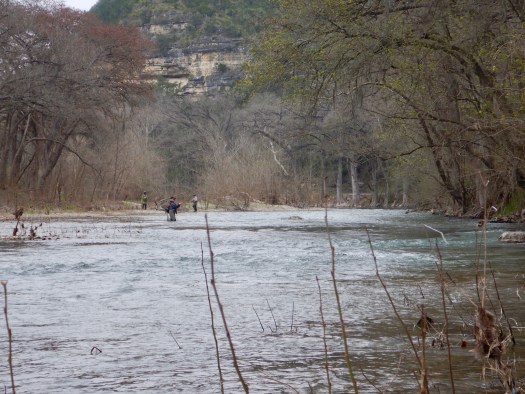
Yesterday we drove to Sattler to fish the Guadalupe. It was only the second time we’d been to the Guadalupe this year. It was crowded, and nobody we talked to was catching anything, including a guide and his clients in a raft. It was TroutFest again, and the same guys with beards were there again this year. Before we fished we ate lunch at The Real Pit Barbecue in Sattler, and in honor of the first Astros spring training game I had a Frito pie. Frito pie is Texan/New Mexican, consisting of chili spooned onto Fritos, sometimes in a sliced open single serving sack, and garnished with cheese and onion. Being a combination of salt, spice, beef, and fat they are delicious, and because I explained to the lady at the counter that the Astros’ season depended on my eating a Frito pie–I’m mildly superstitious about baseball (but oddly never about fishing), she, being an Astros fan, made me an excellent pie. The chili had beans, or at least there were beans added, but I didn’t complain. I’m no Pythagorean.

When we finally got into the water I spent most of my time untangling line or re-rigging and wondering how I could get my tippet, nippers, weights, forceps, sunglasses, readers, camera, wading stick, net, and flies ready to hand. I used to wear a vest, and then tried a different vest, and am currently using a sling pack. I’ve used satchels and hip belts and lanyards and chest packs, and they all have their problems, but yesterday was a real mess. It was that day when everything was always wrong. At one point I sat down on a limestone ledge and took everything off and started over. I also had to unwrap the fly line that had somehow twisted 20-odd times around my net.

Maybe I need a pack. I’ve never tried a pack.

Late in the day I caught a small trout on a red and black size 16 zebra midge under a bead head under some weight under a bobber, then hooked a nicer fish that flipped off the hook after a couple of jumps. I figure I need to eat a Frito pie every time I fish the Guadalupe. Not that I’m superstitious.