John Brown! Kansas.

Porte Crayon (David Hunter Strother), En route for Harper’s Ferry, 1859, wood engraving, Harper’s Weekly, Library of Congress.

The events that led up to the Civil War are a mess, which I guess is the way they should be, but their level of complication is greater than the level of my willingness to learn them. From the founding of the nation to the firing on Fort Sumner there’s all this complicated stuff that happened, dates, compromises, court decisions, slave revolts, expansions, and these then-famous people with now dimly remembered names like Taylor and Pierce and Webster and Calhoun and Clay. They made speeches and policy and enacted laws and whatnot, and all of what they did was overshadowed by the now inexplicable and then intransigent desire of Southerners to maintain a cruel and immoral institution. I have in the back of my mind the suspicion that notwithstanding the absence of any given incident, at the end of the day the War would have happened whatever came before, maybe sooner, maybe later, but the War was inevitable.

I’ve boiled the sequence of what happened down in my own pretty little head to a few things. It’s my litany, useful to me but simplified. In 1807, Congress, at the urging of President Jefferson, voted to ban the importation of new slaves. Congress, both North and South, voted for the ban. They believed that if they stopped African importation, slavery would collapse because it was economically unsustainable. Forty years later, that vote would have been impossible.

Samuel Morris, Eli Whitney, 1822, oil on canvas, Yale University Art Gallery.

Two things intervened that would have made that vote impossible. The same year as the ban, Eli Whitney received a patent for a cotton gin, which made industrial agricultural cotton production profitable in the Deep South, Land of Cotton, not forgotten. Industrial agricultural production of cotton meant that slavery not only wouldn’t collapse, but that it was economically desirable, both for the Deep South, producing cotton, and the upper South, producing slaves through natural increase and selling them down South, and in Northern and European mills, weaving cotton. It is not an accident that for Jim in Huckleberry Finn, the threat of being sold down-river to New Orleans is both real and terrifying.

The second intervening event again involved Mr. Whitney. In 1801, Whitney demonstrated the value of interchangeable parts in firearm production, and after his death in 1825 his family fire arms company produced muskets with interchangeable parts. Interchangeable parts helped spur the North’s conversion from agriculture and artisan production to factory industry. Neither idea, the gin or the parts, was exactly new with Whitney, but there you are. In North America he gets the credit, and because of cotton and factories the North and South went different ways.

A new map of the United States. Upon which are delineated its vast works of internal communication, routes across the continent &c, 1852, Philadelphia, Lippincott, Grambo & Co., Library of Congress.

At the same time the economic engines were changing there was westward expansion. It’s hard now to imagine us as anything other than 50 states with amber waves of grain from sea to shining sea, but when Napoleon pawned off Louisiana in 1804, Mississippi (1817) and Alabama (1819) weren’t yet states. Florida (1821) still belonged to the Spanish, or was it the English? In 1804 America the Beautiful was the original 13 Colonies, the Ohio Territory (1803), Kentucky (1791) and Tennessee (1796).

With the Louisiana Purchase things boomed. Texas was annexed in 1845 . The cession of Mexican lands after the Mexican-American War (which Northern progressives saw as a war of Southern aggression to expand slavery) added the Southwest, and treaties with England settled the northern boundary between the U.S. and Canada. Because of control of Congress, there was constant trauma over whether new territories would be slave or free.

Complicating the expansion there was the Supreme Court decision in Dred Scott. Dred Scott held that regardless of where a black slave stood, North or South, state laws could not supersede the property rights of the slaveholder. The black man or woman was not a citizen but a slave, always, even in Ohio, even in Maine.

And there were the first battles, the first blood, in Kansas.

My father wasn’t a cussing man. At least around his family there was no profanity, no curses, but he did from time to time need an exclamation and his exclamation was usually John Brown! I suppose it was something he’d picked up in East Texas from his father, or his uncles, and we heard it so often that we never noticed it until my older sister married and her new husband made fun of it. It was fair game I guess, but still, it ruined John Brown!, and probably for that reason I never say it.

I guess because of my father’s mild expletive I always knew who John Brown was, or at least knew that he had led a raid on Harper’s Ferry to kick off the Civil War. I was fertile soil in college when I read Stephen Oates’ Brown biography, To Purge This Land with Blood. Still, it was a startling book. Brown was a violent zealot, the first modern terrorist. Brown was right, his opponents’ defense of slavery morally indefensible. Brown was charismatic, reasonably well educated, deeply religious, and a failure at most things he attempted. Oddly, he worked in a tannery with U.S. Grant’s father, and like Grant’s father for a time was a tanner. He farmed. He tried to broker wool. He was mad, or not, but certainly he was monomaniacally opposed to slavery. He believed in the equality of whites and blacks, and he believed that only blood could end slavery and bring about equality.

Photographs of John Brown, Wikimedia Commons.

He was a murderer in Kansas. He was a murderer in a good cause. He was a murderer.

One of the events that led to the War was the Kansas-Nebraska Act of 1854. It probably seemed a good idea at the time: Congress couldn’t agree on whether Kansas and Nebraska should be slave or free, so they took themselves off the hook by letting Kansans decide for themselves. It turned out it wasn’t a good idea: It was a really bad idea. For some, pro-slavery and abolitionists both, it became a matter of missionary zeal to go to Kansas, and that was how John Brown got there. He went to fight a war. The pro-slave side struck first, by sending pro-slave Ruffians–that was the shorthand for white Southern Thugs—across the border from Missouri to steal the local elections and pack the Kansas legislature. There was a resident pro-free state majority, but the pro-slave interlopers, with the support of President Franklin Pierce and his territorial governor, controlled the polls.

On May 21, 1856, the pro-slavery sheriff of Douglas County, Kansas, and his 100-strong pro-slavery posse raided Lawrence, Kansas, an anti-slavery stronghold founded and supported with New England abolitionist money. Only one person died (and him part of the posse and by accident), but Sheriff Jones’s posse burnt the Free State Hotel, trashed the newspapers, looted the town, and took three prisoners. On May 24 Captain Brown, Old Brown as he was known (he was 56 which on the frontier was ancient), led a band that included four of his sons against pro-slavery settlers along Pottawatomie Creek in eastern Kansas, not far from where Kansas City stands today. Brown’s party hacked five pro-slavery settlers to death. It was an execution, like something a radical jihadist would film for distribution via the internet. Brown did not participate in the hacking, he left that for his sons and the rest of the party, but he did shoot one settler through the forehead to make certain he was dead. The Pottawatomie Massacre was in retaliation for the raid on Lawrence. None of the murdered men had been on the Lawrence raid.

John Steuart Curry, Tragic Prelude, 1937, egg tempera and oil mural, Kansas State Capitol, Topeka, Kansas.

Lawrence would be raided once again in 1863 by Quantrill’s raiders, a quasi-military group of Confederate-sympathizing calvary. The Quantrill raid was The culmination of the Kansas guerrilla warfare that began with John Brown’s raid on Potawattomie Creek. You may recall that the hero of True Grit, Deputy Marshall Rooster Cogburn, rode with Quantrill, as did Jesse James. More than 180 civilians were murdered in the raid.

When I was thinking about John Brown and Kansas I went through the 1859 Harper’s Weeklies published immediately after the raid on Harper’s Ferry. Harper’s Weekly was the most widely circulated magazine of its day, and on its back page included amusing cartoons. It was so influential that it is largely responsible for the American adoration of Santa Claus and Christmas. Abolitionists called it Harper’s Weakly.

In an October issue, about two weeks after John Brown’s raid, I found a cartoon of a well-dressed man and woman seated across from each other at a table in a bright and draperied room. “I say, Peg,” says the man, “just give me two or three of your Eyelashes to finish off this Black Palmer; there’s a good Girl!” I hope Peg gave him the eyelashes, and I hope he traveled to the Catskills and caught brookies with that very Black Palmer. Even in the middle of it boys would be boys, and I hope he survived the War. I hope that six years later at the end of the horror he and Peg sat once again across that lovely table in that lovely room, and he tied Black Palmers and dreamed of Catskill streams.

Mary Orvis Marbury, Favorite Flies and Their Histories, Plate A, 1892, The Riverside Press, Cambridge, Ma. Fly 2 is the Soldier Palmer, which is a red version of the Hackle Palmer, which is black. Ms. Marbury (who dedicated the book to her father, C.F.) says that “‘palmer’ has, from this, come to be applied to all bodies of artificial flies made to resemble the hairy caterpillar.” The referenced “this” is the wandering, the palmering or pilgriming, of the caterpillar.

Kansas

Oops.

Our next trip was going to be late June to New York/Vermont/New Hampshire to fish for trout. Now look what’s happened. I realized we had a Memorial Day Holiday, and that we could spend a long weekend in Wichita, Kansas.

On Southwest there’s one direct flight a day to Wichita, and it’s at 6 am. The other flight has a layover in Phoenix, and would take slightly longer than the three day weekend. There are on the other hand about a thousand flights a day from Houston, an oil town, to Tulsa, an oil town, and Tulsa is only a two hour drive from Wichita. Flying though we won’t have a canoe, so we’re stuck to walking the banks once we get there. I certainly do that often enough, but in a strange place you never know what you’ll find. Snakes, the beginning of mystery novels where the corpse is discovered, but most of all trees and brush and high banks and deep, unfathomable or worse unfishable water.

John Vachon, untitled photo, 1938, Farm Security Administration, Coffey County, Kansas, Library of Congress.

There are plenty of kinds of fish in Kansas: channel cats, largemouths, stripers, wipers (oh Lord, why couldn’t someone come up with a better name?), bluegill, white bass, northern pike, stocked trout, and that glamour girl of glamour girls, carp. Any of those can be taken with a fly, and at one time or another I’ve caught all but the white stripe hybrids (there, better) and pike. We don’t allow northern pike in Texas. But I have been skunked before, and I’m terrified of not catching a Kansas fish.

I’ve been to Kansas twice before. Once was long ago, and I don’t remember much except for someone saying look, we’re in the Flint Hills. The other was a recent trip to Kansas City to see the Astros play the Royals at Kauffman Stadium. Kauffman is a mid-century modern masterpiece, and one of MLB’s prettiest baseball stadiums. There are other things worth seeing in Kansas City as well: the National WWI Museum, the American Jazz Museum and the Negro Leagues Baseball Museum at 18th and Vine, the Nelson-Atkins Museum of Art, and the magnificent American, a restaurant in Crown Center. Unfortunately the American is now permanently closed. Too bad, too, because Kansas City barbecue sucks.

But of course everything in Kansas City seems actually to be in Missouri. Even Kansas City, Kansas, actually seems to be in Missouri. So this time we’re going to Wichita, where there’s no danger of stepping over any nearby state line. I guess we’ll get to Kansas and start driving around with a road atlas (that’s a kind of paper Google maps for any younger reader) and Google Earth in hand.

Ho! For the Kansas Plains, sheet music, 1856, Boston, Oliver Ditson, pub., Library of Congress.

If you look at a map of Kansas, it’s veined with rivers and dotted with reservoirs. There’s a lot of conventional tackle fishing on large Kansas reservoirs–we’re talking tens of thousands of acres of big reservoirs and even natural lakes. Of its 87,000 square miles, 459 squire miles of Kansas is covered with water. But fishing the bigger reservoirs without a boat or even a ladder is hard with a fly rod, as are the bigger rivers–there’s both the Arkansas (which must give Kansans fits pronouncing) and the Missouri, and lots of tributaries to both.

There are lots of smaller waters though: Park lakes, creeks, small rivers, natural ponds and ponds left from mining of coal and sand. I would even bet that Kansas has farm ponds, and that driving down a road you can knock on a door and spend an hour fishing. I can catch fish on a farm ponds, and that really seems the right color of fish for Kansas.

We’ll find something, surely, or we’ll go back to Kansas again. Kauffman Stadium is beautiful, and it couldn’t get better than watching the Astros play the Royals in Kauffman on a spring day, even if I had to eat more Kansas City barbecue.

John Vachon, Corn, Kansas, 1938 Farm Security Administration, Library of Congress.

Island Kingdom

Catskill Mountain House Hotel, opened 1824, ”View From The Mountain House” by W.H. Bartlett, 1836. Engraving by R. Branford, published in “American Scenery”, London 1838.

I have been to New York City just enough, and I could live the rest of my days without returning. How often? I don’t know. A half dozen times? A dozen? But the number of times I’ve actually been there isn’t really the point, is it? Most times I’ve turned on the television or listened to the radio or read a book I’ve likely as not been on a trip to New York City, or at least someone’s idea of the place.

Getting ready for the Catskills we’ve been watching The Marvelous Mrs. Maisel, and yes, she is Marvelous, and because of the tv show I’ve been reading about why the great Jewish Catskill resorts died: greater mobility, mismanagement, dispersion from the City by the New York Jewish community, air conditioning, and assimilation.

I have a favorite movie moment, ok I have a lot of favorite movie moments but one is when Cary Grant is abducted from the Plaza Hotel’s Oak Room in North by Northwest. Everything in that sequence, the room, the martini, Grant’s suit and perfect shirt and tie, were meant to show the rest of us New York City. Becoming a man who takes a phone call in the Oak Room and begins an adventure was at least one of the things that I could aspire to. It was as exotic as Tahiti, and just as appealing.

North by Northwest (1959)

When we were getting ready for Louisiana I read a book by Shane K. Bernard about the Cajuns, called, fittingly enough, The Cajuns.* The premise of the book was that until after the World War II mobilization the Cajuns were culturally isolated, and that after World War II and the advent of television the Cajuns were assimilated into a national culture. Not completely: we still thank God have red beans and rice and boudin and spring crawfish, but a Cajun boy born in the 50s or 60s or 70s no longer looked solely to Lafayette or New Iberia or Lake Charles for his only point of reference. The television beamed New York and Los Angeles and London into his home every evening, and what it beamed was inordinately influenced by New York City. As much as any place it came from New York City.

It worked both ways though. If New York had more influence on the national culture, the rest of the nation was more accessible to New Yorkers. New Yorkers also assimilated. Air travel opened the nation physically and at the same time old prejudices declined. New Yorkers were no longer confined to the Castskills. The Catskill resorts died.

Getting ready to go to New York, I’ve been reading a history of Catskill fly fishing by Ed van Put, Gotham: A History of New York City to 1898 by Burrows and Wallace, “Rip Van Winkle”, E.B. White’s short essay “Here is New York“, a book of New York geology (orogeny, glaciers). But whatever I read now, whatever I might try to read before we go, much of my reading life has already involved New York, and I give up. It wins. Just to name a few important books to me: The Last of the Mohicans; The Great Gatsby; The Summer Game; The Emperor’s Children; Netherland; How the Other Half Lives; Bright Lights, Big City; The Power Broker: Robert Moses and the Fall of New York; Eloise; Washington Square; Kaddish; Enter the Goon Squad; Veronica; The Pushcart Wars; Breakfast at Tiffany’s; Lunch Poems; The Boys of Summer; The Poems of Hart Crane; Brooklyn; Catcher in the Rye; The Poems of Charles Reznikoff; Motherless Brooklyn; Leaves of Grass; The Amazing Adventures of Kavalier & Klay; The Age of Innocence; The Bonfire of the Vanities; it wins. It wins.

Spider-Man lived in New York City.

I suspect though that New York doesn’t win in the same way any more. There was a time when a good part of our notions were bundled and delivered from New York, but our notions now come from Fox News or CNBC or what our friends, defined as the people we haven’t unfriended, post on Facebook. We have so many media choices that we only need to see the things that affirm our own prejudices. We can happily return to alienation and separation.


The Oak Room closed in 2017.

Maybe it was always really this way, but it seems that every man is now his own island kingdom of inclinations and prejudices. I’ve been to New York City plenty enough, but at least I’ve been, and it has always changed me in ways I didn’t expect. While there are other places I’d rather go, I don’t at all mind going again, or another half-dozen or dozen times. Mrs. Maisel is still Marvelous. And each time I ‘ll likely come back a little different, a little surprised at what else there is.

* * *

There are roughly three weeks each spring when Houston is the best place in the world to be. Home-grown tomatoes ripen, the largemouths move onto and off of their spawning beds, the reds and the flounder return to the bays from the Gulf, baseball returns, the last of the winter northers come into town not for revenge but gently, sweetly. It is always green in Houston, but for that three weeks it could be no other color. Best of all the walls of climbing star jasmine bloom and add their scent, a scent less cloying but as lovely as a roomful of lilies, and you smell the scent of jasmine on every walk or bike ride or run.

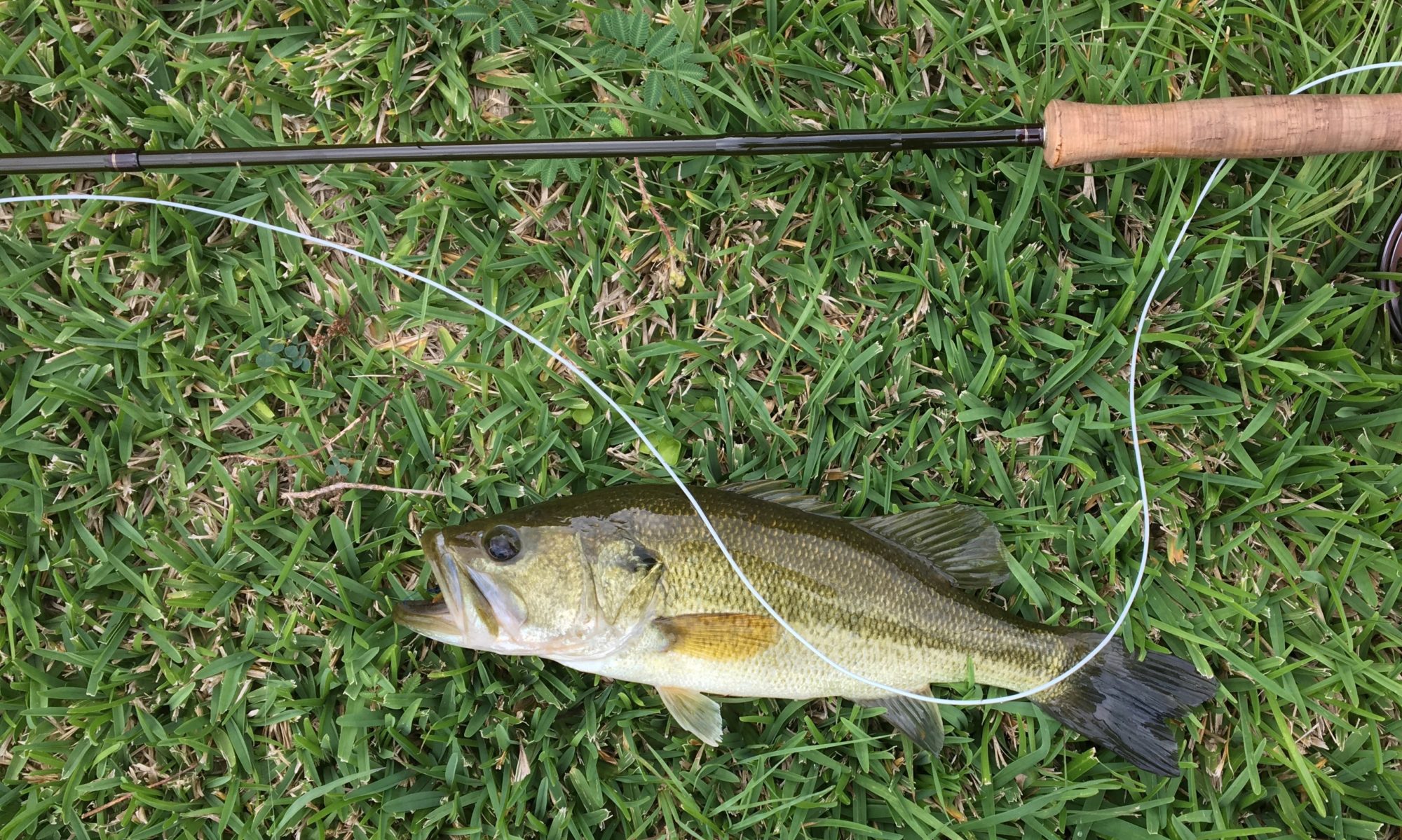
We went Sunday to Damon’s Seven Lakes to catch post spawn bass, and I caught three of these on my new five weight rod. The rod is a Winston Pure, and Trout Unlimited sent it to me because I am kind, handsome, and amusing. It was very good of them. I also saw, cast to, and caught a six or seven or eight pound catfish, which for various reasons neither Kris nor I got a picture of, mostly because she thought I was taking the picture and I thought she was taking the picture. Anyway I caught a trophy catfish and three good largemouths on a rod that, if you look carefully at the picture, is inscribed “Trout Unlimited.” It’s not inscribed “Bass Unlimited,” and certainly not “Channel Cat Unlimited,” but “Trout Unlimited.” It’s not just any trout rod either: according to R.L. Winston it’s Pure. That must mean it’s probably too pure for bass, and certainly too pure for a big channel cat. I hope Trout Unlimited and R.L. Winston don’t find out. They might take the rod back because I abused it, and it really is sweet.

Since I didn’t get a picture of the catfish, I took a picture of a half-eaten plate of cheese enchiladas from Ninfa’s on Navigation to show you. They were delicious, and you’ll have to let that serve in the catfish’s stead. In a Texas sort of way it seems an appropriate trade. Probably because of that fish I had the catfish at Brennan’s of Houston on both Monday and Tuesday, but it’s just not my week to take pictures of catfish, live or fried. The Brennan’s catfish was good though, and the Damon’s catfish was magnificent. Just don’t tell the folk at Winston.

*Actually the name of the book was The Cajuns: Americanization of a People, but the shorter title works better in the paragraph.

New York, Vermont, New Hampshire

At the end of June we go to the Bronx to see the Astros play the Yankees, then we drive north to the Catskills, the home of the Hudson River School, stand-up Jewish comedy, and American dry fly fishing. We’re staying in Sullivan County on the upper Beaverkill. Our inn, the Beaverkill Valley Inn, has a mile of riverside. This is important, because under New York riparian law landowners can post the river, and almost all of the upper Beaverkill is posted. The lower Beaverkill, past Roscoe, is largely open, as are other Catskill rivers, but hopefully we’ll see less of a crowd. Or not.

Google Maps

We’re matriculating for a weekend at the Wulff School of Fly Fishing near Livingston Manor. My reasons for going are confused, it’s the basic trout fishing curriculum, and I like classes, but it may be for beginners, which I am but am not. I’ll learn something. We’ll also fish a day with Pennsylvania casting champion Craig Buckbee, who instructs at the school. I hope it’s legal for him to cast in New York.

After we graduate we drive from Livingston Manor to Manchester, Vermont. There are lots of Manchesters. There’s Manchester, England; Manchester, New Hampshire; California, Connecticut, Georgia, Illinois, Indiana, Iowa, Kansas, Kentucky, Maine, and on and on . . . you get the idea. The big ones, England and New Hampshire, are industrial towns known historically for their grittiness. Now they’re gentrifying. Manchester, Vermont, on the other hand, isn’t known for its grittiness. It’s known for Orvis, which has more of the genteel than the gritty.

Google Maps

We’re staying at the Orvis-endorsed Equinox Resort. As we were settling dates I made a reservation then called to move things around. The reservation clerk at the hotel, we’ll call him Jacques, told me in Québécois French-accented English that I couldn’t move my dates. He told me that my dates were fixed and I would never be allowed to move them, ever, and that my only chance to move them was to call corporate, which is now Marriott, who would not under any circumstance move my dates without charging substantial penalties and inflicting corporal punishment.

I called corporate, stunned and humble, and told them that I was pretty sure that when I made the reservation I had left the dates flexible. They told me I was right, and they didn’t know what Jacques was talking about. They moved the dates around and gave me a better rate. They were nice. They were great. It was great. Everything is great except Jacques, with whom I am still annoyed. I wondered if he was demonstrating New England taciturnity or Gallic bellicosity: whichever or both he was good at it.

new file
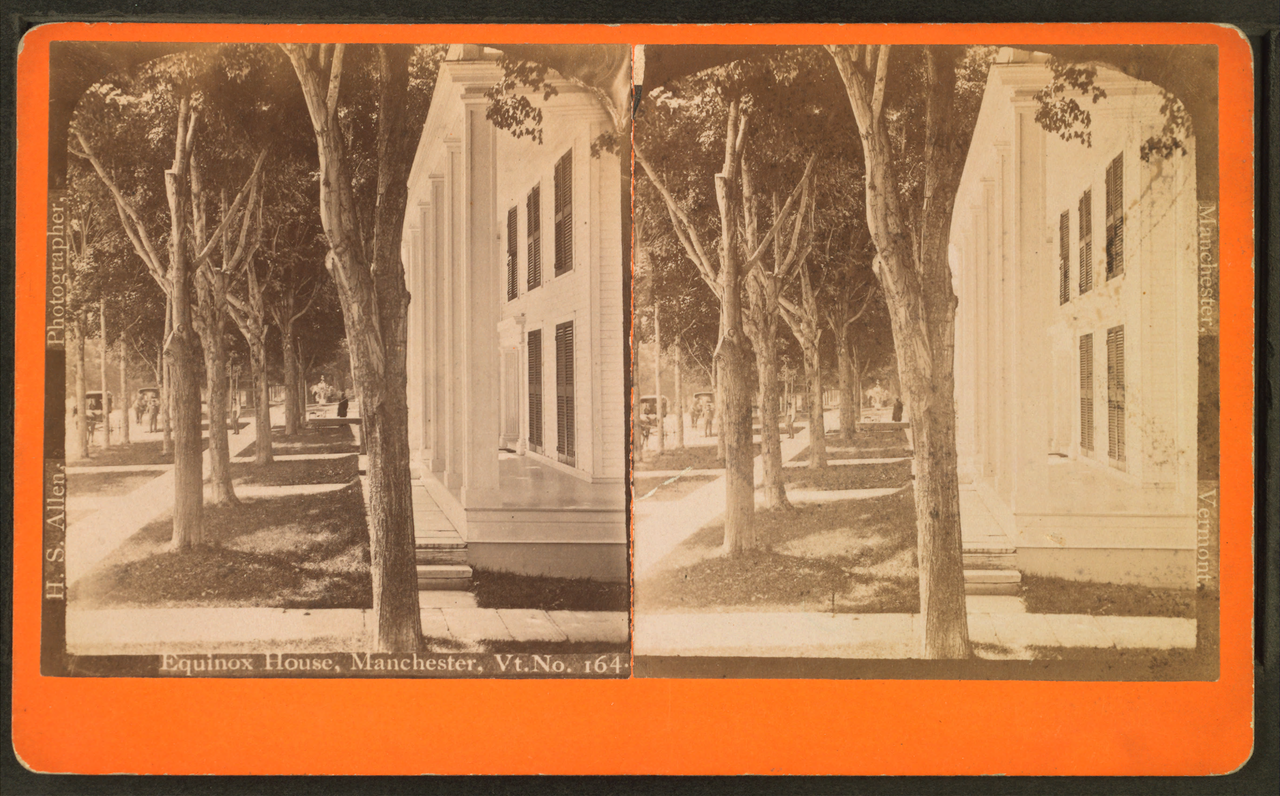
Henry S. Allen, Equinox House, Manchester, Vermont, c. 1880, New York Public Library.

Apparently at the end of the Civil War, over the summer of 1863, Mary Todd Lincoln and their sons stayed at the Equinox to get out of the heat of Washington and away from the War. The family planned to return in the summer of 1865, this time with the President. They never did. Lincoln was assassinated in April 1865, almost immediately after Appomattox.

I have read that the Equinox has Manchester’s best donuts. Manchester also has the Orvis flagship store, and the American Museum of Fly Fishing.

Google Maps

From southern Vermont we drive north to the Canadian border to Pittsburgh, New Hampshire, to the Lopstick Inn on the headwaters of the Connecticut River. Everybody probably knows this but me, but the Connecticut River separates New Hampshire and Vermont, and otherwise New Hampshire and Vermont would be the same thing, which they pretty much are anyway. We have to return south again, to our second Manchester, New Hampshire this time, but that’s in the Boston orbit and we’re only going there to spend one night before we fly back to Houston.

I’ve been to New York plenty, but I have never been to New Hampshire or Vermont. I have a vague notion that this is classic fly-fishing territory, and I’ve already learned something important: I’ve learned that looking north Vermont is on the left and New Hampshire on the right. I’ll be a New Englander yet.