Arkansas packing list, part 2

What we didn’t see

Even before this trip, I’ve seen a lot of Arkansas. I’ve visited the Clinton Library, and the vaccine microchip hadn’t yet told me to. I went to Fayetteville as a teenager and as an adult I’ve seen the Arkansas Delta and Washington and Hot Springs. In January we went to the new museum in Bentonville, Crystal Bridges. My parents took us camping for a week at the Albert Pike Campground, to me a magical place with sparkling clear water where we swam in the heat of the day in the river, and that in 2010 was washed away by flood waters. Sixteen campers were killed. It’s never re-opened.

I have seen the Buffalo River, the first designated National Wild and Scenic River, but only from a car from a bridge. I’ve intended to canoe the Buffalo for 30 years. I still haven’t. I should have gone there to catch my fish. I didn’t. I guess I still need to go back to Arkansas.

US Forest Service, Buffalo River

Where We Went

Other than fishing, we stopped at the Dulcimer Shoppe in Mountain View Arkansas (“Folk Music Capital of the World”). I bought a jar of wild elderberry jelly, since that seemed suitably folksy, but Kris wanted a dulcimer. Did you know that in addition to your index and middle fingers, you use your thumb to fret a dulcimer? I didn’t, so I both learned something and got us out of the shop without a dulcimer. Success! It was a nice shop, and Kris really was sold on dulcimers. The jelly is good too, whatever elderberries may be.

This trip we went out of our way to see Little Rock Central High School. Everyone knows the photo of Elizabeth Eckford walking into Central High: the dignity and vulnerability of Miss Eckford, the rage of the white students . . . In person what’s striking about Central is its size, it’s big, and also its neighborhood. In 1957 when Eisenhower enforced integration there were three high schools in Little Rock . One of the schools, Horace Mann, was black, two others, Central and Hall, were white. One of the white schools, Hall, was generally affluent, which is why integration was slated for working-class Central.

The Central neighborhood hasn’t improved since the 50s. It’s still the same small houses, now 70 years longer in the tooth. It has slipped below working class, or maybe the working class has slipped below what it had achieved in the 50s. The school itself is handsome. Its neighborhood is rough.

Derek Chauvin’s trial for George Floyd’s murder started this week, so racially charged photographs are in the forefront, but there was another Arkansas event this week that brought Miss Eckford to mind. The Arkansas Legislature overrode a gubernatorial veto of a bill forbidding transgender youth from receiving therapy, puberty blockers and hormones, that would aid transition. Many won’t notice the legislation, but it is, well, central, and certainly central to the transgender youth and their families. The proponents’ reasoning is that minors are too young to make gender decisions, and the opponents’ reasoning is that those decisions are best left to the youth, their parents, and their doctors, not the state legislature. I don’t know why anybody would be dubious about the decisions of a state legislature. The Arkansas legislature must be at least as qualified as the Texas.

Playlist

I liked the music we listened to driving around Arkansas. We listened to a lot of Lucinda Williams because, while she was born in St. Charles, she attended the University of Arkansas. I first heard her name on Houston’s nonprofit Pacifica radio station, when the DJ said she had a crush on Lucinda Williams. I’ve listened a lot to Ms. Williams since. I always thought that if I could choose someone famous to sit by on an airplane–this is my personal version of who you’d like at your dinner party–Lucinda Williams would be high on the list. I finally saw her on stage a dozen years ago, and she appeared to be just what I should have thought: a little tough, a little road-weary, a little wild. I don’t share that DJ’s crush, but I would like to talk to Ms. Williams for an hour.

Is there a better road song (or a better song about living in the country) than Car Wheels on a Gravel Road?

Currier & Ives, The Fall of Richmond, Va., on the Night of April 2, 1865, lithograph, Library of Congress.

Levon Helm was from Arkansas. That lets in all sorts of great music, including the troubling The Night They Drove Old Dixie Down, which is a song I like in part because it is troubling. It is arguably about white loss with no connection to slavery, and is often heard as a South’s arising anthem. Ta-Nehisi Coates apparently wrote of the song that it was another song of the “blues of Pharaoh,” but it’s hard for me to equate Virgil Kane with Pharaoh, and it seems one of the points of the song that Pharaoh is Pharaoh and everybody else isn’t. Kane, the narrator, doesn’t mourn Dixie’s defeat, Kane suffers it; hunger, poverty, the death of a brother, and there’s no pride, no blame, only desperate endurance. As the lyrics say, you can’t raise a Kane back up when he’s in defeat. As difficult to interpret as it may be, it remains one of the great antiwar songs, and Kane could have been black or white–it wouldn’t change the song’s bleak message. Whatever happens to Pharaoh he’s still Pharaoh. The rest of us are going to be Virgil Kane.

There’s a common misinterpretation of the lyrics that explains some of the ambivalence of the song. There’s a line where Virgil’s wife calls to him: “Virgil, quick, come see,/There goes Robert E. Lee . . . “, the general. At least that’s the way the lyrics are as often as not misinterpreted. The lyrics are “the Robert E. Lee . . . “, the steamboat, which is apparently clear in the live version but a bit muddled in the original. I like the steamboat better, both as a matter of history–Robert E. Lee was never in Tennessee and the steamboat was on the Mississippi –and because the steamboat had its own fame and tragedy. It’s the sort of steamboat on which Pharaoh would ply the Nile, while Virgil Kane watched from the shoreline.

August Norieri, The Robert E. Lee, oil, 1884

In addition to The Band and Lucinda Williams, there’s also Al Green, Johnnie Cash, Lefty Frizzell, Roy Buchanan, Iris Dement, Conway Twitty, and blues musicians from the Delta: Robert Lockwood, Jimmy Witherspoon, Son Seals. If you ignore Black Oak Arkansas, Arkansas has a pretty good lineup.

Glen Campbell is also from Arkansas, which justifies Galveston and Wichita Lineman, but not Rhinestone Cowboy. Nothing justifies Rhinestone Cowboy.

Guitar

I took the old Kohno. Four years ago when we last fished in Arkansas, I sat on a balcony above the Little Red and tried to play Duarte’s transcription of Pavane pour une infante défunte. The lady on the next cabin balcony asked what I was playing–which either meant I was playing the piece well enough to be nearly recognizable or I played it badly enough that it was unrecognizable. I like to think that the name of the song–Pavane for a Dead Princess in English (though a more literal translation would be Dance that a long-dead princess might have danced)–was on the tip of her tongue, and she just couldn’t quite think of it.

This year I was still trying to play Pavane pour une infante défunte, so for me Ravel will always have a weird connection to Arkansas. I don’t know that Ravel ever went there, and I still can’t play the Pavane. I’m pretty sure there were no steamboats named The Maurice Ravel.

Arkansas Packing List, Part I

Vaccines

We had ’em, two of ’em each, plus the 10 days’ grace period. No side effects, though I’m certain that Hillary Clinton is telling me it’s time for another trip to Arkansas.

Besides mind control (of which I’m all in favor–not having to make decisions seems like a real boon), my friend Limey tells me that the CDC has determined that with rare exceptions the Pfizer and Moderna vaccines prevent virus infections, and don’t just lessen the symptoms. I need to check to see where Limey got his information, but part of me wants not to check and believe what’s most favorable to my world-view. I guess I’m having a fake news moment.

Apparently everybody in Arkansas and East Texas has already had the vaccine, because there wasn’t much social distancing or mask wearing. In a gas station, the cashier pulled down her mask so that I could hear her answer my question. I’m pretty sure I’d have heard her anyway, but I guess she figured I needed to read her lips. In a cafe, another cashier told the couple waiting for a table at the register that I was brave so they didn’t need to move. I told her I wasn’t brave at all. Actually, I think I’m brave enough, but I’m not stupid. I am both a baseball fan and a fisherman, so my outlook starts from superstitious, and as a lawyer I’m always belt and suspenders. Why test fate?

We wouldn’t have gone into restaurants without the vaccine, which leads me to

Where We Ate

It’s just as well that fine dining is a consideration but not a requirement, because there isn’t a lot of fine dining in Arkansas. There is some, in Bentonville and Little Rock, but Arkansas doesn’t really rival Paris, France. On the whole it’s a cheap-food-and-lots-of-it kind of cuisine. There’s nothing wrong with that, but as often as not it’s not something one wants to remember.

Kris and I both like to cook, and even before the pandemic we cooked at home most days. Restaurants are rare, so maybe I think more about them than I should. What good things make me remember a restaurant? I can remember some places vividly, a fish place in the Keys where the fish was great and the couples next to us argued about Donald Trump, a dinner at Three Brothers Serbian in Milwaukee with our friends Tom and Sal, a weekend of ethnic eating in Chicago suggested by Tom, a Basque place in Reno (again suggested by Tom) where we sat at a communal table. . . As often as not I remember places because they are great food, sure, but I think as much because they tell me something about the place. I hated Voodoo Donuts in Portland, bad service, bad food, too many gimmicks, but it did tell me something about Portland. That’s not, though, memory created by good things.

On our January pre-Arkansas fishing excursion, we ate at the Hive in Bentonville. The Hive is generic American imaginative–the kind of place you can now find in almost any urban area From Sea to Shining Sea, with pretty similar menus. It was just fine, had a good wine list, and could have been anywhere, from the Wine Country to Connecticut.

So for this Arkansas trip I tried to figure out where Arkansans thought was essential Arkansas eating. A lot of the places were further west than us, a lot involved fried catfish (which I like), and none were in Heber Springs where we stayed. We had been to Heber Springs before, and pretty much knew what was there. I wouldn’t let the food keep me away from Heber Springs, but I wouldn’t go back for it.

On the way to Heber Springs, we drove out of our way to the Bulldog Restaurant in Bald Knob, because (1) who doesn’t want to visit Bald Knob, and (2) they were supposed to have excellent strawberry shortcake. It has excellent strawberry shortcake because Central Arkansas is, apparently, a strawberry-growing region, and there were no strawberries yet, so no strawberry shortcake. We had a good burger and fries, thought it looked like the people at the next table ordered smarter than us. They always do.

On the way home, we ate breakfast at Cheryl’s Diner in Cabot for their chocolate gravy. Apparently chocolate gravy on biscuits is a breakfast thing in Arkansas. If you can imagine a slightly creamier version of chocolate pudding slathered onto a biscuit, you have chocolate biscuits. I like biscuits. I like cream gravy. I have now had chocolate gravy on biscuits. It was certainly memorable. I would go back for Cheryl’s cream gravy on biscuits.

We skipped a last meal in Arkansas and made it to Jefferson, Texas, to Riverport Barbecue, which is on the Texas Monthly top-50 list. It was 3 in the afternoon, and they were out of just about everything. Except for me and one teenager, no one wore a mask. That teenager was a rebel, and so was I.

We did eat at a great place in Shreveport, Strawn’s Eat Shop, recommended by my high school classmate Cindy (who lives in Shreveport). Great strawberry and coconut icebox pie, and chicken fried steak as part of it’s meat and three lunch special. Larry McMurtry once wrote that only a rank degenerate would drive across Texas without eating a chicken fried steak. We weren’t in Texas, but still. Avoiding rank degeneracy should always be a goal, though some degeneracy probably doesn’t hurt. Cindy texted that Strawn’s would be a good place for a reality TV show: The Waitresses of Strawn’s Eat Shop. Thanks Cindy. You’re right, both about the waitresses and Strawn’s Eat Shop.

The Drive

What’s it like driving up I-40 through Arkansas? It’s like this:

Gear

We took trout stuff; a 9-foot 6 weight for streamers, a 10-foot 4 weight and a 10-foot 3 weight, and a couple of 9-foot 5 weights (because you have to have a five-weight when you fish for trout, even if you never use it). All had reels with floating lines. We fished them all except my Winston 5 weight.

There is a story with the 4 weight, a Thomas & Thomas Avantt that four years ago I’d bought on sale. This year Kris gave me a Thomas & Thomas 10-foot 3 weight for my birthday. 

Here’s the thing about all that weight stuff: with fly fishing, it’s usually the weight of the line that lets you cast the fly, so you match a 3 weight rod to a 3 weight line. You can overline, you can match a 3 weight rod with a 4 weight line, or underline–I’ll let you figure that out yourself–but all of that is nerdy fiddling. Weights and lines are pretty much standardized (if a bit esoteric).

Anyway, I thought I’d taken the new 3 weight, but had accidentally taken the 4 weight. Do I need both these rods that do pretty much the same thing? What a silly question, of course I do. The thing was, I thought I’d taken the 3 weight until I got home. I put a 3 weight line on the 4 weight, and never noticed anything wrong. We had so much weight on the rigs, both with heavy weighted flies and split shot, and all the casts were so short, it made no difference. Not to me anyway. 

All the weighted flies and split shot were to get the flies down in the river as quick as possible and then keep them there. And also to smack me in the back of the head if I tried to get fancy with my casting.

Flies

I’m a firm believer that if I’m fishing with a guide, I should use the flies that the guide brings to the river. It’s funny though, I always look at what should fish in a place, and usually try to tie a few things to fish there. This time I tied some big streamers, Barr’s meat whistles, and fished them for a bit. I foul hooked–snagged–one rainbow in the gill plate, but nothing else. I decided streamer fishing was a lot of work for low reward and stuck to the guide’s stuff. I’ll use the excuse on the streamers that my shoulder’s been hurting.

Drew started us out with mop flies (and I could go into a long digression on mop flies, but won’t), but then switched me to a marabou jig fly, and that worked better. He really liked the jig flies, and bought them pre-tied from Little Rock. He claimed that you could catch anything with a jig fly, and frankly I thought they looked like the perfect fly for crappie and white bass.

Thirty years ago in Arkansas, scud flies were all the rage. Scud flies are an underwater fly that is supposed to look like a shrimp-related crustacean called, of all things, a scud. I don’t think it has anything to do with the missile. Think roly-polies, doodle bugs, but in water. I have never been able to imagine the fly, though from time to time I’ve tried to tie them. Drew said that a study from ASU (translation, Arkansas State University) had determined that scuds were Arkansas trouts’ primary food, and that Arkansans still heavily fished scud flies because Arkansas trout still ate them. He put one on a dropper on Kris’s rig. I thought Oh boy, I’ll see a scud fly, and then I forgot to take a look. I guess I was busy watching my orange bobber.

The second day we fished shallower, and Drew had us fish hare’s ear nymphs, which are about as traditional a fly as nymphs can be. His flies were sparse, and tied on tiny jig hooks. 

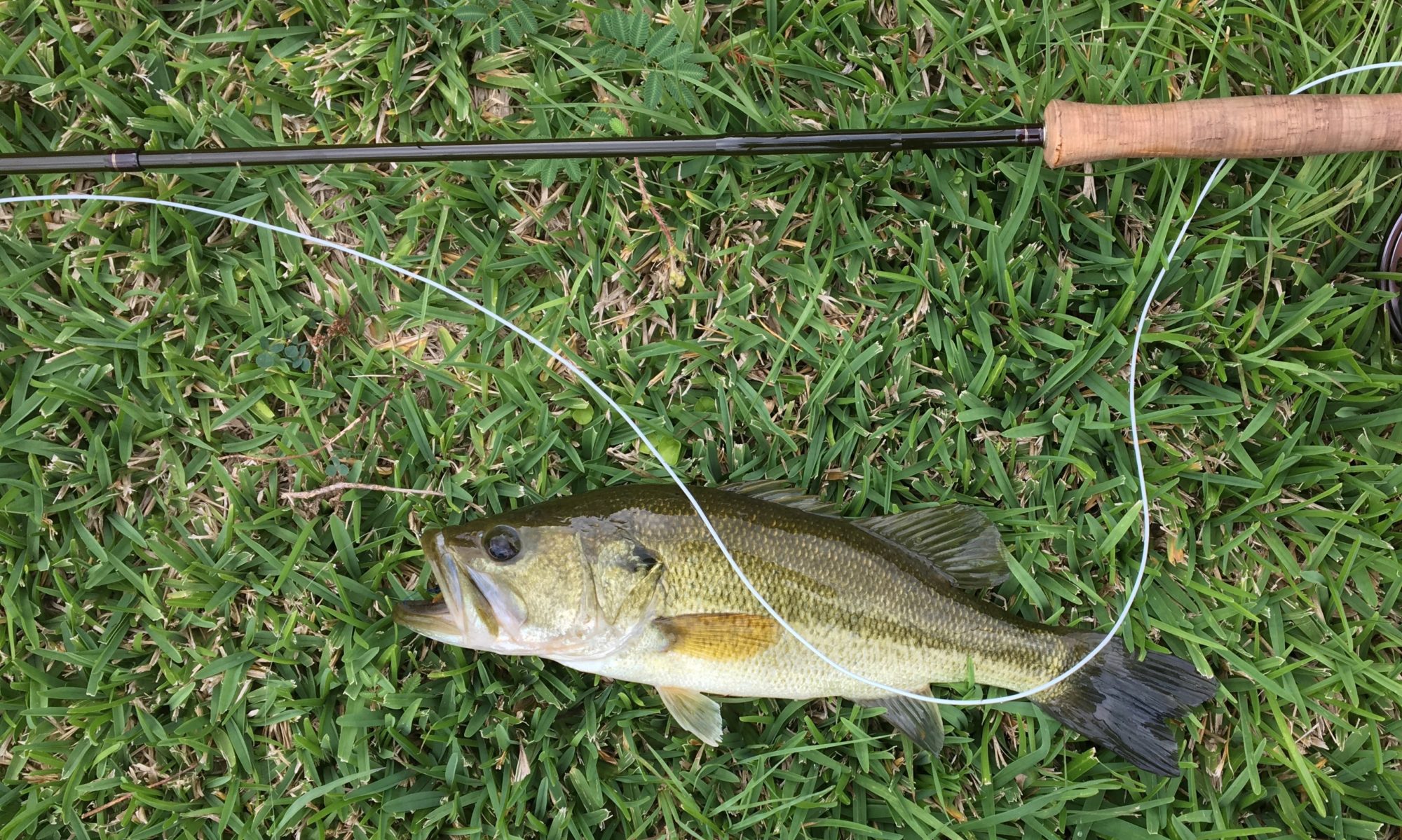
When we came back I tied more Barr’s meat whistles–I wanted to go ahead and use up my cache of streamer jig hooks, and yesterday I fished a purple one at Damon’s. I caught my largest bass in a while, and I watched it crash across a sandy flat to hit the fly. The meat whistle’s usually thought of as a trout streamer, but as often as not, fish are fish. Next time I’ll try a marabou jig fly.

Terrible picture, I know. But it was a big fish, and I wanted to keep it in the water. The purple smudge in the vicinity of its mouth is a purple Barr’s meat whistle.

Little Red and Norfork Rivers, Arkansas, March 18-19, 2021

We planned to fish Arkansas last April, but then coronavirus. We delayed. We delayed some more. We finally delayed a year, less a couple of weeks.

We should have gone last April. People now are maskless and uninhibited, and we might have been safer traveling during the first days of the pandemic. At least more people were worried then. Traveling this week through East Texas, Louisiana, and Arkansas, people are done with being careful. Some of it I suspect is mulish stubbornness–contrariness (can you imagine an East Texan or Arkansan being contrary?); I don’t need no stinkin’ seat belt and you don’t need one either. Some of it is exhaustion and the strong gravity of normalcy. There weren’t a lot of masks, and no particular effort to distance. Restaurants were packed. My guess is that we’re in a close race between vaccinations and another upsurge. 

At least it’s spring. Ok, technically today when I’m writing is the first day of spring, and we fished the last days of winter, but this is the South. The dogwoods and redbuds are blooming and beautiful. It was cold though. We caught an unseasonable cold front and it was 36° when we left Heber Springs. It was as cold or colder the two days we fished. I wore long underwear, ear flaps, and wind gear because not only was it cold, it was blowing. And blowing. Don’t forget the blowing.

It never rained. That’s a good thing, and the second afternoon it warmed up and the sun shone. Shined? Was shining.

We fished with Rouse Fly Fishing. I finally re-booked because Jamie Rouse was a February guest on Tom Rosenbauer’s Orvis podcast, which always inspires me. There are three year-round trout rivers in Arkansas: the White, the Little Red, and the Norfork. The trout are all below dams built for power generation and flood control. The White is the longest of the three, with its headwaters in the Boston Mountains in Northwest Arkansas. It flows first perversely north into Missouri, then turns southeast again to cross the state and meet the Mississippi near Rosedale. Rosedale, as you may know, is where you sell your soul to the devil to play the blues. I don’t know whether the White is interested in the blues, but at 720 miles, it moves a lot of water.

Rouse’s guides guide in all three rivers, though truth be told it’s 100 winding miles from Heber Springs to the main fishing on the White. For the White they may not be the most efficient guide choice. It’s ok though, fly fishing is popular in northwest Arkansas, and if you really want to fish the White, Rouse will guide there, and if not you can’t throw a rock in towns like Cotter without hitting a fishing guide. Every hamlet and holler seems to have its fly shop.

Both the Little Red and Norfork are tributaries to the White. Of course none of these rivers were originally cold water rivers, none of them originally held trout. Arkansas is in the southern native range for smallmouth bass, so before the dams they presumably held some combination of smallmouth and largemouth bass, catfish, sunfish, and plenty of other stuff: the Ozark Plateau is one of the richest areas in these United States for different documented fish species. Seventy-four different species of fish have been identified in the nearby Buffalo River.

With the steady cold water releases from the dams, the species list in the three rivers below the dams narrows until only two are ever talked about, rainbow trout and brown trout. The Little Red is an eight hour drive from Houston, even closer to Dallas and Memphis and Oklahoma City. While there are other trout streams that are closer, the three rivers are a draw for trout anglers, and they hold a lot of catchable trout. Stocked fish mostly, and the rivers are not really wadable (though I’ve read that it is possible to wade near the Norfork dam). Still, they have produced world-record brown trout, and there is reproduction of wild fish. All of the brown trout in the Little Red are wild. In any event, when your home fisheries in Texas and Kansas and West Tennessee don’t include a lot of trout, the three Arkansas rivers are a draw.

Our guide was Drew Wilson. I don’t think Kris and I are particularly hard clients to guide. We didn’t hook Drew, not hard anyway. We didn’t break anything on his boat or any of his equipment. We didn’t even get tangled more than the national average.

The first day with Drew we fished the Little Red. Kris and I had fished the Little Red once before, four years ago in summer, and it was a different fishery then. I guess every river every day is a different river. In a river where, depending on dam releases, it can rise or fall nine feet in a day, that seems especially true. When we fished with Rouse four years ago flow was low, and I threw mostly streamers, big Barr’s meat whistles and smaller clousers. I caught some big fish, and some browns. Like I said, brown trout in the Little Red are always wild.

This trip the river ran deeper, and on the Little Red we fished marabou jig flies with plenty of weight, eight feet deep on a straight six pound leader below a two foot stiff butt section and a big Thingamabobber indicator–a bobber. It’s funny. Fly anglers are language squeamish. Kris drives me crazy when she calls her fly rod a pole, and I suspect she does it on purpose. Flies are flies, not lures. But with bobbers anglers don’t let their squeamishness get in the way of the truth. We take joy in calling those big round indicators bobbers. What did we see in Arkansas? We saw a big orange bobber floating down a river.

Usually when Kris and I fish with guides, we talk with the guide about everything; children, significant others, schools and jobs and where each of us came from and where we think we’re going. With Drew there wasn’t much of that. I doubt if Drew knows that we’re both lawyers, or have children, and we don’t know whether Drew finished college or whether he has a significant other. Kris never once talked about politics (which may be a sign that at least for Kris the election is finally over). We talked about fish, about rivers, about rigging and flies and boats and rods. The conversations were easy and amusing and we liked Drew immensely. As a guide he was attentive and capable, knowing and unflappable. As a companion for two days he was fun. He even mentioned books he liked, though all of them were about fishing.

And we talked about our dogs. You can’t not talk about dogs. And we caught a lot of fish.

Northwest Arkansas is also popular with gear fishers, and the second day on the Norfork there was a spin fish armada. Out of maybe 15 boats, we were the only fly anglers I saw. The Norfork below the dam is a short river, about five and a half miles long, and because of lower flows we only got within a mile or so of the dam. By day’s end we’d been pushed even further down river, and boats were stacked at the confluence with the White. We were motoring up and floating down the same mile over and over. We started the morning with the deep-water rigs we had used on the Little Red, but ended with a tiny foam tab indicator five or six feet over, of all things, a hare’s ear nymph. It almost felt wrong using such a traditional fly, and a single fly to boot. Where’s my mop fly! Where’s my squirmy worm! Don’t you want me to catch fish?

We caught a lot of fish.

Maybe it was because of the sunshine and the afternoon’s warmer weather, maybe it was the novelty of the river or the pleasure of the lighter rigging, or maybe I just finally caught the rhythm of the fishing, but notwithstanding the crowds I enjoyed fishing the Norfork more than the Little Red. We didn’t catch more fish on the Norfork, but we caught a lot of fish.

Two fairly technical notes. First, Arkansas river boats are unique. On the three rivers gear fishers and fly fishers fish from more or less the same boats, with fly guides likely to have added oar locks and oars. They’re long, fairly narrow, shallow draft rectangles, Jon boats, built from aluminum or fiberglass. Motors are relatively small, Drew’s boat had a 40 HP, and guides favor jet motors instead of props. With their flat bottoms they’re probably more like rowing rubber rafts than the classic high-rockered drift boat, but they’re comfortable to fish from and well designed for Arkansas.

Second, the first day I fished a 10′ 4 wt Thomas & Thomas Avantt rod that I’d bought a few years ago. Nine foot is kind of the standard for fly rods, but there’s a theoretical advantage to a longer rod because they can cast farther. There’s a theoretical disadvantage in loss of accuracy, but none of the theory mattered anyway. None of our casts were much more than 20 feet.

Kris fished a 9′ 5 wt on the Little Red, but the second day she fished a 10’6″ Orvis Helios 3 wt that she’d bought herself for my birthday. It maybe the longest single-handed rod on the market. I don’t know about the other theoretical advantages of the longer rods, but they shine at managing line on the water. Most of the work fishing rivers isn’t casting or playing fish, it’s the constant adjustments to the line to achieve a drag-free drift. It is the hardest work of the day, and that extra foot, or in Kris’s case that extra foot-and-a-half, is a noticeable advantage.

Interestingly, I liked the Thomas & Thomas better than the Orvis, but I suspect it was because we had a much lighter reel on the T&T, and because I’d fished it for a day before before I tried the Orvis. Plus it was Blue. Color matters.

On our last drift of the day, down through the spin-fish armada and into the White, the fish got hot. We landed fish after fish, and when we landed a double the gear fishers in the next boat applauded. When we reached the White (at least I’m saying we were in the White–that way I can claim a fish in all three rivers), I landed my final fish of the day, and the only brown of the trip. Drew offered to take us on another drift, but why would we? How could things get better?

Norwood and Bill

I read some books to get ready for fishing in Arkansas. Two stood out, Norwood by Charles Portis and My Life by Bill Clinton. I was going to read something by Dave Whitlock, but then I found out that Dave Whitlock isn’t from Arkansas. He should be from Arkansas, he’s the best known fly fisher from that part of the world, but he’s from Oklahoma, and still lives in the Oklahoma Ozarks. It’s an easy mistake to make; Eastern Oklahoma is pretty much Western Arkansas, but there’s a line and I will not cross it. Plus that’ll make this post a bit shorter.

I can’t find any indication that the other two writers, Portis (author of True Grit) and Clinton (author of My Life), didn’t fish, or at least didn’t fish enough to write about it. Clinton was also the 42nd President of the United States, and the last President before the last President to be impeached by the House of Representatives. I don’t think he fly fished, and he wasn’t impeached for lying about fishing.

From Pinterest, Oyster bamboo fly rod built for Jimmie Carter, with presidential seal.

The Bushes fished, and Jimmie Carter famously fished and had a couple of exquisite cane rods built for him by Bill Oyster. Herbert Hoover wrote a book about fly fishing, in which he remarked that “Presidents have only two moments of personal seclusion. One is prayer; the other is fishing — and they cannot pray all the time!” He also said that fishing teaches an important lesson to Presidents, that the forces of nature discriminate for no man. President Trump played golf, and taught us that the rules of golf were more bendable than the forces of nature, but he did tell some extraordinary fish stories, only not about fishing.

President Obama fly fished and seemed to enjoy it. He certainly made an elegant presentation on the river. That’s one well-dressed fly fisherman.

White House Archives, Barrack Obama and Dan Vermillion, East Gallatin River, Montana, August 14, 2009.

Portis died in 2020, in Little Rock, so there’s another thing to blame on 2020. Portis is one of those authors who everyone is supposed to read, but who no one much ever actually reads. I’ve written before about my near-lifelong fixation with True Grit, and if you want to read Portis without cracking a book, just watch the Coen Brothers film version. The dialogue and narration seems almost word for word from the book.

Besides True Grit, Portis wrote four other novels for no one to read: Norwood (1966), Dogs of the South (1979), Masters of Atlantis (1985), and Gringoes (1991). Except for True Grit, his novels were all out of print for a time. I’ve read Norwood and Dogs of the South, which lets me feel superior to those who haven’t read Norwood or Dogs of the South, but inferior to those who have also read Masters of Atlantis and Gringoes. I’m sure they’re excellent, and maybe one day.

Portis was not a recluse, though he has that reputation. He was apparently a regular in Little Rock beer joints and approachable for strangers, and at the climax of True South Paul Theroux finds Portis in a Little Rock bar–at least that’s how I remember it. Still, Portis wasn’t much shakes as a self-promoter, and while he began his novel-writing in a fishing cabin, and apparently had his own avocations (notably cars), there are no reports of Portis fishing. He may have fished all the time, but unlike yours truly he didn’t feel the need to tell people about it.

As for cars, all of the three Portis novels I’ve read were odysseys, road novels (even if True Grit exchanges a Buick for the Mattie’s horse, Little Blackie). The hero sets out and then returns home changed, except none of Portis’s heroes changes much. Part of what amuses is their immutability, regardless of what crazy weirdness they create. When she gets back to Yell County, Mattie Ross is still a Presbyterian avenging angel and tax accountant, though she is less one arm, and though she has developed familial loyalty for an old man who rode with Quantrill.

Norwood is a road novel too. Norwood goes to New York to collect $70 and to deliver a prostitute, who he doesn’t know is a prostitute, and some stolen cars, which he doesn’t know are stolen cars. When he returns he is still Norwood. Technically Norwood is from Texas, not Arkansas, but it’s just-across-the-border East Texas. Except for his Korean stint in the Marines, and an interlude working for the New York Herald-Tribunein New York and London, Portis lived in Arkansas. He always wrote about Arkansas, and leaving Arkansas, and coming back to Arkansas, even if it’s the Arkansas part of Texas. As the narrator says in Dogs of the South, “A lot of people leave Arkansas and most of them come back sooner or later. They can’t quite achieve escape velocity.”

I doubt that I will ever see the movie version of Norwood, and I have absolutely no clue what role Joe Namath played. With the combination of Namath and Glen Campbell, I suspect that the acting is excruciating.

The character Norwood is honest and marginal, but it is the delight of the novel that notwithstanding all of the bad things that could happen to Norwood–and really bad stuff could happen–nothing ever does. There is a Twainish insistence that things turn out all right, even when a Faulkneresque apocalypse may be more realistic. Norwood finds love on a Greyhound bus, rescues a chicken, and recovers his $70. When I read the novel, Norwood’s final fate made me immensely happy, as does the fate of the chicken. I guess this is a spoiler, but when you get to the end of Norwood and he’s home and the axe hasn’t fallen, it’s ok, it’s more than ok, it’s great. Norwood the character may be hidden away in the Arkansas part of Texas, but he’s authentic and honest, and authentic and honest shines.

The other Arkansas book I read, My Life by Bill Clinton, is also a road novel. Mr. Clinton is born in Hope (not far from El Dorado where Mr. Portis was born), then moves to sin city, Hot Springs (which really was sin city in its heyday), then to Georgetown and Yale (not to be confused with Yell County) and Fayetteville and Little Rock and onward and upward. The book did pretty well when it came out, selling 2.3 million copies, but I suspect that’s because everybody bought it for the sex scenes. There aren’t any, at least in the book. There is a detailed description of political maneuvering at Arkansas Boys’ State. At 1000+ pages, it’s a little long for most folks, but Clinton is a talkative guy talking about two of his favorite subjects, Bill Clinton and politics, and he’s a readable writer, with an eye for detail, then some more detail, then some more detail, then he’ll add in a little detail. He never does tell us what we really want to know. Like I said, there are no sex scenes.

Just like Portis, whenever now that I think of the Clintons, I think of Paul Theroux’s Deep South. Theroux is a bit obsessed with the Clintons. He finds them a basketful of deplorables, but for none of the reasons one might think. Theroux compares parts of the South, particularly the Delta, to Africa’s poorest places, Third World poor, devastatingly poor, irredeemably poor, and he’s right, they are. He was angry that the Clintons–at least one of whom had deep ties to Arkansas and the South–had abandoned Southern poverty after their road trip to Washington. He is angry that the Clintons achieved exit velocity. The Clintons became citizens of the wide world, but no longer citizens of Arkansas, and in Theroux’s mind Arkansas had as much need for them as anyone.

I do suspect that if I were going to cast Joe Namath in a movie, My Life would be a better choice than Norwood.

Official portrait, Bill Clinton, 1993.

On the flip side, notwithstanding conspiracy theories, the Clintons didn’t kill anybody or have anybody killed, and I suspect that much of modern Arkansas, Trump’s Arkansas, would be decidedly hostile if the Clintons lived there. It’s notable that when one Southern President, Jimmie Carter, returned home and became a moral light, his state voted for President Biden. Nobody much argues that Mr. Clinton is a moral light, so maybe that sort of thing only goes so far, and maybe Mr. Carter and the recent Georgia elections are unrelated. It is odd that while Mr. Clinton arguably oversaw our longest period of sustained national economic growth and Mr. Carter’s presidency was an economic failure, it is President Carter who is most admired. It’s not all about the money.

I will say though that the part of My Life about the politics of Arkansas Boy’s State is a dilly.