Hatchery Creek, Kentucky Trout, March 8, 2022

We didn’t fish much in Kentucky. We ate a lot, drove a lot, and we saw a lot of whiskey being made. We bought a lot of whiskey because a gallon of whiskey was cheaper than a gallon of gas, so we filled up the car with whiskey.

Not really. Almost, but not really.

It was cold in Kentucky, and getting colder, and it was wet. This matters because I wanted to fish for smallmouth bass. Smallmouth are native to states west of the Appalachians and east of the Great Plains, and north from Arkansas into Canada. That includes Kentucky. Trout are kind of a mystery to me, bass less so, and I wanted to catch a home-grown Kentucky fish. Native wild fish–as opposed to an introduced wild fish or a stocked fish–are my beau ideal, and trout aren’t native to Kentucky.

In early March there are stocked trout all over Kentucky. In most streams they’ll die out in the heat of the summer. In the Cumberland River below the Wolf Creek Dam trout are stocked year-round. Absent drought, the dam-released water is cold enough for trout, but it’s not really a wading river, and we didn’t have a boat and I hadn’t hired a guide.

Like the other black bass, smallmouth hunker down when it’s cold, and for anything fishing is almost impossible when streams are churned and fast with runoff. When we got to Kentucky, there was water standing in the fields, and the streams we saw from the road were dark grey and ugly. The lady at the gift shop at the Trappist monastery told us there had been five inches of rain in two days. Ladies at Trappist monastery gift shops surely don’t mislead, at least about rain.

I did make a weak effort for smallmouth. We had planned on two days fishing, Tuesday and (if we didn’t catch a fish on Tuesday) Thursday. I’d found two creeks that promised wading for smallmouth, Otter Creek near Louisville and Elkhorn Creek near Lexington. On Tuesday we drove the 30-odd miles to Otter Creek, but I didn’t get to see the creek. The Recreation Area is always closed on Mondays and Tuesdays.

I had a back-up plan, but it involved trout, and a particularly peculiar trout stream.

If you think about Kentucky, it’s shaped a bit like a frying pan lying on its side, with the panhandle on your left. Louisville, where we were staying, is at the very top of the pan on the north. The south along the Tennessee border is buried in sand so it’s flat, and the weird stream, Hatchery Creek, is almost due south from Louisville on the other side of the state. What did we care? There was plenty of whiskey for the gas tank.

Before I tell you about the weird stream, I have to tell you about my new fly rod.

I have all the fly rods that I will ever need, and plenty of extras just in case, but a few weeks ago my friend Mark Marmon texted and asked if I wanted a bamboo fly rod. Mark’s texts sometimes get me into trouble. I have a new used Schaeffer jazz guitar because of a text from Mark, and next year I’m going to Cuba to fish because of a text from Mark. In addition to being an Episcopal priest and fly fishing guide, Mark is a great scavenger. He regularly makes the rounds of the pawn shops and estate sales, he studies Ebay, and people–especially fly fishing people–give stuff to Mark.

Mark said that he had too many bamboo fly rods, and asked if I wanted one. If you don’t fly fish, this takes explanation. From roughly 1870 through 1960, the best fly rods were made by splitting bamboo into six pieces, shaving the pieces into tapered wedges, then gluing together the wedges. There were legendary bamboo fly rod makers like Leonard and Garrison. There were fine company makers like Orvis and Winston and Hardy–Hemingway famously fished with English Hardy rods. There were very good rods, Heddons and Shakespeares, South Bends and Pflueggers, made for sale to the common man at his local hardware store.

There was also junk, but there’s always junk.

In bamboo’s heyday, anglers used silk fly lines and sheep gut leaders. I don’t think they used bone hooks, but maybe. Unlike silk fly lines and sheep gut leaders, bamboo rods are still popular, though not common. They’re organically beautiful in a way that modern graphite rods can’t be. They feel different, slow and soft and heavy, and some people, especially trout anglers, really like how they fish. And they’re collectible. An antique Garrison in great condition might go for $10,000. An antique Heddon in good condition might sell for several hundred dollars. A new bamboo rod–and there are very good rods being made–might cost several thousand dollars.

Mark wasn’t offering a several thousand dollar rod. He was offering a fine hardware-store quality rod, a Heddon Thorobred. I grabbed it, because, after all, one ought to fish a Thorobred in Kentucky. I did buy Mark lunch at Blood Brothers Barbecue. It was a very good lunch, but not as good as the fly rod.

According to the internet, Heddon stopped making bamboo rods in 1956, the year I was born. By the markings on the rod, it was probably made after 1933 but before 1939. I’m no expert, and that’s a pretty wild guess based on an hour or so of internet browsing, but the gift rod is possibly a couple of decades older than me, and is at least as old as me.

It’s really old.

That’s the rod I took with me to Kentucky, a #14 Heddon 9′ split bamboo rod for an HCH line, whatever that is. It’s a lovely thing.

Now I have to tell you about that weird Kentucky stream.

Hatchery Creek where we fished in Kentucky is one mile long, about 20-feet wide, and completely man-made. It’s a stream that before it opened in 2016 never existed in nature. I knew it wouldn’t be blown out because it’s not fed by rain; it’s fed by releases from the Wolf Creek Dam at a constant 25-35 cubic feet per second. Some combination of engineers and fish biologists planned every foot of Hatchery Creek. They planned the bends in the stream, the twisting channels, and the placement and the depth of the big rocks. They hauled in the fallen timber. Not only that, the creek is directly below the Wolf Creek National Hatchery, so there’s a ready supply of stocked trout.

Did I say I wanted wild, native fish? The first 100 feet or so of the stream is a put and take fishery. Anybody can reach it, and short of batteries or dynamite, anybody can fish with whatever they want. Anglers can keep up to five fish. There were people there completing their grocery list, and I suspect they had their five fish after 20 minutes.

Then there’s a fish dam, and below the first 100 feet the fishing is catch and release, artificial lure only. The fish presumably come up from the Cumberland, though maybe there’s some stocking going on to. Here’s the really weird part: if you didn’t know the area below the put-and-take was man-made, you wouldn’t be able to tell. I knew in my head that somebody had placed that streamside log to jut into the stream just so, but it’s still a jutting log, and it’s still a stream. It looks completely natural. Still. It just ain’t natural.

At least that day I was the only person who walked downstream from the put and take fishery. Well, Kris walked down, but she didn’t stay long. She stayed at the put-and-take and talked to people, and watched hatchery trout perform synchronized swimming routines around her fly.

I did do all the things necessary to make my time on the stream as authentic as possible. I lost my flies on a rock in the river and had to re-rig. I got my flies hung in trees, and then got them hung in the creekside brush when I pulled them out of the trees. I had to sit down creekside and work through a mare’s nest of hooks and monofilament. I lost my landing net, then I found my landing net hung in creekside brush where I’d half-climbed to release my snagged line.

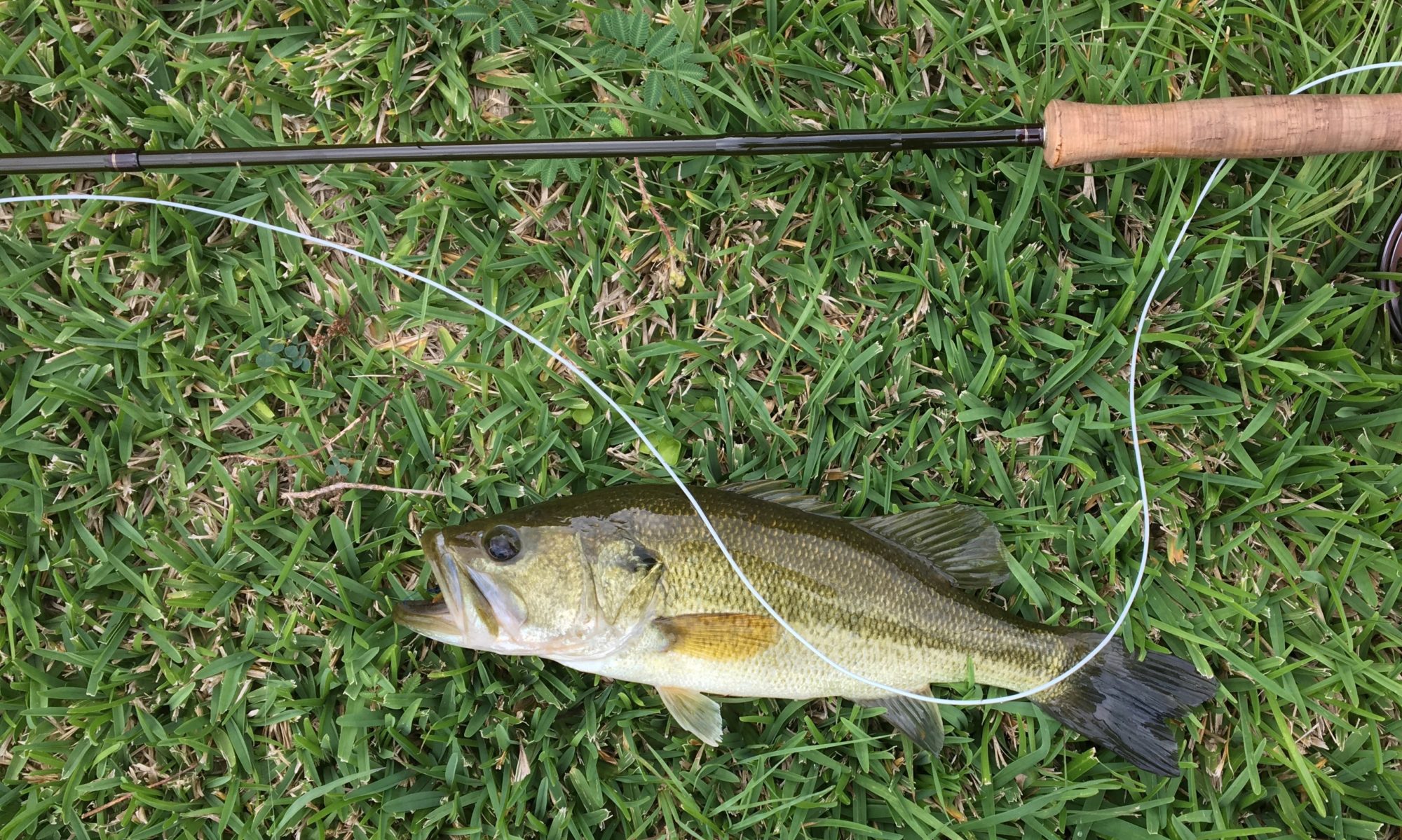
It was a complete fishing experience, and after about an hour I caught an 8″ rainbow and called it a day. That’s when I discovered I’d lost my landing net. At least I caught my stocked rainbow on a non-existent Kentucky stream using an 80-year old rod. The rod was pretty cool.

Kentucky

Kentucky has whiskey and horses, a coal-miner’s daughter, Daniel Boone, and Muhammed Ali. I like whiskey, perhaps too much, and I wish all horses well. The legacy of coal is becoming more and more just that, a legacy. Muhammed Ali was The Greatest. He said so, and I agree.

I’ve never been to Kentucky (or for that matter its northern neighbors, Ohio and Indiana). I’ve been in Missouri across the Mississippi from Kentucky, and often enough to Tennessee, but never Kentucky. This is how Kris and I will look entering Kentucky for the first time, except that I’ll be carrying a fly rod instead of a rifle:

George Caleb Bingham, Daniel Boone Escorting Settlers Through the Cumberland Gap, 1851, oil on canvas, Kemper Art Museum, Washington University, St. Louis.

I hope we can get a horse at the Kentucky border. Otherwise Kris will have to walk.

As of the 2020 census, Kentucky has a population of 4.5 million. The population is 87.5 percent white, 8.5 percent black, and 4 percent everybody else. Less than 5 percent of the population is Hispanic or Latino. The consolidated city-county of Louisville, the state’s largest metro area, has a population of 782,969, with the city itself being 32.8 percent Black and 62.8 percent white. Consolidated Lexington, the second largest area, has a population of 322,570. The urban areas in Kentucky are seeing substantial growth, both economic and by population. The rural areas are generally suffering population losses, and they’re poor. As of 2019, Kentucky ranked among the poorest states, 44th, with a median annual family income of $52,295, just ahead of New Mexico and just behind Oklahoma.

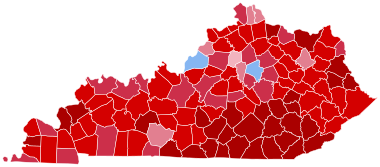
In the 2020 presidential election, Kentucky voted 62 percent (1,326,646) to 36% (772,474) for Donald Trump. That’s pretty consistent with the other poor states, except New Mexico. The only two areas voting for Democrats were the two most populous counties, Fayette (Lexington–59.25% for Biden) and Jefferson (Louisville–59.06% for Biden). The Kentucky senators are Republicans Rand Paul and Mitch McConnell. Five Kentucky Congressmen are Republicans. The sixth, John Yarmuth, is retiring.

Kentucky Presidential Election Results 2020.svg
From Wikipedia

Interestingly, the Governor and Lieutenant Governor of Kentucky are Democrats, though nobody else in Kentucky appears to be. The Governor, Andy Beshear, won the 2019 election by fewer than 5,000 votes, and the election must have seemed a harbinger for the 2020 presidential election. Maybe it was, but not in Kentucky.

On the north, Kentucky is bordered by the Ohio River, on the east the Appalachians, on the west the Mississippi, and the south, well, nothing really. It’s just one of those arbitrary borders that separates two places, in this case Kentucky and Tennessee. The Appalachian/Cumberland Plateau takes up the eastern third of the state. Central Kentucky is apparently rolling hills covered with bluegrass pastures, while the northwest again becomes hilly. There’s some Mississippi River marshland down in the southwest, but not a lot.

There are two coal-producing areas, the Western Coal Field and the Eastern Coal Field. Butcher Holler is in the Eastern Coal Field, somewhere to the right of Lexington.

My daddy worked all night in the Van Lear coal mines
All day long in the fields a-hoein corn

Loretta Lynn, Coal Miner’s Daughter, 1969.

Kentucky coal mining, Kentucky Geological Survey, University of Kentucky

In addition to the Ohio, there are two other major rivers in Kentucky; the Cumberland wanders through Southeast Kentucky and North Central Tennessee, and the Kentucky runs from the Appalachians northwest through central Kentucky to the Ohio. There’s also a bit of the Mississippi. The Green River, the one in John Prine’s Paradise that Mr. Peabody’s coal train hauled away, is in the Western Coal Field.

The Green is supposed to be a pretty good smallmouth river.

For anglers, all of that stuff–except maybe the whiskey and the rivers–is of secondary importance to the real question: what kind of fish are there, and where. Kentucky is not a destination fishing state, at least for fly fishers, but in addition to the big three there are plenty of smaller rivers and streams. There are stocked and naturally reproducing trout, but they’re not native–though a lot of the fly fishing literature on the state is about where to find trout. Most of the guides in the state appear to be located near the Cumberland in Southern Kentucky–a dam tailwater–though there are also some guides out of Lexington. In addition to trout, there are catfish and sunfish, spotted bass, largemouth bass, and smallmouth bass. When we go next week, I hope we can try for smallmouth near Lexington, but it may still be too cold.

I recall that spotted bass used to be called Kentucky bass, but I had a hard time finding references to Kentucky bass on the internet.

Micropterus Dolomieu
Small-Mouth Black Bass
John J. Baird, Small-Mouth Black Bass, 1897, Manual of fish culture based on the methods of United States Commission of Fish and Fisheries, Washington, D.C., Government Printing Office, from the Freshwater and Marine Image Bank, University of Washington.

In addition to Muhammed Ali and Loretta Lynn, Kentucky has had a penchant for producing (or being the home of) poets, especially reasonably important 20th Century poets. There are, in more or less historical order, Robert Penn Warren, Thomas Merton, Wendell Berry, and the recently deceased bell hooks. I can’t say that I’ve read anything by Warren except for All the King’s Men, which I vaguely recall is a novel, but Warren is the only person to have won a Pultizer Prize in both fiction and poetry. I’ve read a good bit of Merton, particularly The Seven Storey Mountain, which I vaguely recall is an autobiography. Reading his poetry–which isn’t always comprehensible–feels almost like reading parts of the Bible–which also isn’t always comprehensible. I’ve read almost none of bell hooks, who honestly until her recent death I hadn’t heard of. Old white Southerner, black feminist writer–I guess I’m not her target audience. I’ve reserved a couple of her books from our local library, but don’t have them yet.

Getting ready to go to Kentucky, I’ve read a good bit of Wendell Berry, who is, I think, peculiarly Southern in his dedication to agrarian values and anti-government convictions, and peculiarly un-Southern in his antiwar convictions. He also doesn’t seem to ever write a funny line, which seems peculiarly un-Southern except among evangelicals. The closest I could come to a funny line was this:

It may be that we can keep without harm some industrial comforts; warm baths in wintertime maybe, maybe painless dentistry.

From Our Deserted Country, Ten Essays.

I say it’s not funny. It’s kinda funny, but I suspect even in that Berry was mostly serious. In his photos he looks happy enough.

Berry in December 2011
Guy Mendes, 2011, Wendell Berry

Besides the poets, I am old enough to have grown up revering Daniel Boone, but probably the folk hero Daniel Boone, not the actual Daniel Boone. The actual Boone never wore a coonskin cap, and no American hero has survived more historical (and ahistorical) revisions than Boone, culminating in the 1964 TV series Daniel Boone, starring Fess Parker.

I loved that show.

The actual Boone was born in 1735 to a Quaker family in Pennsylvania. After his father, Squire Boone, fell out with local Quakers, the Boones moved to North Carolina. Daniel married Rebecca in North Carolina in 1756, but he didn’t much cotton to farming. Even after marriage he spent most of his time on months- and even years- long hunts for pelts for the fur trade. He wandered as far from North Carolina as Florida, and purchased land there. At some point he wandered into Kentucky.

In the popular imagination, Boone opened Kentucky for settlement. He first entered Kentucky in 1767, and in 1769 returned and spent two years exploring. That’s two years out gallivanting. There is a possibly apocryphal tale of Boone returning from a long hunt to find that Rebecca had a new daughter fathered by Boone’s brother. Possibly apocryphal, possibly true. If true, Boone apparently took it in stride.

Defenders In Siege Of Boonesborough H Pyle Harper's Weekly June 1887.jpg
Howard Pyle, 1887, Defenders in Siege of Boonesborough, Harper’s Weekly.

Boone famously trail-blazed the Wilderness Road from Virginia to Tennessee through the Cumberland Gap. Boone entered Kentucky during a peculiarly violent period of American history. Beginning with the Revolutionary War and continuing through the Battle of Fallen Timbers in 1794, there was constant warfare and the threat of warfare with the British and the Northwestern tribes. Boone had the reputation of an Indian fighter, and he was certainly involved in the Northwest Indian War, but late in life Boone said that he had only ever killed three Indians. He was a brilliant pathfinder, a respected leader, a great hunter, but not the rippin’est, roarin’est, fightin’est man the frontier ever knew. He was a colonel in the state militia, at a time when because of the constant threat of local war the rank meant something.

My favorite Boone quote was that he was never lost, but that he was misplaced for a few days from time-to-time.

In 1799 Boone moved west to Missouri because he went broke in Kentucky. He had claimed a lot of land in Kentucky, but didn’t really have the temperament to be a land investor, and didn’t have the resources to hold all of his land together.

In 1820 he was 85 when he died in Defiance, Missouri. He was a legend in his own time, largely because of a contemporary popular pamphlet. Later the penny press took up Boone, and created the folk-hero that lasted through my childhood infatuation with the Boone portrayed by Seth Parker.

D. Boon cilled a bar and swung through the forest on grape vines.

Carl Wimar 1855, The Abduction of Boone’s Daughter by the Indians, oil on canvas, Amon Carter Museum of American Art

In the 1800s Wisconsin historian Lyman Draper collected Boone’s papers and the oral remembrances of his descendants and his contemporaries, so unlike many historical figures we know a lot about Boone. Boone himself wasn’t shy about telling his story, and unlike many, he was pretty reliable. Later still there would be largely discredited revisionist theories concerning Boone, that pronounced that most settlers of Kentucky came down the Ohio River, not across the Wilderness Road, or that Boone was only the lackey of real estate investors who told him what to do, or that in some other way Boone should get no credit for the settlement of Kentucky. That, apparently, is about as bad of history as the folk tales, even though it was propagated by academic historians.

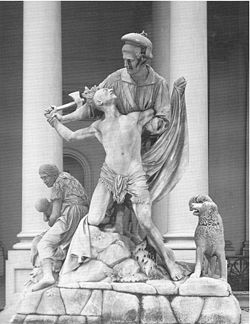
Interestingly, the folk-hero Boone is the subject of an early statue removal, in this case in the nation’s capital. A marble statue of The Rescue, generally believed to be Boone rescuing his family, was displayed in the Capital from 1853 until 1959, more than 100 years, until it was removed during building work and never put back. By 1959 it was the subject of considerable controversy, and I figured that they did the building work just to get rid of the statue, along with the statue of Christopher Columbus on the other side of the stairway (which is also still in storage).

GreenoughRescue.jpg
Horatio Greenough, The Rescue, 1837-1850, white marble. It was dropped by a crane at some point, and is now in storage. I’ve never heard that it was dropped on purpose.

Boone was 43 by the time he made it to Kentucky. For my first trip to Kentucky I’m a bit older than that, but instead of founding Boonesborough, I can make a motel reservation. In any event, I’m just in it for the whiskey. I mean the fish.

Hawaii Packing List, Part Elua

We went to Hawaii two years ago and didn’t catch a fish, so this is my second Hawaiian packing list. This trip was different enough that it’s worth the effort.

Gear

We took 9 weight rods again, with big Orvis and Tibor saltwater reels. This is heavy-weight stuff–we normally use 8 weights (which are considered heavy); this was heavier, but when the first bonefish ran I was scared that the 9-weights were too light. They weren’t, but I wouldn’t have minded a 10-weight.

In addition to the bonefish, I saw three giant trevally, and with only the 9-weight, I was kinda glad they ignored my flies. The 9-weight really isn’t enough for giant trevally.

Our flies were weighted–they weren’t just a hook and fur and feathers. They had barbell eyes so that the flies sank as soon as they hit the water. Barbell eyes are also a spur to better casting, because they hurt more when you blow it and the fly whacks the back of the head. The first day I fished with weighted EP mantis shrimp. I lost both heavy shrimp flies I’d brought, and the second day fished with a similar fly donated by our guide, Joe Kalima.

EP mantis shrimp

Joe wanted us to use 30 pound leaders to tie the fly to the line, which is crazy heavy, but maybe he wanted the heavy line because it’s harder to lose in the coral. Because of leader breaks I lost enough fish the first day that the second I used one of his. On Kauai we went back to 16 pounds.

The Molokai Ferry

There used to be an inter-island ferry from Maui to Moloka’i, but it seems to have shut down in 2016 (though there’s still a website). Now you have to take a plane or drive, and driving between islands really doesn’t work that well.

There’s something about flying on a pond hopper that makes every adventure better, even if the flight itself isn’t really adventurous. It sure feels adventurous when I walk across the tarmac to that bit of a plane. When I get on a pond hopper, I know I’m heading someplace out of my ken.

Traveling between three islands we took a lot of planes, so I likely raised the earth’s temperature a couple of degrees. Sorry. We flew to Honolulu on Delta, took the Mokulele Airlines flight to Moloka’i the next morning, flew back from Moloka’i to Honolulu a few days later, and then immediately flew Southwest from Honolulu to Kaua’i. We flew back to Houston direct from Kaua’i. The only flight we couldn’t cover with mileage points was the flight on Mokulele Airlines, and it wasn’t cheap, maybe $300 by the time we paid added luggage fees. That’s about $10 per minute for the flight.

There was no in-flight meal, but there was a black lab puppy.

Hotels

We spent the first night in Honolulu at the Equus Hotel. On our trip to Honolulu two years ago, we rented an AirBnB for three nights, and spent our last night in a dank dark motel near the airport. I wouldn’t stay near the airport again. The Equus is a bit off of the Waikiki strip, and it’s a $40 cab ride from the airport, but it’s also well priced (for Honolulu). Our room was small and the hotel needs another elevator, but I’d stay there again.

Because we had to fly out early the next morning, we paid the extra $15 per person for the hotel breakfast. I assumed it would be the typical hotel buffet, but instead the Hungarian barmaid at the Paniolo Grill made us bagels and lox. It was lovely, and she gave us her recipe for pickled red onions.

On Molokai, we stayed at the Hotel Molokai. There wasn’t any real choice for hotels on the island, and I’d guess the Hotel Molokai was built in the 60s. The rooms are scattered about the grounds in separate clusters, which gives it a nice open feel. The rooms and grounds are well-maintained, the staff was helpful, and the island’s best restaurant and bar are at the hotel. Internet service kinda sucks, but every room comes with its own rooster.

North Kauai seems to specialize in family condo vacations near a golf course. We stayed at The Westin Princeville Ocean Resort Villas. It was fine, and on a beautiful part of the island, but there were no chickens.

Food

On Kauai, we went to a luau. Tourist luaus are commoditized Hawaiian traditions, but how do you go to Hawaii without sooner or later going to a luau? The mai tais were good, there was a pineapple appetizer, and the poi was surprisingly purple. The music and dancing reminded me of a Ballet Folklorico, or that evening in Spain when we went to see flamenco, or in Lisbon when we went to see fado. The performers took pains to educate the audience, and there was a Tahitian fire dancer. I think it’s Hawaiian law that you can’t have a luau without a Tahitian fire dancer.

On Moloka’i, we ate dinner every night at Hiro’s Ohani Grill at the Hotel Moloka’i. Just like the hotel choices, there aren’t a lot of restaurant choices on Molokai, and the grill had excellent poke, the bar had martinis, and the tables were on a veranda that overlooked the Pacific. There were table cloths. The last night the sun was setting and I thought, “they’ve done a really good job copying a tropical bar,” and then realized it was a tropical bar.

There is a national park on Moloka’i, Kalaupapa National Historical Park. Beginning in the 1860s, about 8,000 Hawaiian lepers were exiled to the Kalaupapa Peninsula. It was an active leper colony until sulfa drugs were available to control leprosy, and there’s still a remnant resident population. Ironically, the peninsula is currently closed to tourists because of Covid. There’s an overlook though, on the cliffs a couple of thousand feet above the peninsula, and on the walk back we talked to a lovely woman who had retired to Molokai from Eugene, Oregon. She was originally from Lake Charles, Louisiana, about 90 miles from Houston. I told her that I had tried the saimin–the Hawaiian version of Japanese noodle soup–at the Ohani Grill, and that it was bland and that I had to ask for hot sauce. The Louisianan in her came to the fore and she said that a lot of Hawaiian food needs hot sauce. She was pretty much right.

When we were planning, I found an internet post on where to eat in Hawaii, and on Kaua’i we followed its recommendations. We ate at Hamura Saimin, which is a working folks soup joint in a warehouse district. It was better saimin than on Moloka’i, and there was sriracha on the table. There weren’t any table cloths though.

The luau was at the Tahiti Nui, a restaurant and bar in Princeville near where we stayed at the Westin Villas. Our first night on Kauai we also ate there, when there was no luau and it was only open as a restaurant. Like the Ohani Grill on Moloka’i, the Tahiti Nui did a good job mimicking a tropical bar by being one, and to celebrate its authenticity we drank mai tais. They didn’t have little umbrellas.

Where We Didn’t Go.

We fished on Moloka’i’s coral reef, but didn’t snorkle. We never saw Moloka’i’s southern beaches, and we couldn’t go to the the Kalaupapa Peninsula. I would like to, and I’d like to visit the Catholic chapel dedicated to Saint Damien of Moloka’i. Damien was a saint in anybody’s book, and I should have stopped at the chapel, at least to pay my respects.

We didn’t visit Mau’i, or the Big Island, or The Four Seasons Resort on Lana’i (though at $1500 a night, it’s out of my price range).

We haven’t eaten at Helena’s or Ahi Assassin in Honolulu. I keep missing Helena’s, and I suspect it’s a real failure on my part.

Covid

You can’t travel to Hawaii without parsing through its Covid regulations. Unless you plan on a 14-day quarantine, you can’t enter the state from the mainland without either proof of vaccination or a negative test within two days of entry. Those are the liberalized rules as of November. Before November there was no entry, vaccinated or unvaccinated, without a negative test. Before testing, the state effectively shut down outside travel. Testing requirements are still in effect for foreign travelers, but those are federal rules for foreign entry to any state.

You can’t enter buildings in Hawaii without a mask, and most people are wearing masks on the street. The grocery store on Moloka’i would only allow one family member inside at a time. Kris guessed that was enforceable because everyone knows everyone else’s family on Moloka’i.

Meanwhile every place was packed. The plane from Houston to LA was packed. The LA airport was packed. The plane from LA to Honolulu was packed. The plane from Honolulu to Molokai was packed (though since it only carried 12 of us, that’s relative). Restaurants were packed. Given the spike in infections, it was nuts. Everybody should have cleared out for us.

You can’t travel in crowds without exposure, and I’m sure we were exposed. We tested negative before we left and we tested negative when we got home. We’re vaccinated, boosted, and we wore masks, but we were lucky.

Once you’re in Hawaii, you can fly from island to island without additional documentation. Returning to the mainland doesn’t require documentation either.

Music

A lot of stuff in Hawaii has to be imported: most of the food, building materials, cars, gasoline, tourists . . . For that matter most residents are imported.

Music is an exception, and Hawaiian music is everywhere, all the time. When you unload from your arrival plane, there’s Hawaiian music playing in the airport. When you get to your departure gate there’s Hawaiian music playing in the airport. At restaurants there will be Hawaiian musicians, really good musicians. When we got into our rental car in Moloka’i, the radio was tuned to a Hawaiian music station.

Michael Keale, Tahiti Nui

If you think about what Hawaiians gave us musically, the steel-stringed guitar, the ukulele, the slack-key guitar . . . If you think about their lovely vocals and gracious melodies . . . Ok, ok, it can get cloying after a while, but then I find Jimi Hendrix cloying. I’m fairly easily cloyed.

But any guitarist has to be fascinated by Hawaiian slack-key guitar tunings. Ry Cooder is the most famous mainland student of slack-key, and Gabby Pahinui and Keola Beamer are famous Hawaiian players. Meanwhile I found this YouTube recording of Chet Atkins playing slack-key, and making it sound a good bit like Delta Country Blues, which is a pretty peculiar bit of cultural fusion. It’s great stuff, but it would have been perfect if he’d been playing a sitar.

Guitar

I took my old Kohno, and sat on the veranda at the Hotel Molokai and played to the chickens. I don’t remember what I played, but it wasn’t Hawaiian. The chickens didn’t seem to mind.

William Brigham photographer, 1889, Saint Damian of Moloka’i, shortly before his death.

Moloka’i and Kaua’i Bonefish, January 8-11, 2022

Our guide in Kaua’i, Rob Arita, said that he thought Moloka’i is the best bonefishing in the world.

That’s a surprising statement, especially about Hawaii, especially about a place as relatively obscure as Moloka’i. Usually descriptions of Hawaiian bonefishing tend more towards it’s interesting, not that it’s great. I’m not a good judge. I’ve fished for bonefish some, once on Oahu when I didn’t catch fish, and a couple of times each in Belize and the Florida Keys. I caught a pretty good fish in the Keys and a lot of smaller fish in Belize, but that’s it. I haven’t been to Venezuela or the Bahamas or to Christmas Island or any of the other numerous places where the bonefishing is famous. Hawaiian bonefishing is not famous, and is usually mentioned as an afterthought.

Outside of the islands, Moloka’i is mostly famous for its historic leper colony.

Here’s what I can tell you about fishing on Moloka’i. Over two days I had at least 30 legitimate shots at bonefish, scared off some fish by hitting them on the head with the fly, had a bunch of follows with no takes, and had a dozen takes when I either failed to set the hook or lost the fish during its run. I landed two fish, one about six pounds and one close to 10 pounds. Ok, ok, I’m a fisherman. It was absolutely 10 pounds, and it’s getting closer and closer to 11. That’s a lifetime bonefish, and that’s an extraordinary bonefish trip, anywhere.

Back to Rob and Kaua’i. I haven’t been to Maui or Hawaii Island, but it would be hard to find a place prettier than Kaua’i. Kaua’i was the setting for the movie South Pacific, which is all us folk of a certain age need to know. The song “Bali Ha’i,” by the way, is the worst earworm ever. Kaua’i is pretty developed now, with a surfeit of golf courses and condos–it tends towards a Florida beach resort–and the island Bali Ha’i in the movie is motion picture trickery–there’s no such place across a tranquil bay from Kaua’i–but Kaua’i is gorgeous, and it’s famous for producing championship surfers. We couldn’t fish where Rob wanted to fish on Kaua’i’s north side because of 40-foot swells. I bet it was great surfing.

We fished the east side in the surf, which had two- or three-foot breakers. No one was surfing.

I like the notion of fishing the surf, and I’ve had some pretty good days in the Texas surf, but I’m not sure I like the reality as much as the notion. On our day fishing, I blind-cast hard until my arm fell off, saw one bonefish (well, ok, Rob saw one bonefish), may have missed one take by a fish, stayed colder than I wanted, and got slapped around by the breakers. I’m not usually much of a cursing man, but at one point I was so sick of getting hit by breakers that I would face each new wave and tell it to fuck off. None of them did, but it made me feel better.

You can’t judge Kaua’i fishing by our bad day. Sometimes there are just bad days to fish, and that’s what we hit. There was nothing Rob could do, there was nothing we could do. We fished, and then I was kinda glad it was over and went and had a mai tai. I’d fish with Rob again in a heartbeat.

By coincidence, it turned out that Rob also partnered with our Moloka’i guide, Joe Kalima, to guide from time to time on Moloka’i, and the best part of our day was talking to Rob about Joe and fishing on Moloka’i. Rob showed us pictures of his 15 pound Moloka’i bonefish. He said that he thought Moloka’i was the best bonefishing in the world. Did I mention that? I can’t tell you what an extraordinary statement that is. Saying that Moloka’i is the best bonefishing in the world is like saying that Houston is a great walkable city. In our neighborhood that’s pretty much true, but it violates most people’s notions.

I may not be a competent judge of Rob’s statement, but I’ve fished with a lot of guides in a lot of places, and I will say that Joe Kalima is about as fun to fish with as it gets, not least because he brings his dachshunds on the boat. Saltwater fly fishing usually consists of one angler fishing, while the other helps spot fish. Fishing with Joe consists as often as not of one angler fishing, while the other sneaks off to scratch Boo-Boo the dachshund’s head. It makes for a very satisfactory day.

I suspect Joe guides fly fishers because he already knew the fish, Not because he knew fly fishing. He’s all you could ask in a guide though. Joe sees fish and he calls the shot. He can tell you how to land the fish. He’s funny. And, as they say in East Texas, he knows everybody on the island and the names of their dogs. He’s got great stories.

Getting to Moloka’i isn’t easy. Unlike Maui or Oahu where you can fly direct from the West Coast, you have to take a commuter flight to Moloka’i from Oahu or Maui. I’m not sure that everyone is happy you’re there, either. Plenty of the islanders have signs in the yard telling tourists to go home, though some temper the message by suggesting you spend your money and then go home (which frankly I pretty much agree with). I don’t remember why I picked it as a destination, but I’d read somewhere that Moloka’i is more like the Hawaii of 50 years ago than anyplace else in the islands.

Moloka’i has fewer than 7500 inhabitants, and when we picked up our rental and started driving down the island (I had also read, by the way, that Jeeps are recommended), my first impression was that it was exactly like Lockett, Texas. Yeah, it was set in the Pacific. Yeah, it’s arguably prettier than Lockett, the fishing is certainly better, and there are apparently even more of Joe Kalima’s friends and relations on Moloka’i than there are Streits in Lockett, but it shares the feel of any other relatively isolated, moderately self-contained country place. It has the kind of grocery store where any country people from the contiguous states would feel right at home. People may not always be happy, and sometimes it’s likely that getting by is hard, but the best of the people really are always the best.

Rob told a story about Joe, about how Joe didn’t have an ID for years, because Joe said that whoever might stop him on the island was likely his nephew anyway. That’s Lockett, Texas.

The only way to Moloka’i from Honolulu are 12-seater commuter flights on Mokulele Air. It’s worth getting to Moloka’i though. Did I mention that I think Moloka’i has the best bonefishing in the world, and that I caught an 11-pound bonefish?

* * * * * *

Here’s how I lost fish on Moloka’i:

  • I lost two fish when my leader broke. The leader is the size-graduated bits and pieces of nylon knotted to the end of the fly line to attach the fly. I don’t know why it broke. Maybe it was cut on coral, maybe it was nicked or had a wind knot. It couldn’t have been that my knots failed. My knots never fail.
  • I lost one fish because my knot failed. When you fly fish, all the beauty is in the casting, all the work is in dutifully retrieving the line from your beautiful cast. I hold the rod with my right hand, and retrieve and set the hook with my left. By the time a fish takes, I may have 20 or more feet of line puddled at my feet. For most fish, that’s no big shakes, but when you catch a strong fish that runs (like a bonefish), then if the puddled line gets caught on something in the boat, or if you stand on it, or if it’s tangled and the tangled line gets stopped by the rod guides, then your leader will snap and you’ll lose the fish. My line got wrapped around my reel. My leader snapped right in the middle of a knot. I possibly cursed.
  • Four fish came off the hook. That’s annoying, but that’s the fish’s goal, and sometimes it happens. I de-barb the hooks on most of my flies to make it easier to get the hook out of the fish, and on the first day I mashed the barbs on my hooks. On the second day, after losing all those fish, I didn’t. I’m sure my decision not to flatten the barbs had nothing to do with me landing that 12-pound bonefish. Or was it 13-pounds? I think it might have been 14.
  • For the rest of the fish, I failed to either set the hook or be quick enough to even try. It happens.

I lost one fish that wasn’t mine to lose. Hooking a bonefish is a bit like hooking an ancient Volkswagen traveling away from you at 30 mph: you think you can slow it with a rod and reel but you’re not completely certain. Kris disputes that, and says to heck with the Volkswagen, it’s like hooking a Jaguar XJ12 screaming away at 60. You just hold on and hope it breaks down.

Kris finally hooked her fish when Joe poled us toward the take out. She saw the fish, cast and spooked it, then recast and it ate the fly. Meanwhile I was busy scratching Boo-Boo’s head. The last time we’d switched places she hadn’t bothered to pick up her rod and was fishing with mine, and as soon as the fish started to run she was yelling for me to take the rod before she lost either the rod or her fingers or most likely both. Of course I was a little worried about her fingers getting caught in the line, but I was more worried about my rod, and worried most of all that we’d never manage a hand-off. We did, and 40-feet further out the fish came off the hook.

When Joe stopped laughing, all he could say was did you see her face? I had. It was a memorable face, a shocked face, a horrified face, and accompanying that horror was the excitement of the puppies, the whir of the line coming out of the reel, and Kris’s demands that I take the rod.

Kris asked later if I got her picture playing her fish. I didn’t.