
Kolache
It’s a toss-up between a good kolache1 and a good donut, but I’d probably choose the kolache because they’re less common. Pretty good donuts can be found in lots of places, but the best kolache are found only on the edge of the interstate in small towns. In Texas they’re common enough, and in one of the best things you can say about anyplace kolache are common in Nebraska.
Kolache are Czech, re-homed by Czech immigrants to Texas and the Midwest, and are most often compared to Danish. It’s not an apt comparison. Danish probably originated in Austria, are often glazed, and like croissant are made with a laminated dough. Kolache should never be glazed,2 or laminated, and they feature a mildly sweet pillowy yeast dough.
Kolache are about the size of a biscuit. The center depression is filled with either a fruit preserve, sweetened cream cheese, or sweetened poppy seeds. A kolache without any filling would be a tiny bread loaf, not a kolache, and there’s no such thing as a sausage kolache. Except there are sausage kolache, but more on that later.

Many years ago I witnessed a panel discussion by a group of Tex-Czech bakers, who said that traditional kolache were filled with prune preserves, sweetened farm cheese, or poppy seeds. The panel members had all grown up on small Central Texas farms during the Depression, and explained that their mothers baked the big three because prunes were very cheap, everybody–meaning every Czech farm family–had a cow and made their own farm cheese, and that there were always poppies in the farmyard. I guess that in addition to farm cheese all those Czech farm wives made their own opium.
Kolache are filled with all kinds of fruit, not just prunes. I’d probably eat any kolache offered, but if they’re available I usually order one or more of the big three: a farm cheese, poppy seed, or a prune. At the kolache counter in Hruska’s in Ellinger–which sells my favorite kolache and where there’s always a line–the woman behind the counter once beamed when I ordered all three and said that those were the three kinds of kolache that her mother always made. That touch of tradition made both of us happy.

I don’t know the history of Kolache in Nebraska, or even how I knew that Nebraska, like Texas, loves kolache, but we had a campsite reserved for three nights at Smith Falls State Park near Valentine, Nebraska. Since by the first morning we had our Nebraska fish (or more precisely I had my fish and Kris had decided not to fish), the next morning we packed up our campsite a day early and took a 150 mile frolic out of our way to Verdigre, Nebraska, the self-proclaimed Kolach Capitol of the World.3
The dough in Verdigre Bakery’s kolache is a little different from Texas kolache. It’s less puffy, denser, more bite sized. . . Maybe the dough is a bit less sweet. After extensive sampling I couldn’t tell any difference between Texas and Nebraska fillings. The picture above is of poppy seed, so I guess opium is also a farmyard cash crop in Nebraska.
The lady in the Verdigre Bakery said that Texans sometimes stop by for kolache, but that we always asked for sausage kolaches. Kolache with sausage are not actually kolache, but klobasnek (or pigs in a blanket). Calling klobasnek “sausage kolaches” is common usage in Texas, and they’re made with the same dough as kolache. Still, even if it’s common usage, the misuse greatly annoys some Tex-Czechs.4 Kolache lovers from other states are just confused.


From Verdigre we drove another 180 miles out of the way to Omaha, because we had never been to Omaha, and somewhere during the drive to Verdigre we decided that this was our big chance. The College World Series was scheduled to start the next day, and Omaha’s streets were crowded with LSU purple and gold. I didn’t see any Coastal Carolina fans, which was the other team in the Series, and like their fans the Coastal Carolina team didn’t show up much for the World Series. We saw the stadium, and the lively district around the stadium, then drove on to Wichita, Kansas, where we spent the night. During that round-about meandering we crossed into Iowa, so I guess we actually drove through nine states, not just eight. The next day we drove 560 miles home from Wichita, a day earlier than we had planned.
Gear
In Wyoming they told us to bring six weight rods, which is a heavier rod than is normal for trout, but these were big fish in heavy current, so a six weight was a good idea. In South Dakota we used five-weights, which is the most common rod for trout. I tried a three weight spey rod to fish the Niobara River, but that didn’t go too well. I had Winston rods, Kris had a very old 1991 Orvis Rocky Mountain six weight, and she said it was so heavy she could barely lift it.5 I suspect she might have been exaggerating just a bit. She also had an Orvis Helios 3 five weight, and there were no complaints from her about the five weight.
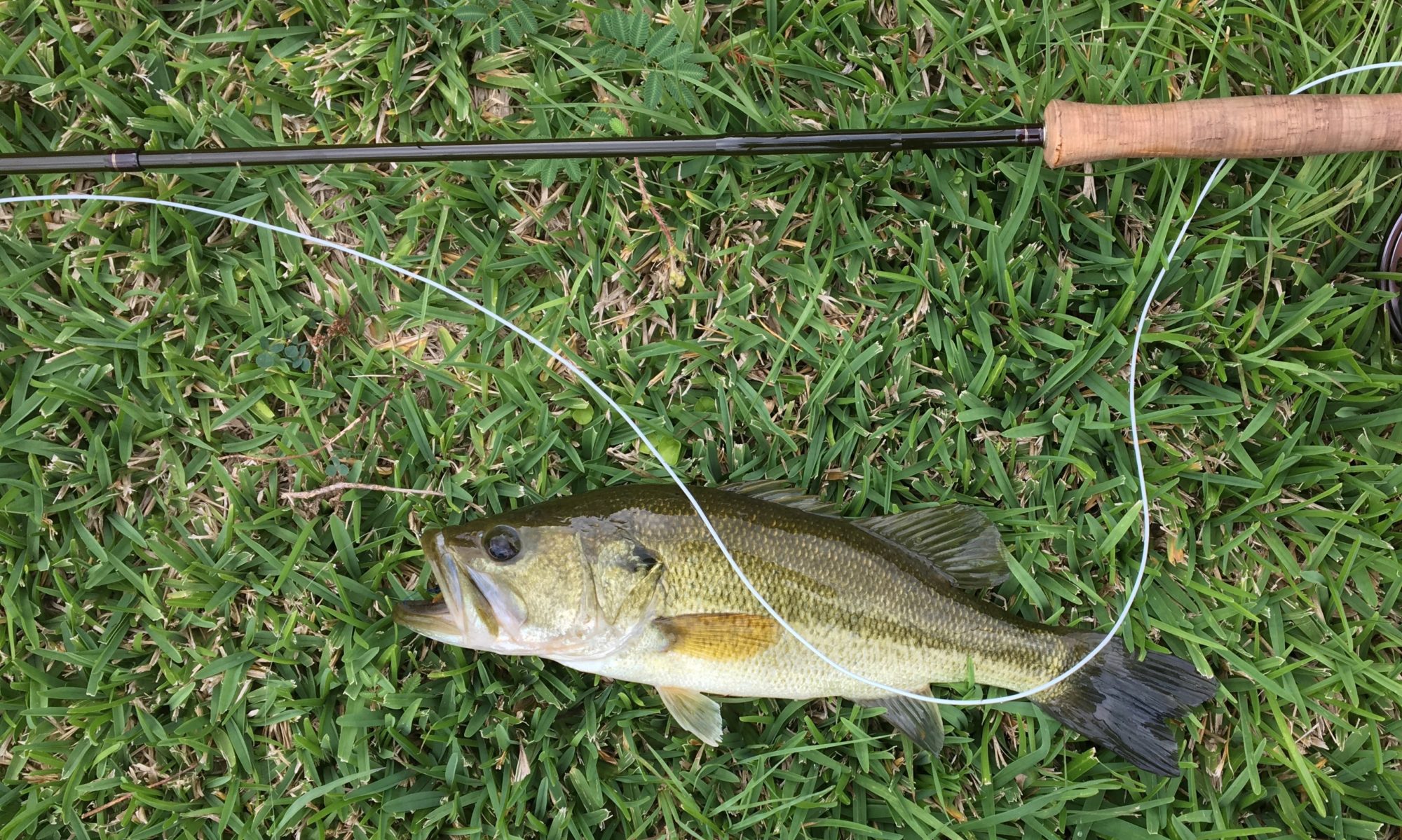
We only used cold water floating lines. In Wyoming and South Dakota we mostly fished with underwater nymphs under indicators. In Nebraska I caught those extraordinary bass on black Pat’s rubber legs fished as streamers.

Our Car
This was a road trip, so a few things about our car.
Pre-trip my car had about 50,000 miles on it. The week before the trip we had scheduled maintenance done, and on the dealer’s recommendation had a brake job and I replaced the battery. I had the tires rotated at Discount Tire. I installed a Victory 4×4 rear window molle panel and upper shelf for storage in the cargo area, and re-mounted the fly rod vault on the roof rack. The upper shelf and the rod vault were useful, the rear window molle panel wasn’t but it looked manly. The fly rod vault holds four assembled fly rods, and rod vaults are apparently required by law in Colorado. They’re certainly common enough.

In addition to the rod vault I bought a Pelican gear box and mounting hardware from REI. I got the smallest box to minimize wind resistance, but it didn’t hold enough stuff. I should have bought the largest size.
In Wisconsin years before our muskie guide had demonstrated the cargo drawers in his truck, and since then I’ve wanted a set for our SUV cargo area. Plenty of companies sell cargo drawers for pickups and SUVs, but they’re expensive, and I thought that I could build my own. It took me about three weeks of intermittent labor, and the result includes the appropriate number of design flaws. I built two 35″ wide drawers from side to side, 30″ deep from front to back. The lower drawer is about 10″ deep and the top 6″.
I loved the top drawer. I could throw in my sunglasses and reels and rod tubes, my fly boxes and maps and camera, and all the other smallish stuff that would otherwise be rattling around loose in the back of my car, but the stuff I put in the bottom drawer would have done better in a duffel. Or a larger roof box.
What’s worse, the two stacked drawers ate up the back of the SUV, and the first time I went to the grocery after installation I realized that except for the back seat I no longer had anyplace to put groceries. When we stacked duffels on the drawers we couldn’t really use the rearview mirror. The drawers will get rebuilt as two shallower drawers, hopefully by our next road trip.
By the time I rebuild the drawers I figure it will have cost me as much as buying pre-made drawers in the first place.

Buc-ee’s
Buc-ee’s is a chain of travel centers, placed strategically along Texas interstates. The first Buc-ee’s was near Houston in Clute (home of The Great Texas Mosquito Festival). I have a love-hate relationship with Buc-ee’s. Once when I fished Matagorda Bay I parked my car for the day in an out-of-the-way corner of Buc-ee’s Wharton parking lot, and management tagged my car with a semi-permanent sticker that told me to never, ever leave my car in a Buc-ee’s lot again. It took an hour of scraping to get the sticker and the residual glue off my car window. It wasn’t very neighborly, and a polite note would have gotten the message across. I also don’t trust their brisket or kolache (though I do give them points for having brisket and kolache), and I hate crowds. Buc-ee’s interstate travel centers are huge and are always crowded, though there are so many urinals in the men’s room that there’s never a line.
On the plus side for Buc-ee’s, there are things you have to respect. There are all those urinals and the bathrooms are immaculate. The gas is cheap. You can buy many strange and amusing things in Buc-ee’s, from barbecue pits to onesies for the grandchild, they don’t allow 18-wheelers, and they’re spaced along the major routes out of Houston just where you need ’em. They pay their employees well above the minimum wage.


Buc-ee’s has now spread beyond Texas, to, among other places, Alabama, South Carolina, Tennessee, and Florida. On this trip we found one north of Denver. Someday Buc-ee’s will be everywhere, and beaver nuggets and mediocre kolache will be available to everyone.
I made my peace with Buc-ee’s on this trip. I forgave them that window sticker and I suffered the crowds. I bought their relatively cheap gas. I even bought some parched corn and a Rice Crispie treat. I did not buy my grandchild a onesie.
Where We Stayed, What We Ate
Out of our 12 nights, we spent only three in hotels. Two of the hotels were unremarkable, a Holiday Inn Express in Amarillo and a Holiday Inn in Wichita, Kansas. The most expensive hotel, The Rally Hotel in downtown Denver, was across the street from Coors Field where we stopped for baseball. Both the hotel and Coors Field were great, though the Rockies not so much. At check-in they gave us free beer, which was friendly even if it was a Coors. Staying next to the stadium was almost worth the cost, and almost worth the drive through downtown Denver at rush hour.

Because Roo the dog was with us, we felt more comfortable leaving her in an AirBnB than in a hotel on the days we spent fishing. We spent four nights in an AirBnB in Wyoming and three in South Dakota, and both were fine. The one in Wyoming had the better view.

We camped two nights in Nebraska, which meant that our car was packed with camping gear. We’ve owned our tent for most of our marriage, more than 40 years, and it has survived a lot of use. This trip though one of the poles broke. We cobbled together a repair, but I wouldn’t trust it in hard weather. The tent may have seen its last road trip.
Because we were camping and staying in AirBnBs, we cooked a lot. At home we almost always cook, and I’d say we’re adventurous, competent cooks, but on this trip there was no adventure. We ate beef for dinner and bacon for breakfast. We ate steaks. We ate burgers. We ate more steaks and then we ate more burgers. We ate eggs and bacon with toast for breakfast.
We spent a lot of time in grocery stores, which is actually a pretty good way to get to know a place. Mack’s Market in Thermopolis, Wyoming, not only sells groceries, but it has its own liquor store inside, and a gun shop. What more does one need?


I think I’ve covered most of the trip’s restaurant stops in the other road trip sections, except for the pizzas we had in Lander and Thermopolis in Wyoming. This really was a junk food extravaganza. We also had donuts in Amarillo, which would make a pretty good country song, and in Fort Collins, Colorado, which would also make a pretty good country song. The donuts were ok, but I wouldn’t have picked them over a good kolache.
Where We Didn’t Go
I would have liked to see more rivers in Wyoming, and in September we are going to fish for a day in Yellowstone at the end of our Montana trip, probably on the Firehole. 6 I’m already thinking about a trip next May through Wyoming and back to the Green River in Utah.
I’d like to explore more of the streams in the Black Hills, but probably never will.
We didn’t stop for an onion burger when we drove through Oklahoma. We didn’t see the giant ball of twine in Kansas. I guess I’ll be remembered as the guy who never saw the giant ball of twine.
Playlist
I made playlists for Nebraska, South Dakota, and Wyoming, but I have to admit we mostly listened to books while we were driving. “Willow, Weep for Me,” by the Nebraska composer Ann Ronnell was on the Nebraska playlist. It has been recorded by everybody, and we had versions by, among others, Billie Holiday, Frank Sinatra, Julie London, Sarah Vaughan, Lew Rawls, Tony Bennett, Barbra Streisand, Chad & Jeremy, and Sam Cooke. Ronnell also wrote “Who’s Afraid of the Big Bad Wolf.”

The other well-known song on the Nebraska list was “Nebraska” by Bruce Springsteen, foreshadowing New Jersey, which will likely be our last state. Omaha and Lincoln seem to have pretty lively alternative music scenes. Mannheim Steamroller is from Nebraska. I’m not a fan of Mannheim Steamroller.
Danielle Ate the Sandwich, from Nebraska and Colorado, plays a ukulele and sings. She is wonderful, witty, and fun.
Ooh, I've got soul, I've got soul
But you'd never know, never know
If you were stuck across the table from me
The terrible dinner guest

The Terrible Dinner Guest, Danielle Ate the Sandwich

There are about 100 songs named “Wyoming,” and all of them are pretty good, though the rap song “Wyoming” by Afroman doesn’t live up to his classic, “Idaho.” The country singer Chris Ledoux is the best known musician from Wyoming, and he’s big on melodramatic story-telling, which for me is not quite the thing unless it involves either Laredo, El Paso, or a girl named Rosalita (also foreshadowing New Jersey).
The best song ever written about Wyoming is “Git Along Little Doggies.” This is jumping ahead, but the best song ever written about Montana is “I Ride an Old Paint.”
I never got around to much of a South Dakota list. The only person on my South Dakota list is Shawn Colvin, though I probably should have included “Born to Be Wild” as a nod to Sturgis. I always enjoy Shawn Colvin, though, so I’m ok with sticking to Shawn Colvin.
Guitar
I played the guitar a lot on this trip, probably because we cooked in our adopted homes and there was more free time in the evenings. In Nebraska, at the state park, after the failed attempt at spey casting on the Niobara River, I sat at our campground and played for a couple of hours while Kris went to Valentine to shop for steaks, bacon, and burgers. A woman with a Denver guitar shop tee shirt came over to talk to me about guitars, and invited us to their campfire that evening. It was a nice gesture, but when I went to bed at nine-ish the campfire hadn’t kicked off. I’m sorry. They might have known someplace to fish.

- The Czech singular for kolache is properly kolach, and the plural is kolache. The Texas usage of kolache as the singular and kolaches as the plural is not correct, but it makes a lot of sense to English speakers, and probably Spanish speakers as well. At various times I use all of them. Sometimes I suspect I use all of them in the same sentence. I’m betting my usage would make a Czech baker’s head spin. ↩︎
- In Schuelenberg, between Houston and San Antonio, there’s an otherwise good bakery that glazes its kolache. It’s unnecessary frippery, and I’ve only stopped for their kolache once. ↩︎
- Verdigre is home of an annual Kolach Days Festival. Wikipedia reports that Kolache are also available in other Midwestern states, including Minnesota, South Dakota, and Prague, Oklahoma. Both West, Texas, and Caldwell, Texas, claim to be the Kolache capitol of Texas, and West does have very good kolache. I’ve never had kolache in Caldwell. ↩︎
- Sausage kolache are not even Czech, but a Texas variant. The greatest kolache variant of all is from a Cambodian-owned donut shop in St. Charles, Louisiana, where instead of sausage they stuff their koblasnek with rice boudin. Brilliant. There are now boudin kolache at most independent donut shops in Houston. ↩︎
- Graphite fly rods are impossibly light, a matter of a couple of pounds and some stray ounces. What’s more, the newer graphite materials in modern rods allow thinner tip ends than rods from 30 years ago, so that when you’re swinging a nine-foot lever a modern rod will feel lighter than a 30 year-old rod of similar weight. The 30-year old rod Kris was fishing was pretty light, but it likely felt heavier than what she was used to. ↩︎
- Most of Yellowstone is in Wyoming. This is one of those factoids that always seems unnatural, like Kansas City being in Missouri. ↩︎


